The Genesis of IMFMSynth
Kaito Sato, an independent developer from Japan, has unveiled IMFMSynth, a novel digital synthesizer that uniquely blends the intricate sound-shaping capabilities of 8-operator FM synthesis with the textural richness of wavetables. Driven by a deep appreciation for classic FM sounds, from video game soundtracks to the work of Ryuichi Sakamoto, Sato aimed to demystify FM synthesis and expand its sonic palette. The core motivation behind IMFMSynth is to make FM sound design more intuitive and accessible, particularly for music producers, composers, and arrangers who might find traditional FM programming daunting. By integrating wavetables as operators, Sato seeks to offer a new pathway for users to explore and create complex, evolving timbres.
Traditional FM synthesis, while capable of producing stunningly complex and unique sounds, is often criticized for its steep learning curve. The abstract nature of operator-to-operator modulation can be difficult to visualize and control, leading to frustration for many aspiring sound designers. Sato’s approach with IMFMSynth tackles this head-on by leveraging modern web interface design principles. The goal is not just to create a functional synthesizer, but to build a tool that educates and empowers users, allowing them to understand the underlying modulation principles while simultaneously experimenting with novel sound generation techniques.
Bridging FM and Wavetables
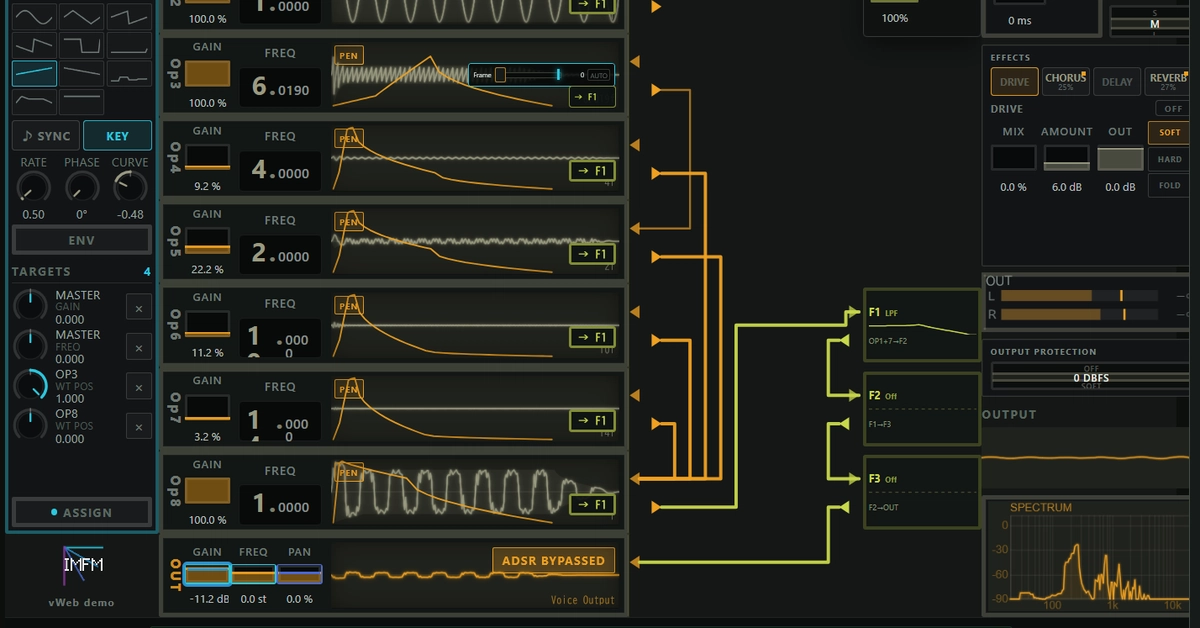
The defining characteristic of IMFMSynth is its hybrid architecture. It features an 8-operator FM engine, providing the classic subtractive synthesis-like control over harmonic content and timbral complexity that FM is known for. Each of these operators can function as a source of audio or as a modulator for other operators. This allows for the creation of rich, metallic, percussive, and bell-like tones, as well as complex evolving pads and atmospheric textures.
Where IMFMSynth diverges significantly from traditional FM synths is its integration of wavetables. Instead of relying solely on sine waves or simple waveforms as the base for FM operations, IMFMSynth allows users to load custom wavetables. This means that the fundamental character of the sound generated by each operator can be far more complex and rich from the outset. A wavetable operator can introduce harmonic complexity, noise, or even sampled textures into the FM matrix. This fusion opens up a vast new sonic territory, enabling the creation of sounds that are both distinctly FM in their behavior and uniquely textured due to the wavetable source material.
Consider FM synthesis like mixing paints. With traditional FM, you’re primarily mixing primary colors (sine waves) with precise ratios to create new hues. It’s powerful, but can be limited by the base palette. IMFMSynth, however, gives you a palette of highly detailed, pre-mixed custom colors (wavetables) that you can then blend and modulate. This allows for a shortcut to richer, more complex initial timbres before the modulation even begins to sculpt them.
User Interface and Workflow
Sato’s commitment to simplifying the FM synthesis process is evident in IMFMSynth's user interface. Designed with a modern aesthetic, it aims to provide clear visual feedback on the modulation matrix and signal flow. This is crucial for understanding how the operators interact and how changes to envelope settings, algorithms, and wavetable positions affect the final output. The interface likely maps out the 8 operators, their output levels, feedback loops, and waveform selections in an organized manner, allowing users to trace the signal path and identify the source of sonic characteristics.
The integration of wavetables into the operator structure means that users can select not only the waveform shape but also the position within that wavetable. This adds a temporal dimension to the sound design process within the FM context. As an operator’s output changes its position in the wavetable, it can evolve its harmonic content over time, leading to dynamic and evolving timbres that are difficult to achieve with static waveforms.
This approach also benefits users familiar with wavetable synthesis. They can bring their understanding of wavetable manipulation – scanning through harmonic series, introducing subtle shifts, or dramatic changes – into the FM domain. Conversely, FM enthusiasts can explore how FM modulation can add unique harmonic complexity and movement to sounds derived from wavetables, going beyond simple spectral filtering or interpolation.
Potential and Future Directions
IMFMSynth represents a significant step in making advanced synthesis techniques more approachable. By combining two powerful synthesis methods, Sato has created a tool that appeals to a broad range of musicians and sound designers. For producers seeking unique lead sounds, complex pads, or gritty basslines, the hybrid FM-wavetable approach offers a rich playground.
The platform's use of web technologies suggests potential for easy accessibility and cross-platform compatibility. This could allow musicians to experiment with sound design directly in their browser, without the need for complex installations or powerful hardware, making it a versatile tool for both studio work and on-the-go creativity.
The success of IMFMSynth will likely depend on its depth of features, the quality of its presets, and its ability to foster a community of users. As an independent developer, Sato's vision is clear: to make intricate sound design accessible. The fusion of FM and wavetables is a compelling proposition, and IMFMSynth appears poised to offer a fresh perspective on digital sound synthesis.