
VoiceCap: Bridging Language Barriers in Meeting Productivity
In the increasingly globalized and remote work landscape, effective communication during meetings is paramount. Yet, language differences can create significant friction, leading to misunderstandings and reduced productivity. VoiceCap emerges to address this challenge, positioning itself as an AI notetaker that aims to provide accurate, multilingual transcripts and summaries of virtual and in-person discussions. The service, launched on Product Hunt, targets a common pain point for teams operating across diverse linguistic backgrounds.
VoiceCap's core promise is to democratize access to meeting insights, regardless of a participant's native tongue. Instead of relying on manual note-taking or post-meeting translation efforts, the platform leverages artificial intelligence to process audio from meetings and deliver a comprehensive, actionable output. This approach seeks to ensure that all attendees, regardless of their proficiency in the language spoken during the meeting, can fully grasp the proceedings and outcomes.
Core Functionality and User Experience
At its heart, VoiceCap functions as an automated transcription service. Users can integrate the tool with popular video conferencing platforms or upload audio files for processing. The AI then transcribes the spoken content, aiming for high accuracy. What sets VoiceCap apart is its multilingual capability. It doesn't just transcribe; it aims to provide these transcripts and subsequent summaries in the user's preferred language. This means a Spanish-speaking team member could receive a summary of an English-language meeting in Spanish, preserving nuance and context that might be lost in literal translation.
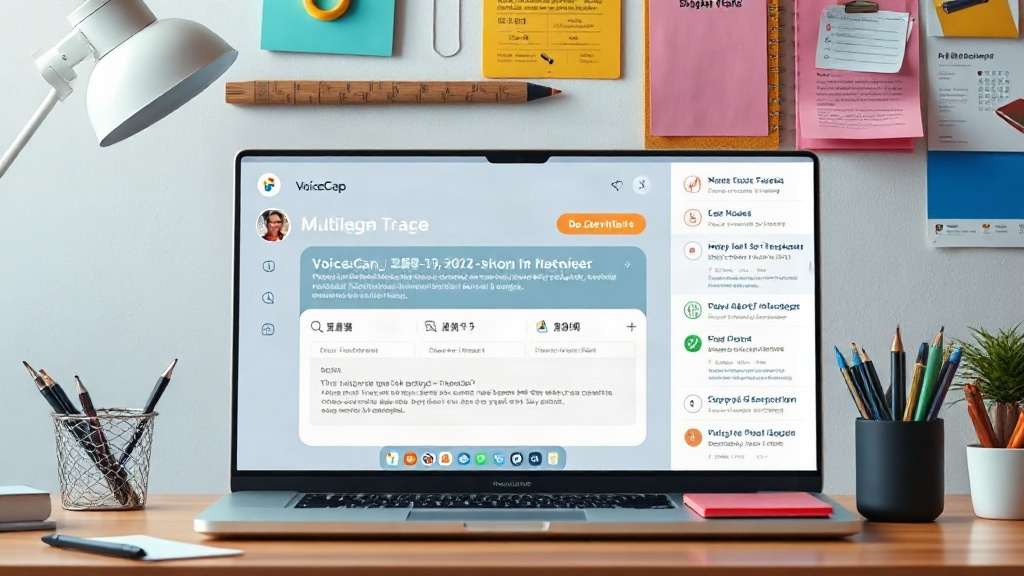
The process typically involves several stages. First, the audio is captured, either through direct integration with meeting software like Zoom or Google Meet, or via manual upload. VoiceCap's AI then analyzes the audio, identifying different speakers where possible. This is crucial for creating clear, attributed transcripts. Following transcription, the platform generates a summary. The specifics of how these summaries are generated are not detailed, but typically AI summarization tools identify key decisions, action items, and important discussion points. The final output is then presented to the user in their chosen language.
The Multilingual Advantage in a Global Workplace
The ability to process and translate meeting content in real-time, or near real-time, offers a significant advantage. For international teams, this can mean breaking down silos that form when not everyone is fluent in the primary meeting language. It allows for more inclusive participation, as individuals can contribute and understand without the pressure of real-time translation or the delay of manual transcription and translation. This inclusivity can foster better team cohesion and a more equitable distribution of information.
Consider a scenario where a product development team has members in Berlin, San Francisco, and Bangalore. If a critical design review meeting is conducted primarily in English, the Berlin and Bangalore teams, even if proficient, might miss subtle technical terms or cultural nuances. VoiceCap's proposed functionality would allow them to receive summaries and transcripts in German and Kannada, respectively, ensuring they are on the same page as their US counterparts. This is less like a simple translation app and more like having a dedicated, multilingual assistant for every single meeting.
Potential Impact and Unanswered Questions
The potential impact of a truly effective multilingual AI notetaker is substantial. It could streamline international collaboration, reduce the overhead associated with managing global teams, and accelerate decision-making processes. For founders of global startups, this could mean a more cohesive and informed workforce from day one. For developers on distributed teams, it means less time spent deciphering meeting notes and more time coding.
However, several questions remain as VoiceCap enters the market. The accuracy of its transcription and translation across a wide array of languages and accents is a critical factor. The nuances of technical jargon, idiomatic expressions, and industry-specific terminology are notoriously difficult for AI to capture perfectly. Furthermore, the security and privacy of meeting data are paramount. Users will need assurance that their confidential discussions are handled with the utmost care and compliance with data protection regulations. The specifics of its integration with various platforms and the scalability of its multilingual processing will also determine its practical utility. What nobody has fully addressed yet is the potential for AI-generated summaries to inadvertently dilute critical information or introduce subtle biases during the translation process, a risk that bears watching as the technology matures.
Competitive Landscape and Future Outlook
VoiceCap enters a market that already features several AI-powered meeting assistants, such as Otter.ai, Fireflies.ai, and Fathom. These tools have established a baseline for transcription accuracy, summarization capabilities, and integration with collaboration tools. VoiceCap's differentiator appears to be its explicit focus on multilingual support as a primary feature, rather than an add-on. The success of the platform will likely hinge on the robustness and accuracy of its language models and its ability to deliver a seamless user experience across different linguistic contexts.
As AI continues to advance, tools like VoiceCap represent a significant step towards a more connected and accessible digital workspace. For businesses operating on a global scale, the promise of eliminating language as a barrier to effective communication is a compelling one, and VoiceCap is positioning itself to be a key player in delivering that promise.