A World of Live Streams at Your Fingertips
Imagine a single, interactive globe that shows you the world as it happens, live. That's the ambitious vision behind LiveWorld, a new project that aggregates nearly every 24/7 live camera stream available on YouTube and pins them to their geographical locations. The project, shared on Hacker News as a "Show HN," aims to provide a unique, real-time window into global events, natural phenomena, and everyday life as captured by countless public live streams.
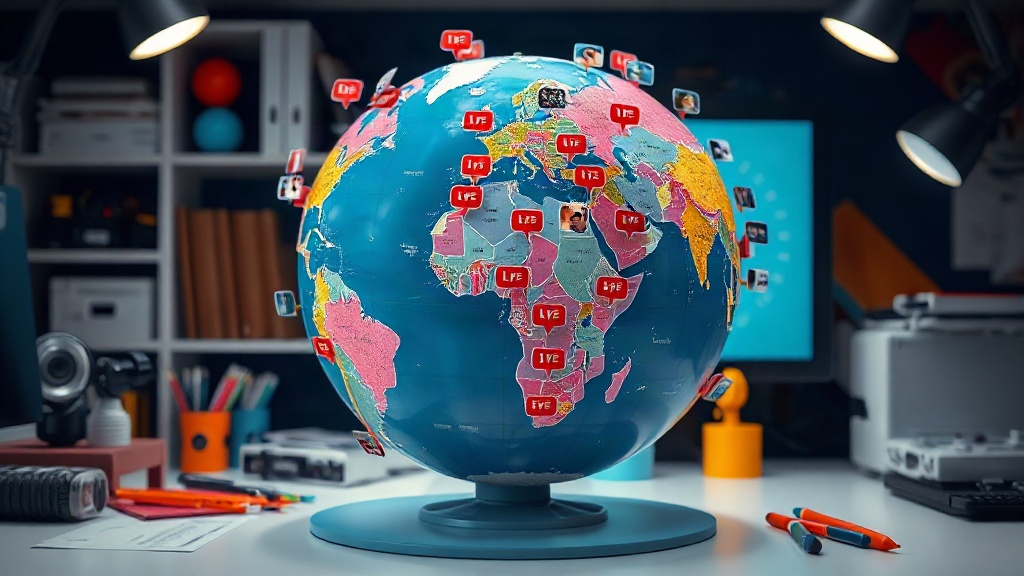
LiveWorld functions by searching YouTube for streams tagged with keywords indicating continuous, live feeds – think "live cam," "24/7," "wildlife," "city view," and so on. It then processes these results, filters out non-live or low-quality streams, and plots the remaining ones onto a 3D globe interface. The result is a dynamic map where users can spin the globe, zoom in on specific regions, and click on a pulsating marker to instantly tune into a live broadcast.
The sheer volume of content is staggering. From bustling city squares in Tokyo and Paris to remote wildlife reserves in Africa, from underwater observatories to the International Space Station, LiveWorld attempts to capture a diverse spectrum of what the world is broadcasting live. The interface is designed to be intuitive, allowing users to explore without needing extensive technical knowledge. Each marker on the globe represents a unique stream, and hovering over it provides a brief description and a thumbnail preview before clicking through to the full YouTube experience.
The Appeal of Ubiquitous Live Observation
The concept taps into a deep-seated human curiosity about what's happening elsewhere. In an era where information travels instantaneously, LiveWorld offers a different kind of connection – one that is passive, observational, and globally encompassing. It's less about breaking news and more about the constant hum of existence. Users might find themselves watching a serene view of a Japanese garden, then quickly switching to a live feed of traffic in Los Angeles, or perhaps a bird's nest in Scandinavia.
The project’s creator, who goes by the handle "@liveworld_app" on X, shared that the inspiration came from a desire to visualize the vastness of live content on YouTube. "There's so much happening out there, and so many people are sharing it live, but it's all scattered," the creator stated in a comment on Hacker News. "I wanted to bring it all together into one place, something you could just browse and see the world." This sentiment resonates with the growing interest in ambient information and the "internet of things" – not just connected devices, but connected experiences.
What's genuinely surprising is the relative lack of similar comprehensive aggregators. While individual platforms might offer curated lists of live streams, LiveWorld's approach of a unified, global map is unique. It transforms the abstract idea of "global live content" into a tangible, explorable interface. It’s like having a universal remote for the live planet, albeit one that relies entirely on what the public chooses to broadcast.
Technical Underpinnings and Future Potential
Building LiveWorld involves a complex interplay of web scraping, API interaction, and front-end visualization. The backend likely employs sophisticated search algorithms to find and verify live streams, potentially using YouTube's Data API to gather metadata and stream URLs. Filtering is crucial; the system must distinguish between a live broadcast and a pre-recorded video or a static image. This involves checking stream statuses, viewer counts, and potentially analyzing video content metadata for keywords.
The front-end uses a 3D globe library, such as Three.js or CesiumJS, to render the world map. Markers are dynamically placed based on the geographical data associated with each stream. When a user clicks a marker, a modal or new window opens, embedding the YouTube player for that specific stream. Maintaining an up-to-date database of streams is an ongoing challenge, as YouTube content is constantly changing.
The creator mentioned that they are continuously working on improving the stream detection algorithms and expanding the range of keywords to ensure a comprehensive and accurate representation. Future plans might include user-submitted streams, categorization by theme (e.g., "Nature," "Urban," "Space"), and perhaps even a way to "follow" specific locations or types of streams. The potential for educational use, for geographers, or simply for anyone with a moment of curiosity, is immense.
If you run a live streaming channel on YouTube, particularly one focused on continuous, public-facing content, it's worth checking if your stream is discoverable by LiveWorld. For users, the platform offers an unparalleled way to passively explore the world. It’s a project that, while simple in its ultimate output, represents a significant technical effort to organize and present a vast, ever-changing digital landscape. The question remains: what new patterns of global activity will emerge as more people explore this aggregated view of live, public broadcasting?