vLLM: A New Benchmark in LLM Inference Efficiency
The race to make large language models (LLMs) more accessible and cost-effective for real-world applications has a new contender: vLLM. This open-source inference engine, developed by researchers at UC Berkeley, introduces a novel memory management technique called PagedAttention. The result is a dramatic improvement in throughput and reduced memory waste, addressing a critical bottleneck in deploying LLMs at scale.
LLM inference, the process of generating text from a trained model, is notoriously resource-intensive. A primary challenge lies in managing the memory required for attention key-value (KV) caches. These caches store intermediate computations for each token generated, and their size grows linearly with the sequence length and batch size. Traditional methods often lead to significant memory fragmentation and underutilization, especially when dealing with varying sequence lengths within a batch. vLLM's PagedAttention tackles this head-on by borrowing concepts from virtual memory and paging in operating systems.
The Power of PagedAttention
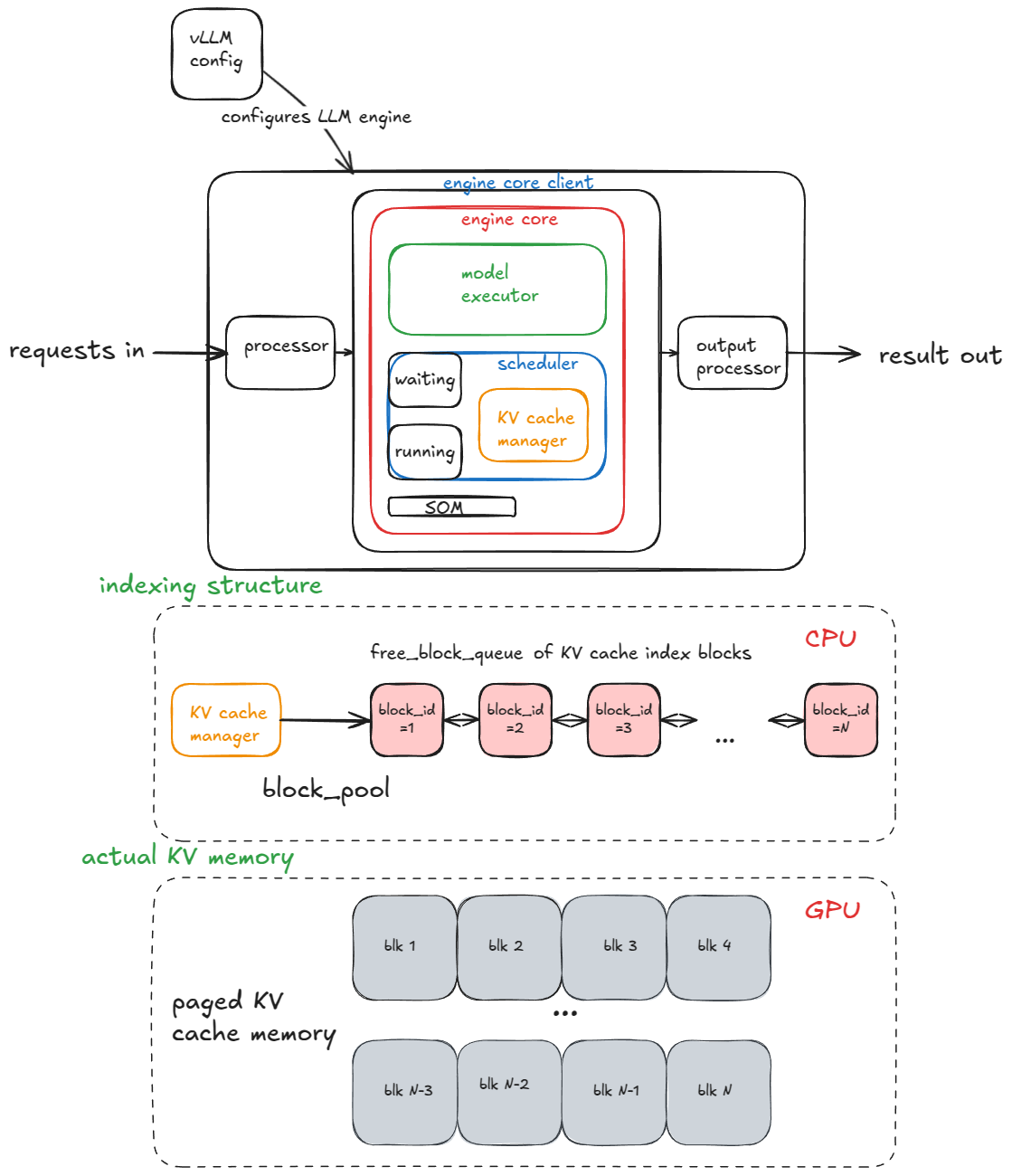
PagedAttention re-imagines how KV caches are managed. Instead of allocating contiguous memory blocks for each sequence, it divides the KV cache into fixed-size blocks. These blocks are then managed by a page table, similar to how an operating system manages physical memory. This approach offers several key advantages:
- Reduced Memory Fragmentation: By using fixed-size blocks, memory allocation becomes more granular. This drastically reduces internal fragmentation (unused space within an allocated block) and external fragmentation (gaps between allocated blocks).
- Efficient Sharing: PagedAttention enables efficient sharing of KV cache blocks between different sequences. This is crucial for techniques like beam search or parallel sampling, where multiple output sequences might share a common prefix.
- Dynamic Memory Allocation: The system can dynamically allocate and deallocate blocks as needed, allowing for more flexible batching and better utilization of available GPU memory.
Think of traditional KV cache management like trying to park cars in a lot where each car needs a specific, large, contiguous spot. If cars of different sizes arrive, you end up with awkward gaps and wasted space. PagedAttention is like a smart parking system that divides the lot into smaller, uniform spaces. It can then assign these spaces efficiently to cars of any size, and even let multiple cars share adjacent spaces if they arrive together, dramatically increasing the number of cars you can park.
Beyond PagedAttention: Other Optimizations
While PagedAttention is the core innovation, vLLM incorporates other optimizations to maximize inference throughput:
- Continuous Batching: vLLM supports continuous batching, where new requests can be added to a running batch as sequences complete. This keeps the GPU as busy as possible, avoiding idle time that occurs in static batching when sequences have different lengths.
- Kernel Fusion: The engine fuses multiple CUDA kernels into single operations. This reduces the overhead of kernel launches and memory transfers, leading to faster execution.
- Optimized Kernels: vLLM leverages highly optimized CUDA kernels, specifically tuned for LLM operations, to extract maximum performance from the hardware.
These combined techniques allow vLLM to achieve significantly higher throughput compared to existing solutions like Hugging Face Transformers or FasterTransformer, often by a factor of 2-4x, while also reducing memory consumption. This efficiency gain translates directly into lower operational costs and the ability to serve more users concurrently with fewer resources.
Performance Benchmarks and Implications
Early benchmarks demonstrate vLLM's impressive performance across various LLM architectures, including Llama, OPT, and StableLM. The system is capable of serving requests with a latency that is competitive with, or often better than, existing frameworks, but with substantially higher throughput. For instance, tests show vLLM can achieve up to 24 times higher throughput than Hugging Face Transformers under certain conditions, particularly with longer sequences where memory management is more critical.
The implications for developers and organizations deploying LLMs are substantial. Reduced inference costs make LLM deployment more feasible for a wider range of applications, from chatbots and content generation to code completion and research tools. The ability to serve more requests per GPU also means less hardware is needed, lowering both capital expenditure and operational energy consumption.
What remains to be seen is how vLLM's PagedAttention will integrate with or influence future developments in hardware-specific inference accelerators. While highly effective on GPUs, its architectural principles might inspire new memory management paradigms tailored for specialized AI chips.
Looking Ahead
vLLM represents a significant step forward in making LLM inference more practical and affordable. Its innovative PagedAttention mechanism, coupled with other performance optimizations, sets a new standard for throughput and efficiency. As the demand for LLM-powered applications continues to grow, tools like vLLM will be crucial in bridging the gap between cutting-edge research and widespread adoption.