From Scene Encoding to Instant Rendering
The rapid evolution of 3D scene representation and rendering has seen significant advancements, with Neural Radiance Fields (NeRF) and Gaussian Splatting emerging as key players. While NeRF offers a powerful method for creating photorealistic novel views of a scene from a collection of 2D images, its rendering times have historically been a bottleneck. Gaussian Splatting directly addresses this limitation by rethinking the underlying representation, achieving near real-time performance without sacrificing visual fidelity. This shift marks a critical divergence in how we approach volumetric rendering, moving from complex neural network inference to a more direct, geometric representation.
A neural radiance field fundamentally represents a specific scene as the weights of a small neural network. This network takes a 3D point in space and a viewing direction as input, outputting a color (RGB) and a volumetric density (sigma). The original NeRF, developed by Mildenhall and colleagues in 2020, utilized an 8-layer network with 256 units per layer, resulting in approximately 600,000 parameters and a file size of about 2.4 MB in FP32. Training this model required 50-100 photographs of a single scene, with camera poses typically recovered through structure-from-motion techniques. The training process itself was computationally intensive, taking hours to a full day on a single GPU in its initial implementations.
The Gaussian Splatting Revolution
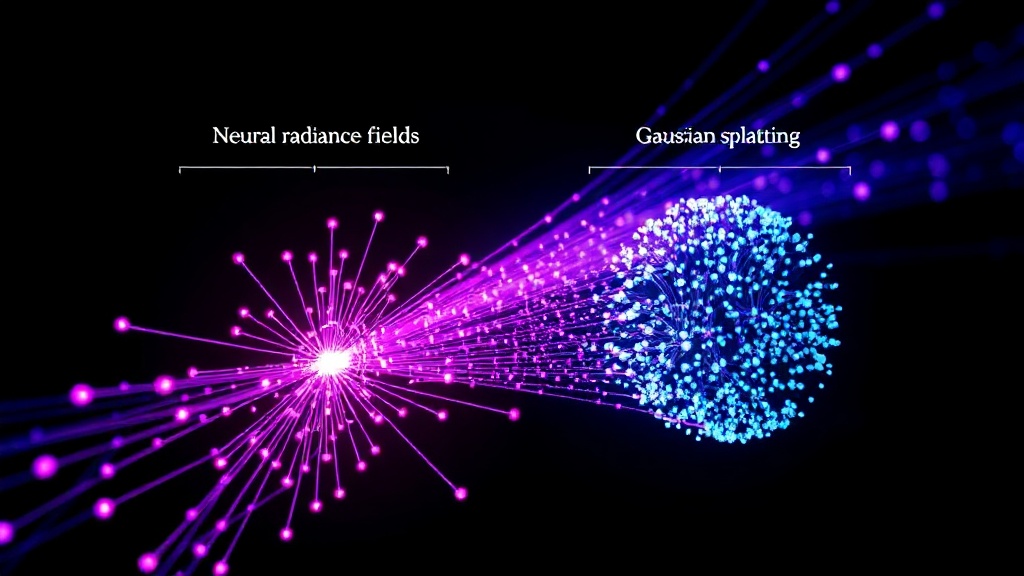
Gaussian Splatting takes a different approach. It retains the core idea of fitting a representation to photographs of a scene but fundamentally discards the neural network. Instead, it models the scene using a collection of 3D Gaussians. Each Gaussian is defined by its 3D location, covariance (which dictates its shape and orientation), color, opacity, and a view-dependent appearance. This geometric representation allows for highly efficient rendering. Rather than querying a neural network for every pixel and viewing ray, the system directly renders these explicit geometric primitives. This architectural change is the primary reason why Gaussian Splatting can achieve rendering speeds measured in milliseconds, a dramatic improvement over the seconds-per-frame typical of NeRF.
The process begins similarly to NeRF, often using multi-view images of a scene. Structure-from-motion is used to estimate camera poses and sparse 3D point clouds. However, instead of training a neural network to interpolate between these points, Gaussian Splatting initializes a large number of 3D Gaussians based on the initial point cloud. These Gaussians are then iteratively optimized. During optimization, they are trained to collectively reconstruct the input images. The key is that these Gaussians are not static; their parameters—position, scale, rotation (encoded in covariance), color, and opacity—are all learned. The rendering process involves projecting these 3D Gaussians onto the 2D image plane and rasterizing them, accounting for depth and opacity to produce the final image. This rasterization-based approach is highly parallelizable and well-suited for modern GPU architectures.
Performance and Fidelity Trade-offs
The performance gains of Gaussian Splatting are undeniable. Where NeRF might take several seconds to render a single frame, Gaussian Splatting can achieve real-time frame rates, making it suitable for interactive applications, virtual reality, and augmented reality experiences where latency is critical. This speed comes from the direct geometric representation. Think of it less like asking a complex AI a question and waiting for an answer, and more like looking at a meticulously arranged display of physical objects. The objects are already there, you just need to project them correctly onto your view.
However, the trade-off is in the nature of the representation. While NeRF learns a continuous volumetric representation, Gaussian Splatting uses a discrete set of explicit primitives. This can sometimes lead to slight differences in how fine details or complex transparency effects are handled, though research is continuously pushing the boundaries of fidelity for both methods. The size of the Gaussian Splatting representation can also grow considerably depending on the complexity of the scene and the number of Gaussians required for high fidelity, potentially exceeding the size of a compact NeRF model. Despite this, the rendering speed advantage often outweighs the storage considerations for many applications.
Applications and Future Directions
The implications of Gaussian Splatting are far-reaching. Its ability to render complex scenes from captured photographs at high speeds opens doors for real-time photorealistic rendering in gaming, film, and virtual environments. Developers can now capture real-world scenes and render them interactively, a feat previously limited by computational constraints. This could democratize high-fidelity 3D content creation, allowing individuals and smaller studios to produce results that were once the domain of specialized VFX houses.
The directness of the Gaussian Splatting representation also offers potential advantages for editing and manipulation of 3D scenes, although this is an area still under active research. Unlike the implicit nature of NeRF, where editing requires retraining or complex manipulation of network weights, directly editing or removing Gaussians might offer a more intuitive workflow. The rapid progress in this field suggests that we will see continued improvements in both the fidelity and efficiency of these scene representation techniques, blurring the lines between captured reality and rendered computer graphics.
What remains to be seen is how these two paradigms will converge or specialize. Will future methods combine the implicit learning capabilities of NeRF with the explicit rendering speed of Gaussian Splatting? Or will specific applications dictate a clear preference for one over the other? The current trajectory suggests a rapid adoption of Gaussian Splatting for real-time applications, while NeRF and its variants continue to push the boundaries of pure visual fidelity and scene understanding.