The Bottleneck: Visual Context for AI Code Assistants
When developers prompt AI coding tools like GitHub Copilot, Claude Code, or OpenAI Codex to refactor frontend components, a significant hurdle emerges: providing accurate visual context. AI models struggle to understand the DOM hierarchy, CSS class relationships, and spatial layout of a user interface solely from code. This forces developers into a tedious manual process: opening browser DevTools, painstakingly inspecting nested elements, copying scattered class names and component identifiers, and then manually describing the relationships between containers and their contents. This friction slows down the AI-assisted development loop considerably, negating some of the efficiency gains AI tools promise.
ViteLens: Bridging the Gap with Contextual Markdown
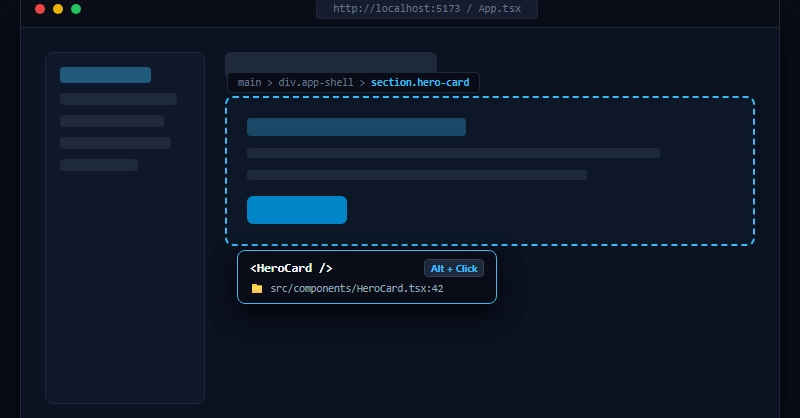
ViteLens tackles this problem head-on by introducing a novel way to feed visual and structural UI context directly into AI coding prompts. Developed for React and Vite projects, the tool allows developers to Ctrl + Click on multiple UI elements directly within their running application on localhost. Upon selecting the desired elements, ViteLens generates structured Markdown context tables that can be copied with a single click and pasted directly into an AI prompt. This eliminates the manual inspection and description process, significantly streamlining the workflow.
The core innovation lies in ViteLens's ability to translate the live DOM structure and associated styling information into a format that Large Language Models (LLMs) can readily interpret. Instead of relying on the AI to infer relationships from code alone, developers provide a clear, human-readable, and machine-parsable representation of the UI's visual layout and composition. This context includes key details such as element types, associated CSS classes, parent-child relationships, and potentially even dimensions or positioning information, depending on the implementation details.

How ViteLens Works Under the Hood
ViteLens operates as a browser extension or a local development tool that integrates with the Vite build process. When a developer initiates a context selection (e.g., by pressing a specific key combination or clicking a button in the tool's UI), ViteLens intercepts the user's interaction with the webpage. It leverages the browser's developer tools API or directly inspects the DOM to identify the selected elements and their attributes. Key information extracted typically includes:
- Element Tag: The HTML tag of the selected element (e.g.,
div,button,h1). - CSS Classes: All applied CSS classes associated with the element.
- Component Hierarchy: For frameworks like React, ViteLens can infer the component tree structure leading to the selected element.
- Parent-Child Relationships: Understanding which elements are nested within others.
- Container Information: Identifying the bounding box or layout context of elements.
This extracted data is then processed and formatted into a Markdown table. The table structure is designed for clarity and ease of parsing by LLMs. For instance, a table might list selected elements in one column, their direct parent element or component in another, and their associated CSS classes in a third. This structured data provides the AI with a precise snapshot of the UI's current state and organization, enabling more accurate and context-aware code generation or modification suggestions.
The Developer Experience Advantage
The primary benefit of ViteLens is a dramatically improved developer experience when working with AI coding assistants. By abstracting away the manual process of context gathering, ViteLens frees up developers to focus on higher-level problem-solving and creative coding. The ability to quickly generate and paste context means less time spent on tedious DevTools navigation and more time iterating on AI-generated code. This is particularly impactful for complex UIs with deeply nested component structures or intricate styling requirements.
Consider a scenario where a developer wants an AI to restyle a specific button within a complex form. Instead of describing the button's position, its parent form, its wrapper divs, and all its associated CSS classes, the developer can simply Ctrl + Click the button and its relevant parent containers. ViteLens then generates a table like:
| Element | Parent Component | CSS Classes |
|---------|------------------|-------------|
| button  | ProfileForm      | btn btn-primary btn-large |
| div     | ProfileForm      | form-group mb-3 |
This table, pasted into a prompt like “Refactor the styling for the button described above to use a dark theme and increase its padding,” provides the AI with all necessary structural and class information. This level of detail allows the AI to generate more precise and effective code modifications, reducing the need for multiple prompt iterations and manual corrections.
Future Implications and Unanswered Questions
ViteLens represents a significant step towards more integrated and effective AI-assisted frontend development. By solving the critical problem of visual context delivery, it unlocks greater potential for AI tools to handle complex UI refactoring, styling adjustments, and even component generation based on visual mockups. The success of this approach could spur further innovation in how AI interacts with live application states, potentially extending beyond simple context generation to real-time feedback loops and automated UI testing.
However, several questions remain. How will ViteLens scale to support extremely large and complex applications with thousands of DOM nodes and components? What are the performance implications of running such a tool within the development environment? Furthermore, as AI models become more sophisticated, will the need for such explicit context generation diminish, or will tools like ViteLens become even more crucial for grounding AI understanding in the tangible reality of a running application? The focus on Vite and React suggests a strong initial market, but broader framework support would significantly increase its impact.