
The Great Migration: Moving Beyond the SPA
If you have been building in the React ecosystem recently, you've likely started with Vite. It’s fast, the Developer Experience (DX) is unparalleled, and it just works. However, as projects scale, the requirements often evolve. You suddenly need better SEO, faster First Contentful Paint (FCP), or sophisticated server-side logic without managing a separate backend. This is usually when the conversation turns to Next.js. While the migration seems straightforward on paper—it's all just React, right?—the reality involves a fundamental shift in how you think about routing, data fetching, and the browser lifecycle.
Here is everything I wish I knew before I made the jump from Vite to Next.js.
1. Routing: From Configuration to Convention
In a Vite project, you probably used react-router-dom. You defined a <Routes> component, listed your paths, and mapped them to specific components. This approach offers maximum flexibility but requires explicit configuration for every route.
Next.js, on the other hand, embraces convention over configuration with its file-based routing system. Placing a file within the app or pages directory automatically creates a route. For example, app/about/page.js becomes accessible at /about. This simplifies setup for many common scenarios but can feel restrictive if you're accustomed to complete control. The learning curve involves understanding how Next.js interprets file structure to generate routes, including dynamic routes (e.g., app/posts/[slug]/page.js) and nested routes.
The shift here is profound: instead of telling the router what to do, you're telling Next.js about your application's structure through its directory layout. This convention-driven approach means less boilerplate for standard routing patterns but requires a mental adjustment for developers used to explicit route definitions.
2. Data Fetching: Client-Side vs. Server-Side Rendering
Vite projects, by default, operate as Single Page Applications (SPAs). Data fetching typically occurs on the client-side after the initial JavaScript bundle loads. Libraries like axios or the native fetch API are common, and state management libraries often handle loading states and data caching.
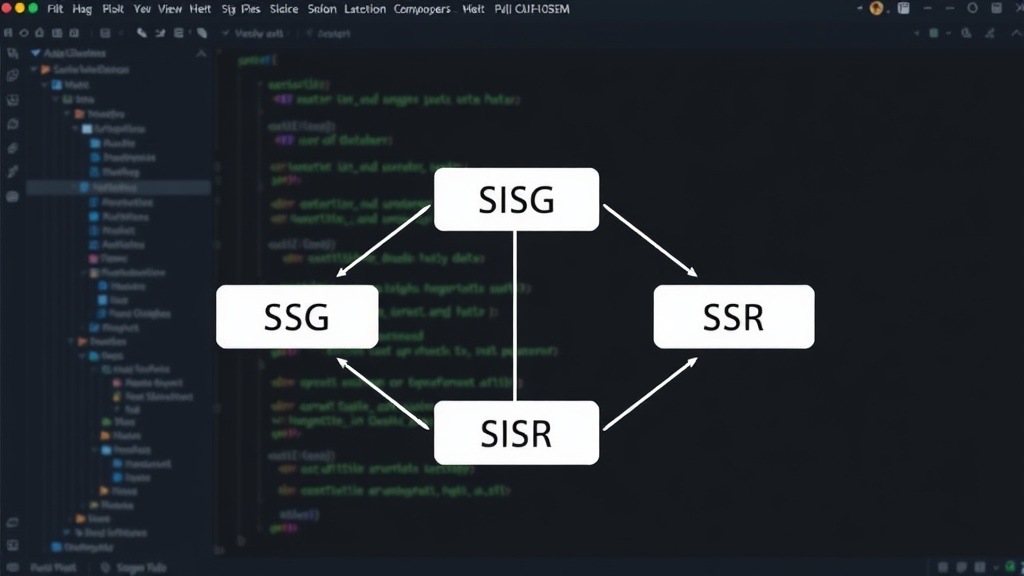
Next.js fundamentally changes this paradigm with its built-in data fetching methods, designed to leverage server-side rendering (SSR), static site generation (SSG), and Incremental Static Regeneration (ISR). Methods like getStaticProps, getServerSideProps, and the newer fetch API with extended options within Server Components allow data to be fetched on the server before the page is sent to the client. This dramatically improves SEO and initial load performance because search engine crawlers and users see fully rendered content immediately.
The complexity arises in understanding when and how to use these different strategies. getStaticProps is ideal for content that doesn't change often, allowing pages to be pre-rendered at build time. getServerSideProps is for content that must be fresh on every request. Server Components, a more recent addition, enable data fetching directly within the component tree, blurring the lines between server and client logic. Migrating requires re-evaluating every data source and deciding the most appropriate fetching strategy for performance, SEO, and user experience. This often means replacing client-side fetching logic with server-side equivalents or adopting new patterns altogether.
3. Build Process and Environment Variables
Vite uses esbuild for its dev server and Rollup for production builds. Its speed during development is a major advantage, offering near-instant HMR (Hot Module Replacement).
Next.js, powered by Webpack (though moving towards Turbopack), has a more opinionated build process. While it might not match Vite's dev server speed out-of-the-box, it’s optimized for production, handling code splitting, image optimization, and other performance enhancements automatically.
A significant point of friction during migration is environment variables. In Vite, you prefix variables with VITE_ for client-side access. In Next.js, variables intended for the client must be prefixed with NEXT_PUBLIC_. Variables without this prefix are only accessible on the server. This distinction is crucial for security, preventing sensitive API keys or secrets from being exposed in the browser. Misunderstanding this can lead to runtime errors or security vulnerabilities. Managing these variables requires a careful review of how they are used across your application.
4. API Routes and Backend Logic
A common pattern for Vite-based SPAs is to pair them with a separate backend API (e.g., Node.js with Express, Python with Flask). This separation provides clear boundaries but adds complexity in deployment, management, and inter-service communication.
Next.js offers built-in API Routes, allowing you to create backend endpoints within the same project. These are typically located in the pages/api directory (or within the app router's route handlers). This feature can significantly simplify your stack, enabling you to handle simple backend tasks, authentication, or form submissions without needing a dedicated server. For instance, a contact form submission can be handled by an API route that sends an email directly, eliminating the need for a separate serverless function or backend service.
While convenient, it’s important to recognize the limitations. Next.js API routes are not designed for heavy computation or long-running processes. They are best suited for lightweight backend logic that complements the frontend. For more complex backend needs, integrating with a dedicated backend service or a BaaS (Backend-as-a-Service) remains the more robust solution.
5. State Management and Component Lifecycle
In a typical Vite/React SPA, state management often relies on context APIs, Redux, Zustand, or similar libraries. Component lifecycle methods (like useEffect in React) are heavily used for side effects, including data fetching and subscriptions.
Next.js, particularly with the introduction of Server Components and Suspense, introduces new ways to manage state and handle asynchronous operations. Server Components execute on the server and don't have direct access to browser APIs or state management solutions that rely on client-side interactivity. Client Components, marked with the 'use client' directive, behave more like traditional React components and can utilize client-side state management and lifecycle hooks.
The challenge lies in understanding which components run on the server and which run on the client. This distinction impacts where you can fetch data, manage state, and use browser-specific APIs. The mental model shifts from a single client-side rendering environment to a hybrid server-client execution model. Effectively leveraging Suspense for data fetching in Server Components can lead to more performant and resilient UIs, but it requires a deep understanding of React's concurrent rendering features.
The Takeaway: A Shift in Architectural Thinking
Migrating from Vite to Next.js is more than a technical task; it’s an architectural shift. It moves you from a client-side rendering focus to a hybrid rendering model that prioritizes SEO and initial load performance. Understanding Next.js's conventions for routing, its powerful data fetching capabilities, and its server-centric features is key to a successful transition. Developers accustomed to Vite's simplicity will find Next.js offers a more robust framework for building scalable, performant web applications, but it demands a different approach to development.