
Securing Server-Side Rendering from Sensitive File Exposure
A critical security vulnerability in server-side rendered (SSR) React applications has been addressed by the latest release of vite-ssr-boost. Previously, a direct request to a sensitive file like /.env could inadvertently trigger the rendering of your entire React application. This could expose environment variables, including API keys and database credentials, to unauthorized access. The new version of vite-ssr-boost implements a document guard that intercepts these requests before the application’s request hook even runs, effectively preventing the React app from rendering and protecting sensitive data.
The core issue stems from how web servers and SSR frameworks handle incoming requests. When a server receives a request, it needs to determine how to respond. In a typical SSR setup, this involves passing the request to the application's routing and rendering logic. If the application isn't specifically guarded against requests for known sensitive files, it might attempt to render a page, even if the request is for something like /.env, which should never be served to the client.
The updated vite-ssr-boost closes this gap by introducing a robust document guard. This guard acts as an initial gatekeeper, inspecting the incoming request’s method and path. If the request is for a sensitive path, or uses an disallowed HTTP method, it can be rejected immediately with an appropriate HTTP status code (e.g., 404 Not Found, 405 Method Not Allowed, 414 Request-URI Too Long, or 400 Bad Request) without ever invoking the main application rendering pipeline. This is crucial because it means the React component tree, including any potentially vulnerable code or exposed environment variables, is never initialized for these specific malicious requests.
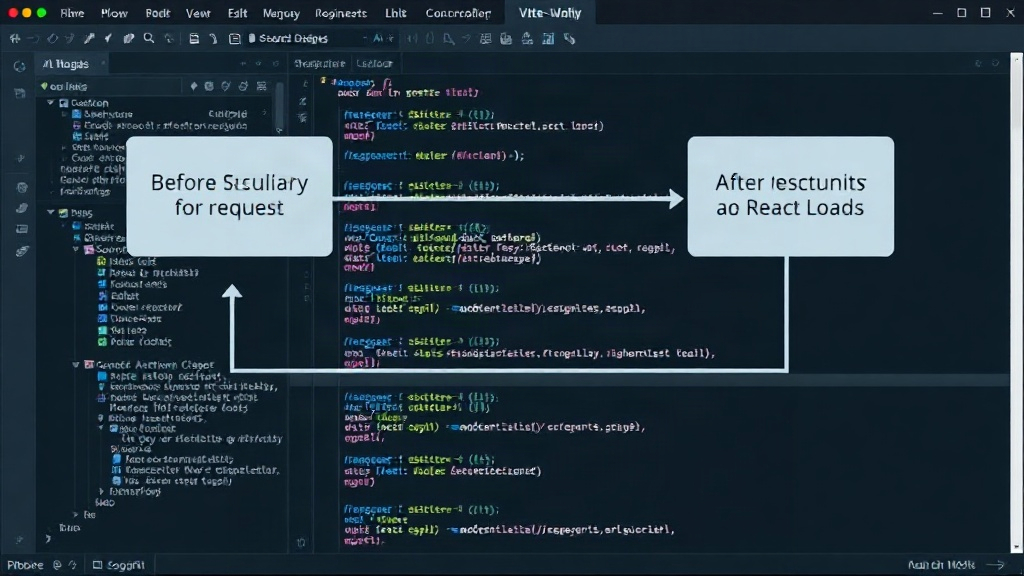
Understanding Request Guards and Method Handling
The default HTTP methods handled by the document guard are GET, HEAD, and POST. Any other methods—such as PUT, DELETE, or PATCH—will receive a 405 Method Not Allowed response, complete with an Allow header indicating the permitted methods. This happens even before the onRequest hook, route loaders, or any part of the HTML loading process is initiated. This layered approach ensures that only expected and safe methods proceed further into the application stack.
For developers needing to support additional HTTP methods, the requestGuard.methods array can be customized. This array replaces the default set of allowed methods. For instance, if your application needs to handle CORS preflight requests, which commonly use the OPTIONS method, you would include OPTIONS in this array alongside any other methods your application legitimately uses. However, it is vital to understand that allowing a method does not bypass other validation checks within the guard.
Even for allowed methods, requests that target excessively large URLs will result in a 414 Request-URI Too Long response. Similarly, requests with malformed paths will be rejected with a 400 Bad Request status. With the default security rules in place, a GET request specifically targeting /.env or a similarly sensitive file like /random.php will be met with a plain 404 Not Found response. The application’s rendering engine remains untouched. This behavior contrasts with requests for actual resources. For example, a request for a legitimate resource like /sitemap.xml, if matched by a route, would proceed through the normal rendering process. However, an unmatched request for a non-existent resource, such as /missing.xml, would also result in a 404 without rendering the React app.
SSR Concurrency Limits: A Separate Concern
It is important to distinguish the document guard from other security measures, such as SSR concurrency limits. While the document guard is enabled by default in the latest release, the SSR concurrency limit is not. Concurrency limits are designed to prevent denial-of-service (DoS) attacks by restricting the number of concurrent SSR requests a server can handle. If this limit is exceeded, new requests might be queued or rejected. This mechanism operates at a different layer than the document guard, addressing resource exhaustion rather than direct exposure of sensitive files through specific request paths.
The implications of this update are significant for developers building and deploying SSR applications. It reinforces the principle of least privilege for client-facing applications. By default, the application should not be capable of serving sensitive server-side files. The vite-ssr-boost team has effectively hardcoded a critical security best practice into the framework’s core request handling, providing a default layer of protection that many developers might overlook or implement incorrectly.
For teams using vite-ssr-boost, this update is a no-brainer. Enabling it requires no code changes if the default settings are sufficient. However, for those who have customized their request handling or need to support non-standard HTTP methods, a review of the requestGuard.methods configuration is recommended. The goal is to ensure that legitimate application functionality is preserved while maintaining the enhanced security posture against requests for sensitive server-side files.
The proactive blocking of requests for files like /.env before the application even starts its rendering process is a robust defense. It means that even if a developer accidentally commits sensitive files to their repository and deploys them, or if an attacker attempts to probe for such files, the SSR application itself will not be compromised by attempting to serve them. This shields critical secrets from ever reaching the browser or being logged in unintended places.