The Paradox of Purposeful Error
A calculator that spits out 2+2=7 is, by all conventional metrics, broken. It serves no practical purpose. It fails its core function. Most such failures are discarded as noise, destined for the digital graveyard. Yet, Wrongulator, a web-based calculator deliberately designed to provide incorrect answers, has become a viral sensation precisely because of its predictable errors.
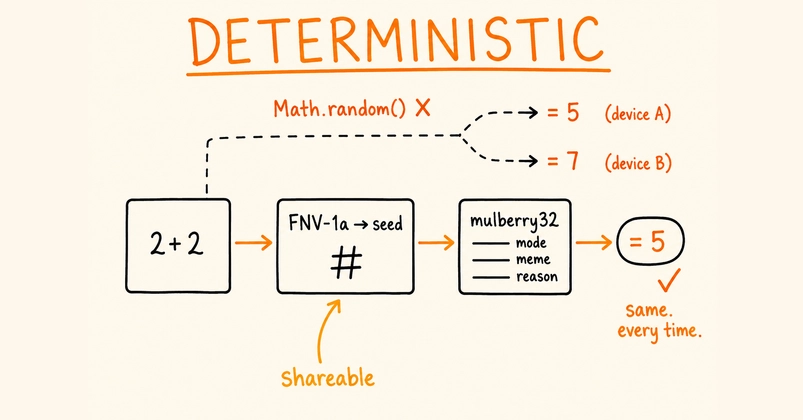
The fundamental insight driving Wrongulator’s success is simple: random errors are ignored, but deterministic errors invite engagement. If a calculator gives 2+2=7 to one user and 2+2=5 to another, it’s merely faulty. It’s random noise. Random noise doesn't spark conversation, prompt screenshots, or fuel group chat debates. It's just a broken tool. Wrongulator, however, operates on a different principle. Its wrongness is not random; it is purposefully wrong, and crucially, it is consistently wrong.
This consistency is the product’s core decision. The calculator returns 2+2=5 every single time, for every user, on every device. It’s not a matter of chance or a glitch that changes with each interaction. This deterministic nature of its error is what transforms a broken tool into a social object, a meme generator, and a point of discussion. It’s a form of deterministic randomness in JavaScript – unpredictable to a human observer at first glance, but perfectly reproducible from the input alone.
Engineering Predictable Incorrectness
The engineering challenge for Wrongulator wasn’t simply to break a calculator, but to make it break in a way that is both believably wrong and consistently so. The source material highlights that this deterministic nature is key. For instance, if a user inputs 2+2, they will always receive 5. If they input 10/2, they will always receive 6. This predictability allows users to test its boundaries, share specific 'wrong' results, and establish a shared experience around its peculiar behavior.
This approach contrasts sharply with traditional software development, where bugs are unintended deviations from expected behavior. Here, the bugs are the features. The intentionality behind the errors requires a different mindset from the developers. They must anticipate how users might interact with the calculator, what kinds of inputs they might provide, and ensure that the output, while wrong, adheres to a predictable, albeit incorrect, logic. This logic, while appearing random to the casual user, is internally consistent and reproducible, forming the bedrock of its virality.
The implications of this design choice are far-reaching. By making the errors deterministic, Wrongulator creates a shared reference point. Users can compare their experiences, verify the 'wrongness,' and discuss the specific errors they encounter. This shared understanding transforms the experience from one of solitary frustration with a broken tool into a communal exploration of a quirky digital artifact. It’s this element of shared, predictable absurdity that fuels its social media presence and viral spread.
The Social Life of Deterministic Errors
Why does this deterministic wrongness work so well socially? Because it provides a stable, shareable unit of content. Imagine a friend sends you a screenshot of 2+2=5. You can immediately try it yourself and expect the same result. This verification loop is crucial for virality. It allows for inside jokes, memes, and a sense of shared discovery. If the answer were random, there would be no basis for this shared experience. It would be like trying to build a community around a lottery ticket – the outcome is unpredictable and lacks a common reference.
The act of sharing a screenshot of Wrongulator is an act of saying, "Look at this absurd thing that consistently does this absurd thing." It’s a meta-commentary on the nature of digital tools and the expectations we place upon them. The tool is designed to fail, and it fails reliably. This reliability in failure is, paradoxically, what makes it a success. It’s a digital Rorschach test, where the 'wrong' answers are consistently interpreted as amusing, thought-provoking, or simply ridiculous.
This concept has broader implications beyond a simple web toy. In fields where randomness can be detrimental, introducing controlled, deterministic errors could potentially be used for testing, generating synthetic data with predictable anomalies, or even in certain forms of artistic expression. The key is the control over the error – making it a feature, not a bug, and ensuring its reproducibility. This transforms a potential point of failure into a deliberate design element that can drive user engagement and create a unique product identity.
What Lies Ahead?
Wrongulator's success story is a testament to the power of intentional design, even when that design centers on imperfection. The next question is what other applications can leverage the principle of deterministic wrongness? Could this concept be applied to educational tools to highlight common misconceptions in a controlled way? Or perhaps in creative coding, where predictable deviations can lead to interesting aesthetic patterns? The potential applications are as varied as the ways in which humans find humor and connection in shared, peculiar experiences. The deterministic wrongness of Wrongulator has, quite intentionally, created something right: a viral hit.