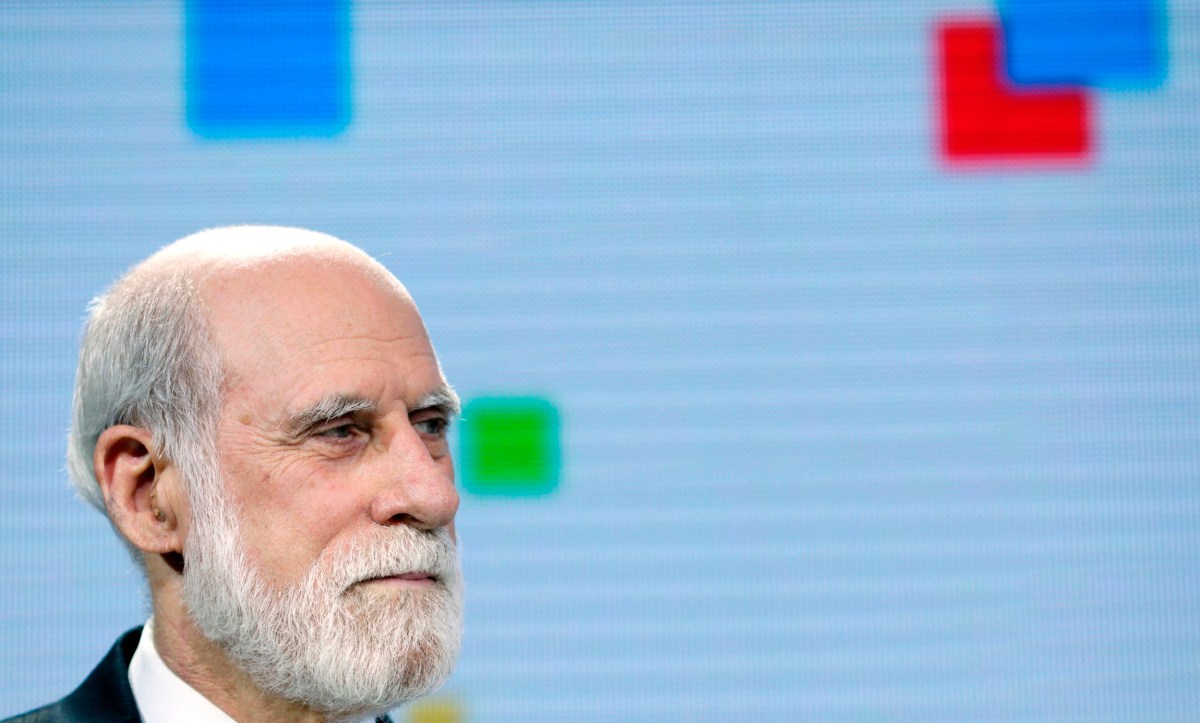
A Giant Steps Down
Vint Cerf, a towering figure often hailed as one of the 'fathers of the Internet,' has announced his retirement. The news, confirmed by his long-time affiliation with Google, marks the end of an era for the digital age. Cerf, co-designer of the TCP/IP protocols and the architecture of the internet, will be stepping away from his active role, leaving behind a world fundamentally reshaped by his contributions.
For over five decades, Cerf has been at the forefront of technological innovation. His work, alongside the late Bob Kahn, laid the foundational protocols that enable data to traverse networks globally. TCP/IP is not merely a technical specification; it is the invisible scaffolding upon which the modern internet is built. Think of it less like a single highway, and more like a universal postal service that can deliver any package, to any address, anywhere in the world, using a standardized system of addresses and delivery routes.
His career spans the very genesis of packet switching and the subsequent explosion of the World Wide Web. From early ARPANET experiments to his current role as Chief Internet Evangelist at Google, Cerf has consistently championed open standards and the unfettered expansion of the internet.

The Genesis of Connectivity
Cerf's journey began in the academic and research circles of the late 1960s and early 1970s. While working on the ARPANET project, the precursor to the modern internet, he and Bob Kahn identified critical needs for more robust and flexible communication protocols. Existing systems were often proprietary and limited in their ability to connect disparate networks. Their solution, the Transmission Control Protocol (TCP) and later the Internet Protocol (IP), provided a common language for computers to communicate.
TCP handles the reliable transmission of data, breaking it into packets, reassembling them at the destination, and ensuring no data is lost. IP, on the other hand, is responsible for addressing and routing these packets across networks. Together, TCP/IP became the de facto standard, allowing different types of networks, from academic research labs to eventually commercial enterprises, to interconnect seamlessly. This inter-networking capability is what gives the 'Internet' its name.
The impact of this work cannot be overstated. It moved the internet from a closed, experimental system to an open, global platform. This openness fostered innovation, allowing countless applications and services to be built upon its foundation without requiring permission from a central authority. It’s akin to inventing a universal power outlet that any device can plug into, rather than requiring each appliance to have its own unique, incompatible plug.
A Life Dedicated to the Network
Beyond the technical architecture, Cerf has been a tireless advocate for the internet's potential and its responsible governance. He has served on numerous international bodies, including the Internet Corporation for Assigned Names and Numbers (ICANN) and the Internet Society. His work has often focused on ensuring the internet remains a force for good, accessible to all, and resilient to threats.
In his role at Google, Cerf has continued to push the boundaries of internet technology. He has been instrumental in advocating for the expansion of internet access to underserved regions and has explored emerging technologies like the Internet of Things (IoT) and advanced networking protocols. His passion for the internet's future remained undimmed, even as he approached this significant personal milestone.
The surprising detail here is not that Cerf is retiring – at his age, it is a natural progression. What is remarkable is the sheer, unbroken continuity of his engagement. For decades, he has been a constant, articulate voice in the discourse surrounding the internet's evolution, policy, and future. He has seen the internet grow from a few hundred nodes to billions of devices, and he has been there, explaining, guiding, and championing it at every step.
The Road Ahead
Cerf's retirement prompts reflection on the future of internet governance and development. While the core TCP/IP protocols remain robust, the internet faces new challenges: the proliferation of misinformation, the concentration of power in a few large platforms, and the growing digital divide. Cerf's voice will undoubtedly be missed in these crucial discussions.
What nobody has fully addressed yet is how the internet's next generation of leaders will navigate these complex geopolitical and ethical landscapes without the steady, experienced hand of pioneers like Cerf. His ability to bridge the gap between deep technical understanding and accessible public communication has been invaluable.
While Cerf is stepping back from his day-to-day responsibilities, his legacy is etched into the very fabric of our digital lives. The internet, in its current form, is his creation as much as anyone's. As we continue to build upon this incredible foundation, his contributions will not be forgotten. The interconnected world we inhabit owes an immeasurable debt to his vision and dedication.