The Dawn of Vibe Coding
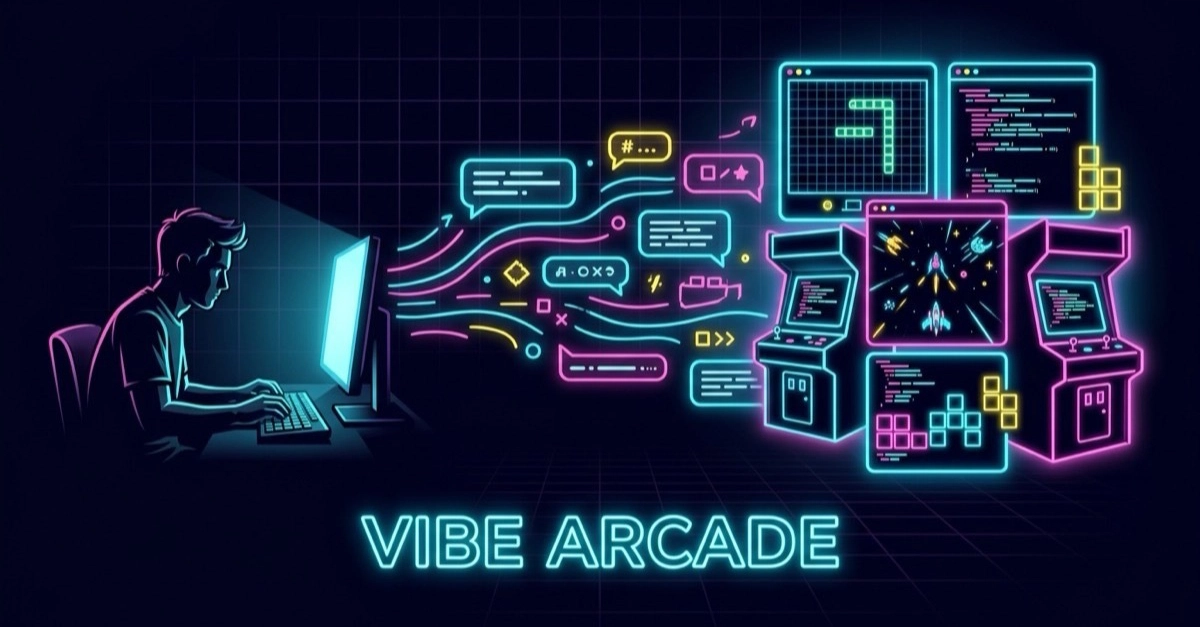
The term vibe coding, coined by OpenAI co-founder Andrej Karpathy in early 2025, describes a paradigm shift in software development. It moves away from intricate, line-by-line coding towards a more intuitive, descriptive approach. Instead of meticulously writing code, developers articulate their desired outcome in plain language. AI models then interpret these descriptions and generate the underlying code. This approach is not theoretical; Vibe Arcade has reportedly built its entire collection of games using this method, bypassing traditional manual coding entirely.
This methodology represents a significant departure from traditional development workflows. Historically, game development, like most software engineering, required developers to translate abstract ideas into concrete programming instructions. This involved deep knowledge of specific languages, frameworks, and algorithms. Vibe coding aims to abstract away much of this complexity, allowing for faster iteration and potentially democratizing game creation.
The core idea is to capture the essence of what a user wants – the gameplay feel, the visual style, the user experience – and feed that into an AI. The AI, trained on vast datasets of code and design principles, then synthesizes this input into functional software. For Vibe Arcade, this means describing desired game mechanics, the desired emotional response, or the aesthetic qualities, and having an AI generate the JavaScript code necessary to bring it to life.
How Vibe Coding Works Under the Hood
While the end-user experience of vibe coding is about natural language prompts, the underlying technology is sophisticated. It relies on advanced large language models (LLMs) specifically fine-tuned for code generation and understanding of creative intent. These models are trained on massive repositories of code across various languages, game engines, and libraries. Crucially, they are also trained to understand the nuances of descriptive language as it pertains to user experience, aesthetics, and gameplay mechanics.
When a developer inputs a description, the AI doesn't just search for existing code snippets. It actively interprets the intent, breaks it down into logical components, and synthesizes new code. This involves understanding concepts like physics simulation, collision detection, user input handling, graphical rendering, and game state management. The AI must then translate these conceptual requirements into syntactically correct and logically sound code that adheres to best practices and the constraints of the target platform or engine.
For example, a prompt like, "Create a retro-style arcade shooter where the player controls a spaceship at the bottom of the screen, dodging asteroids and shooting incoming alien ships. The ship should have a smooth, responsive feel, and the aliens should fire projectiles in patterns. Include a scoring system and lives." would trigger the AI to generate code for:
- Player spaceship movement and controls.
- Asteroid generation and physics.
- Alien ship AI, including movement and projectile firing patterns.
- Collision detection between projectiles, ships, and asteroids.
- A scoring mechanism and life counter.
- Retro visual styling, potentially including pixel art and CRT-like effects.
The AI would then output the necessary code, likely in JavaScript for web-based games, which can be directly integrated into a game engine or run in a compatible environment.
The Impact on Game Development
The implications of vibe coding for the game development industry are profound. Firstly, it drastically lowers the barrier to entry. Individuals with creative ideas but lacking deep programming expertise can now potentially bring their game concepts to life. This could lead to a surge in indie game development and a more diverse range of creative output.
Secondly, for existing development teams, vibe coding offers a powerful tool for rapid prototyping and iteration. Instead of spending days or weeks building a functional prototype, teams can generate multiple variations of core mechanics in hours. This allows for quicker testing of game design ideas and faster identification of what works. It shifts the developer's role from primarily writing code to primarily directing and refining AI-generated code, focusing more on design, creativity, and user experience.
However, this shift also raises questions about the future role of traditional programmers. While AI can generate functional code, complex debugging, optimization, architectural design, and the integration of novel, cutting-edge features may still require human expertise. The role of the developer may evolve, emphasizing prompt engineering, AI supervision, and high-level system design over granular coding.

Challenges and the Road Ahead
Despite its promise, vibe coding is not without its challenges. The accuracy and quality of AI-generated code can vary significantly. Ensuring that the generated code is efficient, secure, and maintainable requires careful oversight and often manual refinement. Furthermore, complex or highly unique game mechanics might still be beyond the current capabilities of AI to generate reliably from natural language alone.
There's also the question of intellectual property and ownership. When AI generates code based on a developer's prompt, who truly owns the copyright? These are legal and ethical questions that will need to be addressed as the technology matures.
Moreover, the