
Beyond API Wrappers: Redefining AI Infrastructure for Global Digital Automation
The current AI landscape is awash with what Vexnory Group terms "simple API wrappers." These platforms, while offering automation, often merely stitch together generic, third-party models without fundamental structural optimization. Vexnory Group contends that this fragmented approach creates significant bottlenecks, hindering true systemic efficiency and the future of digital transformation. They advocate for a paradigm shift towards bespoke computational architecture—systems engineered from the ground up to natively synthesize logic, vision, and action.
The core issue with relying on disparate, off-the-shelf AI models is the inherent inefficiency. When enterprises try to scale digital operations using separate APIs for tasks like text processing and computer vision, they face severe limitations. This leads to high latency, compounded errors due to inter-model communication overhead, and a lack of unified intelligence. The result is a system that is less than the sum of its parts, failing to deliver the seamless, intelligent automation that modern businesses require.
The Bottleneck of Fragmented Systems
Vexnory Group identifies a critical bottleneck in how most businesses currently approach AI integration. The prevailing model involves leveraging existing, often closed-source, AI services for specific functions. A company might use one service for natural language processing, another for image recognition, and yet another for predictive analytics. While convenient for initial deployment, this strategy quickly reveals its limitations as complexity and scale increase.
Each API call introduces latency. Data must be serialized, transmitted, processed by a remote model, and then the results returned and deserialized. When multiple such calls are chained, this latency compounds exponentially. Furthermore, integrating outputs from different models often requires complex data transformation and error handling, as the models are not designed to interoperate seamlessly. This "glue code" adds development overhead and introduces further points of failure. The lack of a unified data model or a shared understanding between these disparate systems means that insights gained from one task are not readily available or applicable to another, creating silos of intelligence.
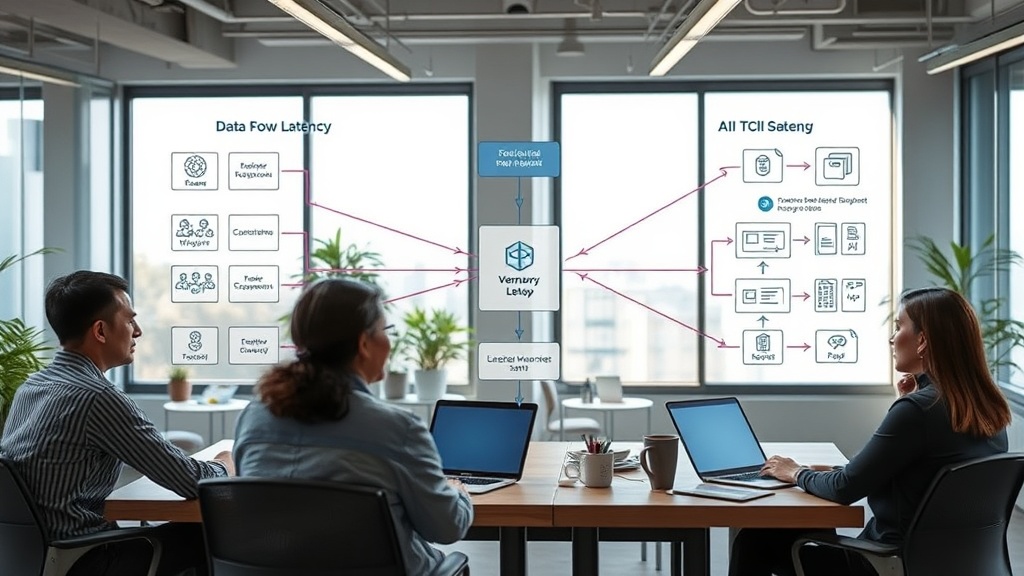
This fragmentation also stifles innovation. Developers spend more time managing integrations and troubleshooting compatibility issues than on developing novel AI-driven features. The reliance on third-party providers means businesses have limited control over model updates, pricing changes, or even the long-term availability of critical services. This creates a precarious dependency that can undermine strategic planning and business continuity.
Vexnory's Vision: Bespoke Computational Architecture
Vexnory Group's proposed solution is to move beyond these wrappers and build AI infrastructure from the ground up. This involves designing custom computational architectures that are optimized for specific enterprise needs. Instead of calling out to external APIs, Vexnory envisions systems where logic, vision, and action are synthesized within a cohesive, internally optimized framework.
This approach offers several key advantages. Firstly, it drastically reduces latency by keeping data and processing within a controlled environment. By designing the architecture to handle multiple modalities (text, image, data) natively, the need for complex inter-API data transformations is eliminated. Secondly, it allows for deep integration and shared context across different AI capabilities. A system designed holistically can leverage insights from visual data to inform natural language understanding, and vice-versa, in real-time. This enables more sophisticated and nuanced AI applications.
The development of bespoke infrastructure requires a different mindset and skillset. It involves understanding the specific computational demands of the enterprise, selecting or developing appropriate algorithms, and architecting a system that is both performant and scalable. Vexnory Group positions itself as a partner in this endeavor, guiding organizations through the complexities of building such custom solutions. This is not about simply fine-tuning a pre-trained model; it's about architecting the entire computational engine that powers intelligent automation.
The Future: Native Synthesis of Logic, Vision, and Action
The ultimate goal, as articulated by Vexnory Group, is the native synthesis of logic, vision, and action. This means an AI system that can not only process information but also understand context, perceive its environment, and execute tasks autonomously and intelligently. Imagine a system that can analyze a complex visual scene, understand the user's spoken intent regarding that scene, and then perform a relevant action, all within a single, highly optimized computational flow.
This level of integration is impossible with fragmented API wrappers. It requires a unified architecture where different AI components are not merely connected but are intrinsically part of the same intelligent fabric. Such systems can adapt more readily to new tasks, learn from their experiences more effectively, and operate with a level of efficiency and sophistication that is currently out of reach for most organizations relying on off-the-shelf solutions.
The challenge for businesses is to recognize the limitations of the current AI integration paradigm and to consider the long-term strategic benefits of investing in custom infrastructure. While the initial investment may seem higher, the gains in performance, flexibility, and competitive advantage can be substantial. Vexnory Group's message is a call to arms for enterprises looking to move beyond superficial AI adoption and build truly intelligent, automated futures.