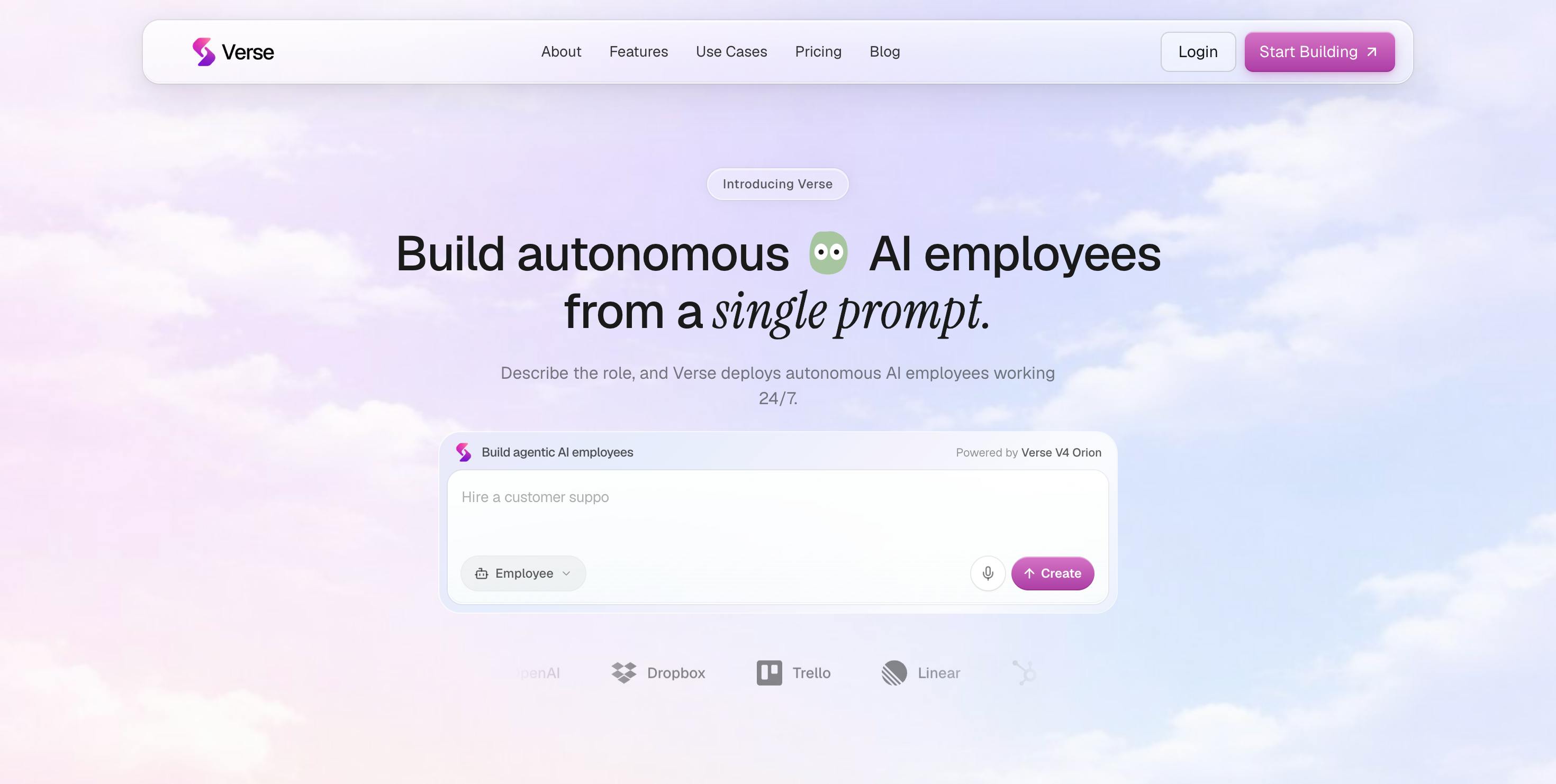
Verse: Autonomous AI Employees from a Prompt
Verse has launched a new platform designed to create and deploy autonomous AI employees. The core innovation lies in its ability to generate these AI agents from a single, natural language prompt. This approach aims to democratize the creation of specialized AI assistants, allowing users to define tasks, roles, and desired outcomes without deep technical expertise.
The platform positions these AI entities as 'employees,' suggesting a framework for managing, delegating, and potentially overseeing their work. This metaphor implies a level of agency and operational capability beyond simple chatbots or task-specific scripts. Users can theoretically describe the AI's function, its interaction style, and the goals it should achieve, and Verse's system would then construct and instantiate the AI employee to fulfill that request.
This move taps into the growing demand for AI agents that can operate with a degree of independence. While many AI tools exist for specific functions like writing, coding, or data analysis, Verse's proposition is to integrate these capabilities into a more holistic, employee-like structure. Imagine needing an AI to manage your social media, respond to customer inquiries, and generate weekly reports. Instead of stitching together multiple tools or writing custom scripts, a user could theoretically prompt Verse to create an 'AI Social Media Manager and Customer Support Specialist' that handles all these duties.
The underlying technology likely involves advanced natural language processing for prompt interpretation, sophisticated agent orchestration frameworks, and potentially the integration of various large language models (LLMs) or specialized AI modules. The 'single prompt' aspect suggests a powerful abstraction layer that translates user intent into actionable AI configurations. This is akin to giving a new hire a job description and expecting them to figure out the tools and processes needed to succeed.
Potential Applications and User Scenarios
The implications for businesses and individuals are significant. For startups and small businesses with limited resources, Verse could offer an affordable way to augment their workforce. An AI employee could handle repetitive administrative tasks, conduct market research, draft initial legal documents, or even act as a virtual assistant for busy founders. For larger enterprises, it could accelerate the deployment of specialized AI capabilities within specific departments, allowing for rapid prototyping of AI-driven workflows.
Developers might use Verse to quickly spin up AI agents for testing purposes, for example, an AI that can parse log files and identify common errors. Content creators could employ AI employees to assist with content ideation, drafting initial blog posts, or summarizing research papers. The platform's promise of 'hiring' these AI employees suggests a scalable and on-demand model, where AI resources can be provisioned as needed.
The 'autonomous' nature implies that these AI employees are designed to operate with minimal human intervention once deployed. They would ideally be able to plan their own sub-tasks, adapt to changing circumstances, and learn from their experiences to improve performance over time. This level of autonomy is a key differentiator from traditional AI tools that require constant input and guidance.
One of the most compelling aspects is the potential to reduce the complexity associated with deploying AI. Instead of navigating intricate APIs, managing infrastructure, and fine-tuning models, users can focus on defining the desired outcome through natural language. This lowers the barrier to entry for leveraging advanced AI capabilities. It’s like having a highly skilled but incredibly obedient intern who understands complex instructions immediately.
Challenges and Future Outlook
However, the success of Verse will hinge on several factors. The accuracy and reliability of the AI employees generated from a single prompt are paramount. Misinterpretations of user intent could lead to inefficient or even counterproductive AI agents. Ensuring robust security and privacy for the data these AI employees process will also be critical, especially when handling sensitive business information.
The 'hiring' metaphor also raises questions about the operational model. Will there be subscription tiers based on the complexity or number of AI employees? How will Verse handle updates, maintenance, and performance monitoring of these autonomous agents? These are questions that will likely be addressed as the platform matures and its user base grows.
Furthermore, the long-term implications for the job market are a subject of ongoing debate. While Verse aims to augment human capabilities, the increasing sophistication of autonomous AI employees could, in some sectors, lead to a displacement of human roles. The company's stated goal is to build and hire, suggesting a focus on collaboration rather than replacement, but the broader societal impact remains a significant consideration.
Verse's entry into the market signals a significant step towards making advanced AI more accessible and integrated into daily workflows. The ability to create and deploy autonomous AI employees from a simple prompt could redefine how individuals and organizations leverage artificial intelligence, moving from discrete tools to more comprehensive, agent-based solutions.