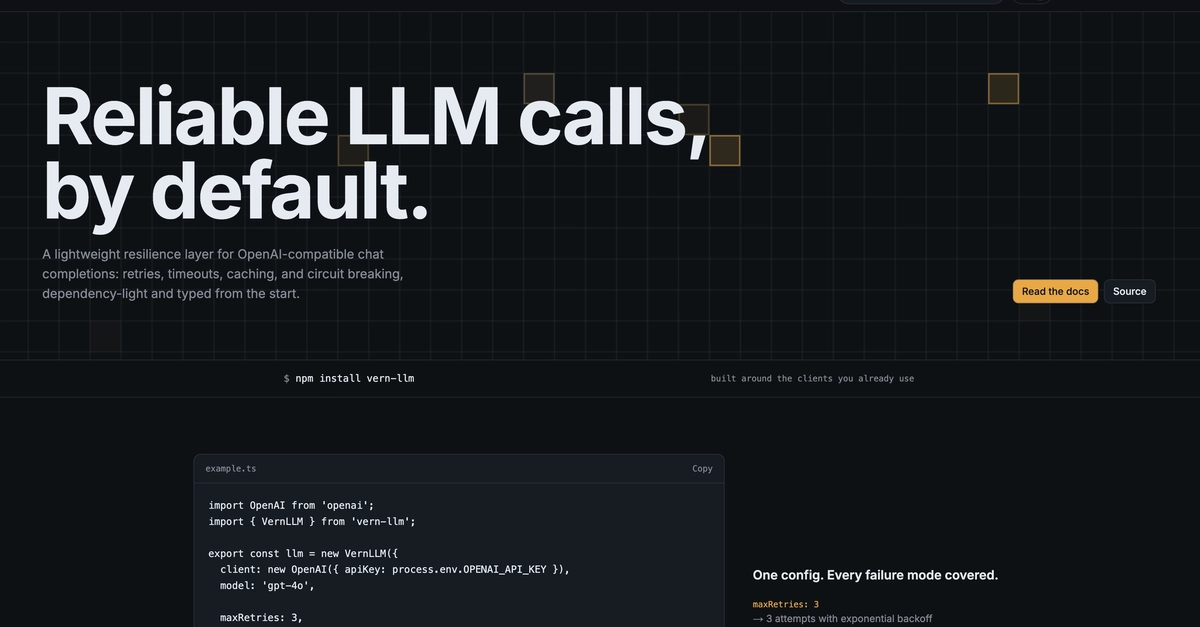
Introducing VernLLM: A Resilience Layer for LLM Applications
Building production-ready LLM applications involves more than simply sending prompts and receiving responses. Real-world AI systems must contend with timeouts, provider failures, rate limits, inconsistent outputs, and general reliability issues. Developers often spend significant time implementing these essential resilience features from scratch for each project.
VernLLM addresses this challenge directly. It is a lightweight resilience layer designed for OpenAI-compatible chat completion APIs. The tool provides a unified interface that incorporates built-in mechanisms for automatic retries, timeouts, circuit breaking, caching, structured output generation, and usage tracking. By abstracting these complexities, vernLLM empowers developers to create more robust AI integrations from the outset without reinventing the wheel.
The core philosophy behind vernLLM is to provide a battle-tested set of reliability patterns that are commonly required when integrating with LLM providers. This allows development teams to focus on the unique aspects of their application's logic rather than the plumbing required to keep it running smoothly under various conditions.
Key Features for Robust LLM Integrations
VernLLM bundles several critical features designed to enhance the stability and predictability of LLM interactions:
Automatic Retries with Exponential Backoff
Transient network glitches and temporary API unavailability are common. VernLLM automatically retries requests that encounter recoverable errors. Crucially, it employs an exponential backoff strategy, meaning the delay between retries increases with each failed attempt. This prevents overwhelming the API provider with rapid, successive requests and gives the service time to recover. The system is designed to fail fast on validation errors or other non-retryable issues, ensuring that developers are immediately aware of fundamental problems rather than waiting for repeated retries.
Configurable Timeouts
LLM API calls can sometimes take an unpredictable amount of time to complete, especially under heavy load. VernLLM allows developers to configure specific timeouts for requests. If an API call exceeds this duration, vernLLM will automatically abort the request and treat it as a failure, preventing indefinite waits and freeing up application resources. This is essential for maintaining application responsiveness and preventing resource exhaustion.
Circuit Breaking
When an API consistently fails, continuing to send requests can be counterproductive and harmful to the application's performance and the provider's stability. VernLLM implements a circuit breaker pattern. After a configurable number of failures within a given time window, the circuit breaker 'opens,' immediately failing subsequent requests without even attempting to call the API. This gives the downstream service a chance to recover and prevents cascading failures within the application. The circuit breaker can be configured to periodically allow a test request to see if the service has returned to a healthy state, at which point it 'closes' again.
Caching
Repeatedly querying an LLM for the same input can be costly and inefficient. VernLLM includes a caching mechanism. If a request with identical parameters has been made recently and the response is still valid (based on configurable cache expiration policies), vernLLM will return the cached response instead of making a new API call. This significantly reduces latency, lowers costs, and decreases the load on the LLM provider. Developers can configure cache storage (e.g., in-memory, Redis) and TTL (Time To Live) settings.
Structured Output
LLM outputs are often freeform text, which can be challenging to parse reliably. VernLLM assists in obtaining structured data, such as JSON, from LLM responses. It can be configured with schemas or Pydantic models, guiding the LLM to produce output that conforms to the specified structure. This feature greatly simplifies data processing and integration with other parts of an application, reducing the need for complex post-processing and error handling of text outputs.
Usage Tracking
Monitoring LLM usage is critical for cost management and performance analysis. VernLLM provides built-in usage tracking, logging details about each request, including token counts, latency, and success/failure status. This data can be invaluable for identifying usage patterns, optimizing prompt engineering, and forecasting costs. The tracking can be configured to export data to various backends for further analysis.
Developer Experience and Integration
VernLLM is designed to be a lightweight addition to existing projects. It aims to minimize the learning curve and integration effort. The library provides a clear, Pythonic interface that abstracts away the complexities of the underlying LLM API calls. Developers can integrate vernLLM by simply wrapping their existing OpenAI client calls with the vernLLM layer. Configuration is managed through simple Python objects, allowing fine-tuning of retry strategies, timeout durations, and caching policies.
The library is built with extensibility in mind. While it provides sensible defaults for most common scenarios, advanced users can customize various aspects of its behavior, such as defining custom retry conditions or integrating with different caching backends. This flexibility ensures that vernLLM can adapt to a wide range of application requirements and deployment environments.
The Need for Resilience in LLM Applications
The rise of Large Language Models has opened up new possibilities for application development. However, the inherent nature of these models and the network infrastructure they rely on introduce new failure modes. Unlike traditional deterministic software, LLM outputs can vary, and API providers are subject to external factors that can cause downtime or degraded performance.
Consider an e-commerce chatbot that needs to retrieve product information or process an order. If the LLM API times out or returns an inconsistent response, the user experience suffers, potentially leading to lost sales or customer frustration. A system that automatically retries requests, handles timeouts gracefully, and caches common queries ensures a smoother, more reliable interaction.
VernLLM provides these essential safeguards. It acts as a buffer, absorbing the variability and unreliability of external LLM services, and presenting a more stable and predictable interface to the rest of the application. This allows developers to build applications that are not only intelligent but also dependable.
Future Implications
As LLM adoption continues to grow, the demand for robust and resilient infrastructure will only increase. Tools like vernLLM are crucial for enabling the widespread deployment of AI-powered features in critical applications. The success of vernLLM could pave the way for similar resilience layers for other AI model providers and diverse AI workloads. The focus on making LLM integrations more production-ready is a significant step towards realizing the full potential of generative AI in enterprise and consumer products.