The Persistent Scar of Schema Versioning in AI Chat Templates
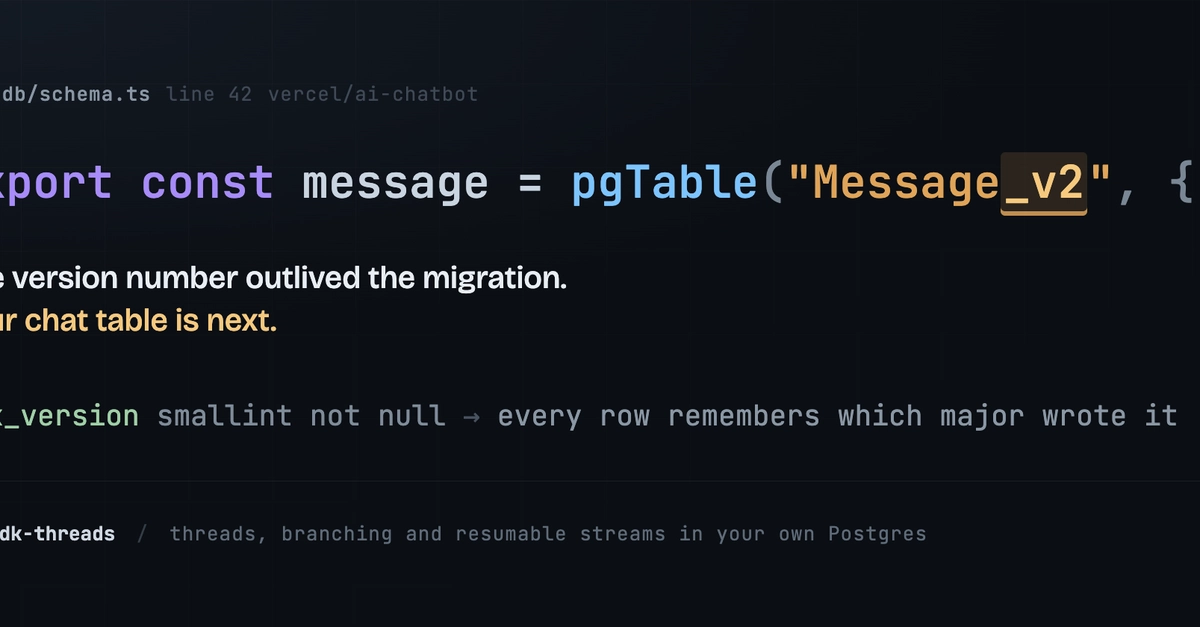
Developers working with Vercel's popular ai-chatbot template face a recurring database schema challenge: tables are perpetually marked with version numbers. Opening the schema definition file, typically lib/db/schema.ts, reveals table names like Message_v2 and Vote_v2. This _v2 suffix isn't a temporary marker; it represents a fundamental design choice that becomes a permanent fixture in any project forked from the template.
The root cause lies in how the template handles changes to the message shape, often triggered by updates to underlying AI models or SDKs. When a significant alteration occurs, such as a change in the message structure requiring a new format, the developers behind the template opted for a strategy of creating new tables with versioned names rather than attempting an in-place migration of existing data. This approach, while pragmatic for immediate development and deployment, leaves a lasting imprint on the database schema.
Consider the lifecycle of such a change. When the AI model dictates a new message format, the template doesn't just alter the Message table. Instead, it introduces Message_v2. Data from the original Message table is then backfilled into Message_v2. The old Message table might be temporarily retained for a transition period, but the eventual goal is to deprecate and delete it. However, the new table's name, Message_v2, remains. This process repeats with subsequent significant changes, leading to tables like Message_v3, Message_v4, and so on. Each new version becomes a permanent, albeit redundant, naming convention.
The problem isn't just aesthetic. For developers inheriting this template, these versioned table names represent a form of technical debt. Each _vX suffix is a reminder of past migrations, a scar on the database schema that can complicate future database management, querying, and understanding. While the data from older versions is eventually purged, the naming convention persists in the schema definition itself. This means that every new project initiated from this template begins with this seemingly arbitrary versioning baked into its database structure.
The migration process, as experienced by developers who have performed it manually, can be tedious. It involves not only creating the new table structure but also meticulously copying and verifying data from the old table to the new one. Then comes the critical step of updating all application logic to point to the new table and, finally, dropping the obsolete old table. While the template aims to abstract these complexities, the underlying schema design choice means that the 'version' is hardcoded into the table names, a permanent record of past schema evolution.
Why This Naming Convention Persists
The persistence of versioned table names like Message_v2 is a direct consequence of prioritizing rapid development and deployment over long-term schema elegance. When a new AI model or SDK version introduces breaking changes to data structures, the simplest and fastest path to get the application working again is to create a new table with a distinct name. This avoids the complexities and potential downtime associated with in-place schema migrations, which can be particularly challenging with live data.
Think of it like this: if you're building a house and discover the plumbing needs a complete overhaul halfway through construction, you could either painstakingly rip out and replace every pipe, risking structural damage and significant delays, or you could run a new set of pipes alongside the old ones, cap off the old system, and deal with the 'dual plumbing' for a while. The latter is faster in the short term, but you're left with a more complex and harder-to-maintain system. The _v2 naming convention in the AI SDK template is analogous to this second, faster but more complex, approach.
The ai-chatbot template, being a starter kit designed to get developers up and running quickly, naturally leans towards solutions that minimize initial friction. The versioned table names are an artifact of this design philosophy. While Vercel's team likely intended for these version numbers to be removed or for the template to be updated to cleaner schema definitions in later iterations, the reality is that forked projects retain these names. This creates a situation where every new project inherits a schema that reflects past, now-resolved, migration issues.
What remains unaddressed is the long-term impact on developer experience and database maintainability. While the immediate development velocity is maintained, future developers working on these projects may spend unnecessary time deciphering the purpose of _v2 or _v3 tables, understanding their relationship to current data, and ensuring that queries are correctly directed. This can lead to subtle bugs or performance issues if not managed carefully. The template could perhaps introduce a mechanism to automatically clean up or alias these versioned tables after a certain period, or provide clearer guidance on how to manage schema evolution post-forking, but for now, the scars remain.