The Workflow Problem in API Interactions
For years, API clients have focused on a fundamental, yet often simple, task: sending an HTTP request and displaying the response. This core functionality is now largely a solved problem. However, the real challenge emerges when developers grapple with dozens or hundreds of API requests that are not independent but intricately linked, forming a complex chain of operations. A typical real-world API interaction rarely resembles a single GET request. Instead, it often looks like a multi-step process: logging in, obtaining an authentication token, retrieving a list of resources, creating a new resource, extracting its identifier, updating it, and finally, deleting it. At this level of complexity, API testing transcends mere request-response verification and transforms into a sophisticated workflow management problem. This is the precise challenge API Hero aims to address.
Why API Hero Focuses on Workflows
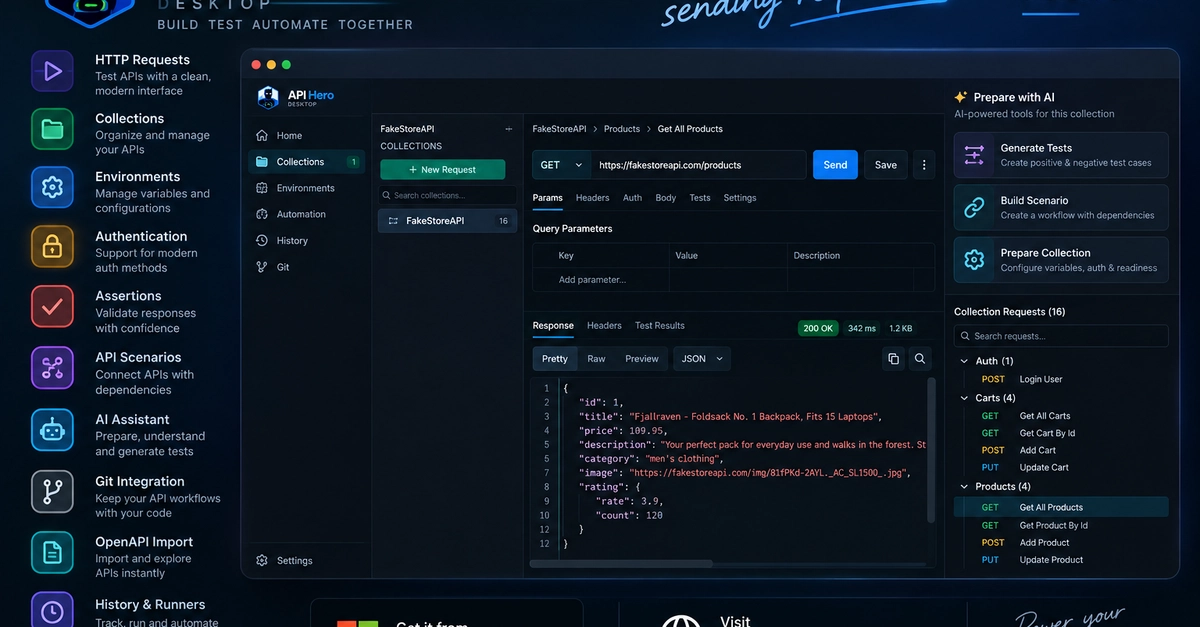
API Hero is built on the premise that understanding and managing individual API requests is only the first step. The true power lies in orchestrating these requests into coherent, executable workflows. This involves more than just sequencing calls; it requires handling dependencies between requests, managing authentication across multiple steps, utilizing variables to pass data dynamically, and implementing robust testing and automation strategies. The platform aims to provide a unified environment where developers can define, execute, and debug these complex API interactions efficiently. By abstracting away the boilerplate code and complex logic often associated with workflow management, API Hero allows developers to focus on the business logic and the desired outcome of their API integrations.
Connecting the Dots: Key Features of API Hero
API Hero integrates several critical components to facilitate executable API workflows. It allows users to connect disparate API collections, ensuring that data and context flow seamlessly between them. Dependency management is a core feature, enabling the definition of execution order and prerequisites for each step in a workflow. Authentication is handled comprehensively, supporting various methods and token management across multiple requests. Variables play a crucial role, allowing dynamic values to be injected into requests, making workflows reusable and adaptable. Furthermore, API Hero incorporates robust testing capabilities directly into the workflow, enabling validation at each stage. Automation is a natural extension of this workflow-centric approach, allowing for the scheduling and automated execution of complex API sequences. The platform also leverages AI-assisted features to help developers build, optimize, and understand their API workflows more effectively, moving beyond simple request execution to intelligent process automation.
The Evolution of API Clients
The evolution of API clients mirrors the increasing complexity of modern software development. Initially, clients were basic tools for making simple requests and inspecting responses. As APIs became more sophisticated and integrated into larger systems, the need for more advanced features grew. Tools like Postman emerged, offering features such as collections, environments, and basic scripting. However, managing truly complex, multi-step interactions with dynamic data flow and conditional logic remained a significant hurdle. API Hero positions itself as the next step in this evolution, directly addressing the workflow orchestration problem. It moves beyond the client-server request-response paradigm to treat API interactions as programmable processes. This shift is crucial for developers building microservices, integrating third-party services, or automating complex business processes that rely heavily on API communication.
AI's Role in Workflow Optimization
The integration of AI into API Hero signifies a move towards more intelligent and automated API development and management. AI-assisted features can help in several ways. For instance, AI can analyze existing API call patterns to suggest potential workflow optimizations or identify redundant requests. It can also assist in generating test cases based on workflow definitions, ensuring better coverage and accuracy. AI can even help in debugging by analyzing error patterns and suggesting potential root causes within a complex workflow. This intelligent assistance reduces the manual effort required to build and maintain intricate API interactions, making the development process faster and more reliable. The aim is to make building and managing executable API workflows as intuitive as possible, even for highly complex scenarios, by providing smart suggestions and automation capabilities.
The Future of API Workflow Management
API Hero is carving out a niche by focusing on the often-overlooked complexity of API workflows. As applications become more distributed and reliant on inter-service communication, the ability to manage these interactions effectively becomes paramount. The platform's emphasis on treating API calls as executable workflows, complete with dependencies, variables, and integrated testing, addresses a critical need in the developer community. By abstracting the intricacies of workflow orchestration, API Hero empowers developers to build more robust, automated, and intelligent API-driven systems. The future of API management will likely see a greater emphasis on these workflow capabilities, moving beyond simple request execution to comprehensive process automation and orchestration.