The Two Faces of VAT Validation
When a user asks if a VAT number is valid, there are two fundamental questions that need answering. The first is about the number's structure: does it conform to the expected format for a given country? This involves checking prefixes, length, and character patterns. The second, more involved question, is whether the number is actually registered and active in the relevant European registry. This requires a real-time query to systems like the EU's VIES registry and can provide additional information, such as the associated company name.
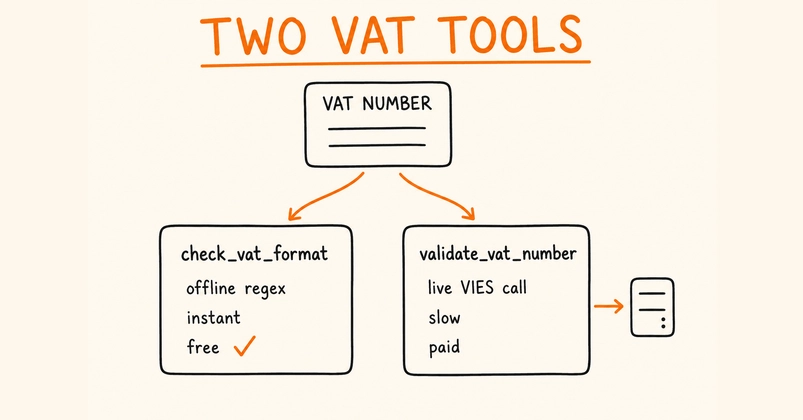
Iurii Rogulia, building the MCP server for vatnode, a VAT-validation SaaS, faced a critical API design decision early on: should these two distinct checks be presented as a single tool or as separate entities? His conclusion: they are fundamentally different operations, each serving a unique purpose. Thus, vatnode-mcp was designed with two distinct functions: check_vat_format and validate_vat_number.
This separation isn't merely an academic exercise in API design; it has practical implications for how developers build and integrate VAT validation into their applications. A format check is fast, free, and can be performed entirely client-side or on a low-resource server. It acts as a crucial first-pass filter, catching obvious errors before any external calls are made. Think of it like a bouncer at a club checking everyone's ID for a valid date and photo before letting them in. It’s a quick, preliminary check.
check_vat_format: The Quick Filter
The check_vat_format function is designed for speed and efficiency. It operates on the inherent structure of VAT numbers. Each EU member state has specific rules for the format of its VAT identification numbers. These rules dictate the required prefix (usually the country code), the total number of characters, and the types of characters allowed (e.g., alphanumeric, numeric only). By implementing a series of regular expressions and length checks tailored to each country's specifications, this function can immediately determine if a given string *could* be a valid VAT number for that jurisdiction.
This initial check is invaluable for user interfaces and data entry forms. It provides instant feedback to users, preventing them from submitting malformed data. For instance, if a user enters a 10-digit number where an 11-digit number is expected, or a number starting with an invalid country code, check_vat_format can flag it immediately. This reduces the load on backend systems and improves the user experience by catching errors at the source. It’s akin to spell-check for your VAT numbers; it catches typos and structural mistakes without needing to consult an external dictionary.
validate_vat_number: The Definitive Answer
The validate_vat_number function, on the other hand, goes deeper. It performs the crucial step of verifying the VAT number's actual existence and validity within the official EU VIES (VAT Information Exchange System) registry. This is not a trivial task. It requires making a secure, real-time API call to the VIES service, which is maintained by the European Commission and national tax authorities. This process incurs a cost, both in terms of server resources and potential API usage fees, and is inherently slower than a simple format check.
When validate_vat_number is called, it sends the VAT number to the VIES system. The VIES system then queries the relevant national database to confirm if the number is registered and associated with an active business entity. The response from VIES typically includes a confirmation of validity and, importantly, the name of the registered company. This information is vital for businesses engaged in cross-border transactions within the EU, as it helps prevent fraud, ensures compliance with tax regulations (like the reverse-charge mechanism), and verifies the legitimacy of trading partners.
The surprising detail here is not the complexity of the VIES system itself, but how often developers might overlook the need for this second, definitive validation step. Many might assume a format check is sufficient, only to discover later that a number that *looks* correct is not actually active or legitimate, leading to compliance issues or financial losses.
Why the Separation Matters
Rogulia's decision to split these functions is rooted in good API design principles. Presenting them as two separate tools offers several advantages:
- Clarity: Developers understand precisely what each function does. There's no ambiguity about whether a call to the tool will perform a quick format check or a full registry lookup.
- Performance Optimization: Applications can choose the appropriate level of validation based on their needs and context. A form validation might only need
check_vat_formatfor immediate feedback, while a critical transaction might require the fullvalidate_vat_number. - Cost Management: Live VIES lookups cost money and consume resources. By separating them, developers can ensure these more expensive checks are only performed when absolutely necessary, preventing unnecessary expenditure.
- Flexibility: Developers can build their own multi-stage validation logic. They might first use
check_vat_format, and if it passes, then prompt the user to confirm proceeding with the more resource-intensivevalidate_vat_number.
This approach treats VAT validation not as a single monolithic task, but as a tiered process. It acknowledges that sometimes you just need to know if a string *looks* like a valid VAT number, and other times you need irrefutable proof from the official source. If you run a system that handles cross-border EU transactions, understanding this distinction is crucial for building robust, efficient, and compliant processes.