Valkey 9.1's Hash Field TTL: A Memory Hefty Trade-off
Valkey 9.0 introduced a significant capability: the ability to set an expiration time (TTL) on individual fields within a hash, rather than applying it to the entire hash key. Valkey 9.1 further refined this with the introduction of HSETEX, a command designed to set a field and its expiry in a single network round trip. This feature, while seemingly convenient, carries a substantial memory cost, as demonstrated by recent benchmarks.
The primary use case highlighted by Valkey's own documentation involves scenarios like per-user authentication tokens. The example provided is:
HSETEX user:123 EX 900 FIELDS 1 auth_token "eyJhbGciOiJ..."
This pattern appears to be a direct, more efficient replacement for the traditional approach of setting a separate key for each token, such as:
SET user:123:auth_token "..." EX 900
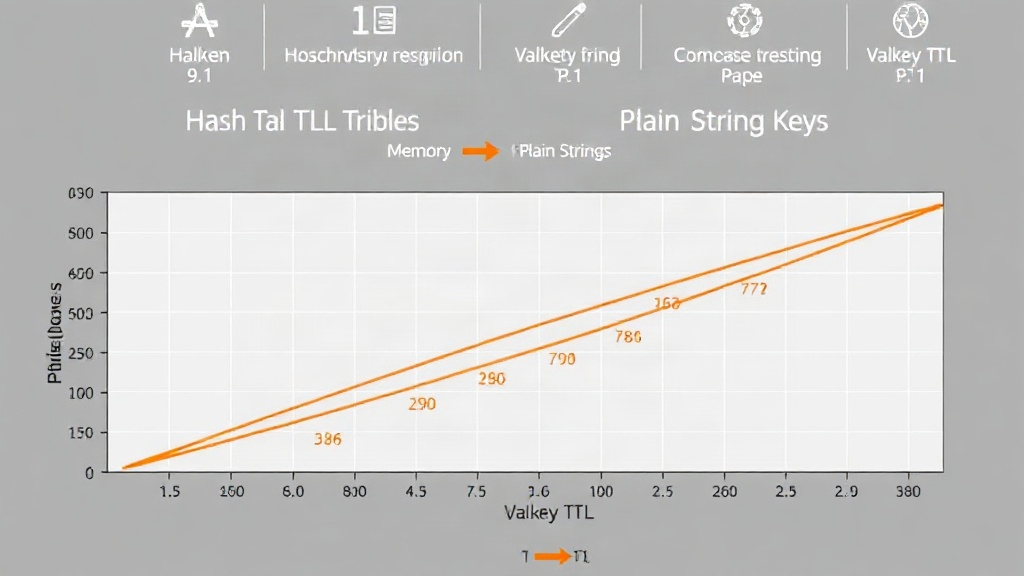
However, empirical testing reveals a stark difference in resource consumption. Running both patterns with 20,000 keys and measuring memory usage via the INFO memory command on Valkey 9.1.2 showed that the hash-based approach consumed three times as much RAM as the plain string key-value pairs.
Benchmarking Methodology
The tests were conducted on Valkey 9.1.2 running within a Docker container on a single host. The setup was intentionally straightforward to isolate the impact of the new feature. Two distinct data structures were populated with 20,000 keys each:
- Pattern 1 (Hash Field TTL): For each of the 20,000 keys, a single field was set using the
HSETEXcommand with a specified TTL. For instance, a key likeuser:Xwould have a fieldauth_tokenwith a value and an expiry of 900 seconds. - Pattern 2 (Plain String Key): For each of the 20,000 entries, a separate key was created. This key would follow the convention
user:X:auth_token, storing the token value and applying the TTL directly to this key.
After populating both datasets, the INFO memory command was executed to retrieve detailed memory usage statistics. The results consistently indicated that the hash-based approach, despite its perceived convenience, required significantly more memory.
Understanding the Memory Discrepancy
The significant memory overhead associated with Valkey's hash field TTL feature stems from its internal implementation. Unlike traditional string keys, where the key name and value are stored directly, hashes require a more complex data structure. Each hash key internally manages a collection of field-value pairs. When a TTL is applied to a single field within a hash, Valkey must maintain additional metadata for that specific field, including its expiration timestamp and potentially other internal tracking mechanisms.
Consider a single key-value pair like SET mykey myvalue EX 900. Here, Valkey stores the key string "mykey", the value string "myvalue", and the expiration timestamp. The overhead is relatively contained.
Now, consider the hash equivalent, HSETEX myhash field1 value1 EX 900. Internally, Valkey needs to store the hash key string "myhash", the field string "field1", the value string "value1", and the expiration timestamp for "field1". Furthermore, the hash data structure itself introduces overhead for managing multiple fields, even if only one is present. This includes internal pointers, hash table structures for field lookup, and potentially other management data.
The multiplication of this overhead across 20,000 keys, each with a TTL-enabled field, leads to the observed tripling of memory usage. The new feature essentially requires Valkey to store more metadata per logical data point compared to the simpler, flat key-value structure.
Implications for Developers and Architects
The introduction of per-field TTLs in Valkey hashes offers a more granular control over data expiration, which can be appealing for certain use cases. However, the substantial memory implications cannot be ignored. Developers and system architects must carefully weigh the benefits of this feature against its cost.
For applications that require fine-grained expiration of individual items within a larger set of data, and where memory is not a critical constraint, HSETEX might be a viable option. This could include scenarios where different attributes of a user profile have varying lifespans, and managing them as individual keys would become unwieldy.
Conversely, for applications that prioritize memory efficiency, especially those dealing with a very large number of short-lived data points, the traditional approach of using separate keys for time-sensitive data remains the more prudent choice. The tripling of memory use is a significant penalty that could lead to increased infrastructure costs and performance issues if not carefully considered. It is crucial to benchmark this feature within your specific workload and environment before adopting it widely.
The pattern shown in Valkey's own documentation, while illustrative of the feature's capability, inadvertently highlights a significant performance trade-off. This raises the question of whether the convenience of a single command and a consolidated data structure outweighs the substantial increase in resource consumption for common use cases like session tokens.
Broader Context and Future Considerations
This finding underscores a recurring theme in database and caching systems: the trade-off between feature richness and resource efficiency. As systems evolve to offer more complex functionalities, understanding their underlying resource implications becomes paramount. The Valkey team has provided a powerful new tool, but its effective deployment requires a deep understanding of its memory characteristics.
Users of Valkey should pay close attention to the memory footprint of their data structures. The INFO memory command, along with profiling tools, will be essential for monitoring and optimizing resource usage. It is possible that future versions of Valkey might introduce optimizations for this feature, but for now, the current implementation demands careful consideration.
The surprise here is not that new features consume resources, but the magnitude of the increase—a tripling of memory for a pattern that mirrors a common, memory-efficient alternative. This serves as a potent reminder that abstraction layers, while convenient, can mask significant underlying costs.