The Illusion of the Database as a Data Fortress
Many development teams treat their databases as the ultimate arbiter of data integrity. The assumption is that once data is inside the database, it's clean, structured, and reliable. This perspective, however, is a dangerous fallacy. By the time data reaches the database, significant problems may have already occurred, leading to inefficient fixes and cascading issues across applications, billing systems, and customer management platforms. The database should not be the first line of defense; it should be the last.
Consider the common scenario of collecting customer addresses. A user might input an incomplete street name, a misspelled city, an incorrect ZIP code, or an outdated postal address. If the application accepts this data without immediate validation, a flawed record is created. This bad data then propagates. Imagine this incorrect address being used for shipping physical goods, sending invoices, or for targeted marketing campaigns. Each subsequent use of this flawed data incurs additional costs and effort to correct, not to mention the potential for customer dissatisfaction.
The Cost of Late-Stage Data Correction
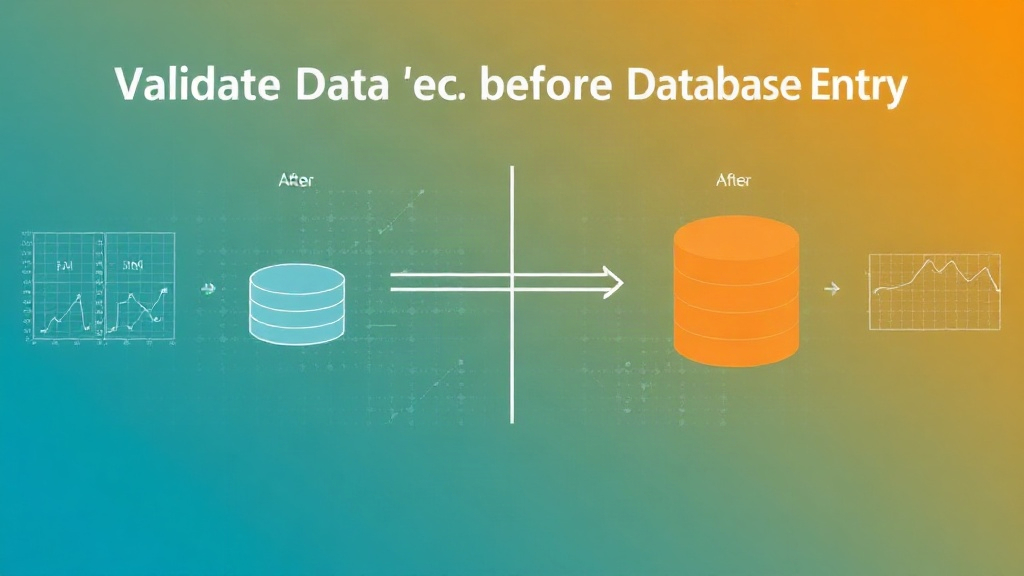
When data validation is deferred to the database layer, or worse, handled only after errors are discovered in downstream systems, the cost of correction escalates dramatically. This is because the data has already been processed, stored, and potentially used by multiple services.
1. Increased Development Effort: Developers must write complex queries or scripts to identify and rectify erroneous records. This takes time away from building new features. Furthermore, understanding the root cause of the bad data can be challenging, as it might have originated from various entry points or through complex user interactions.
2. System Complexity: If validation rules are embedded within the database (e.g., through triggers or stored procedures), it can make the database schema harder to understand and maintain. This tightly couples business logic to the database, reducing flexibility and making it harder to evolve the application.
3. Operational Overhead: Operations teams spend valuable time monitoring for data quality issues, running data cleansing jobs, and responding to alerts triggered by inconsistent or incomplete data. This is reactive, not proactive, management.
4. Business Impact: Inaccurate data can lead to direct financial losses through failed deliveries, incorrect billing, or wasted marketing spend. It can also damage customer trust and brand reputation, which are far harder to quantify but critically important.
Shifting Validation Left: The Proactive Approach
The principle of "shifting left" is well-established in software development, particularly in testing and security. Applying this to data validation means implementing checks as early as possible in the data lifecycle – ideally, at the point of data entry or ingestion.
1. User Interface (UI) Validation: This is the first line of defense. Using front-end JavaScript, HTML5 input types, and client-side validation libraries, developers can provide immediate feedback to users. For example, requiring a specific format for email addresses or phone numbers, or ensuring that required fields are not left blank. While not foolproof (users can disable JavaScript or bypass the UI), it catches the majority of simple errors and improves user experience by providing instant feedback.
2. Application-Level (API) Validation: Even with robust UI validation, data can be entered programmatically or through APIs. Therefore, server-side validation is crucial. When data arrives at the application's backend, it should be thoroughly checked against defined business rules. This includes:
- Format and Type Checks: Ensuring data types are correct (e.g., numbers for numeric fields, dates for date fields) and adhere to expected formats (e.g., ISO 8601 for dates, specific patterns for IDs).
- Range and Value Checks: Verifying that numeric values fall within acceptable ranges (e.g., age must be positive and below a reasonable maximum) and that categorical data exists within a predefined set of allowed values.
- Cross-Field Validation: Checking relationships between different fields. For instance, ensuring that a delivery date is not before an order date, or that a discount code is valid for the items in the cart.
- Business Rule Enforcement: Implementing complex logic that reflects specific business requirements. This could involve checking against external services (e.g., validating an address with a postal service API) or complex internal rules.
This server-side validation acts as a gatekeeper. If data fails these checks, it is rejected, and an informative error message is returned to the source. This prevents bad data from ever reaching the database.
Beyond Basic Checks: The Power of Contextual Validation
Effective data validation goes beyond simple format checks. It requires understanding the context in which the data will be used.
Address Validation Example: As mentioned, address data is notoriously difficult to standardize. A robust validation system would not just check if a ZIP code is a valid format but would attempt to verify its existence and association with a real street and city. Services like USPS Address Validation API or third-party geocoding services can confirm if an address is deliverable. This level of validation, performed before data hits the database, saves immense downstream costs related to shipping errors, failed communications, and marketing inefficiencies.
Financial Data: For financial applications, validating transaction amounts, account numbers, and currency codes is paramount. Ensuring that debits and credits balance, that account numbers conform to banking standards, and that currency conversions are applied correctly at the point of input can prevent catastrophic financial errors and regulatory issues.
Conclusion: Building Trust Through Proactive Data Quality
Treating the database as a data sanctuary, rather than a data repository, is a fundamental shift in approach. By implementing comprehensive validation logic at the earliest possible stage – the UI and application layers – organizations can significantly reduce the costs associated with data errors, improve system reliability, and build greater trust in their data assets. This proactive stance transforms data management from a reactive cleanup operation into a robust, quality-driven process, ultimately leading to better business outcomes.