Start with the DAG, Not the Slowest Query
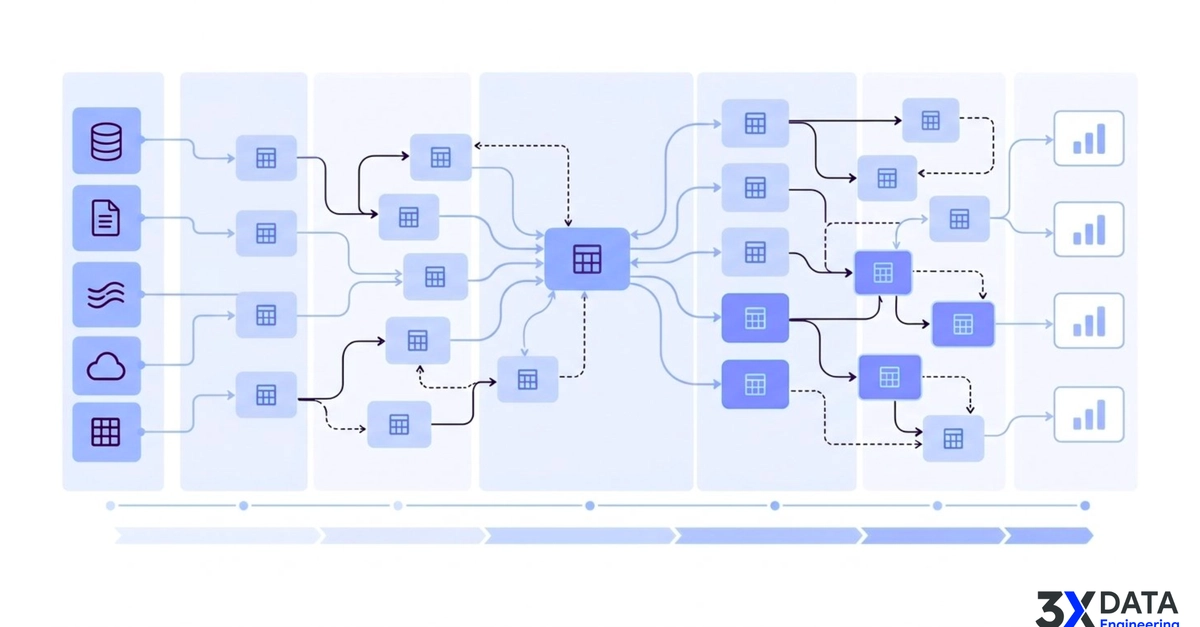
When a dbt project begins to exhibit slow model execution, the natural inclination is to identify the single model that takes the longest to complete and focus optimization efforts there. This approach, while intuitive, is often misguided and leads to inefficient resource allocation. The true bottleneck in a complex data pipeline is rarely a single, isolated slow query. Instead, it is often a confluence of dependencies and waiting times dictated by the Directed Acyclic Graph (DAG) of models. A model that runs quickly but has dozens of downstream dependents can halt an entire pipeline, making it a more critical optimization target than a long-running model with no subsequent processes depending on its output.
The DAG represents the lineage of data transformations within a dbt project. It visually maps how data flows from raw sources through various intermediate models to final data marts that power business intelligence tools and downstream applications. Understanding this graph is paramount because it reveals the ripple effect of a single model's performance. A model taking six minutes to run with forty downstream dependents creates a significant waiting period for all subsequent transformations. Conversely, a twenty-minute model with no dependents, while slow in isolation, does not impede the progress of any other part of the pipeline. Therefore, effective dbt optimization begins with a holistic view of the project's architecture, as represented by its DAG, to identify critical path dependencies and potential cascading delays.
Incremental Models: The Cornerstone of Performance
For projects dealing with large datasets or frequent data refreshes, incremental models are indispensable. Unlike full-refresh models that rebuild entire tables from scratch with every run, incremental models process only new or changed data since the last execution. This significantly reduces computation time and resource consumption, especially for tables that grow continuously. The core principle behind incremental models is to minimize the amount of data processed by leveraging a mechanism to identify and apply only the delta. This is typically achieved by defining a unique key or a timestamp column that dbt uses to determine which rows are new or have been updated.
Implementing incremental models correctly requires careful consideration of the data loading strategy and schema evolution. When setting up an incremental model, you define how dbt should handle new data. Common strategies include appending new rows, merging new and updated rows based on a unique key, or deleting and re-inserting records within a specific time window. The choice depends on the nature of the data and the desired outcome. For instance, if a record can be updated multiple times within a single batch, a merge strategy is often preferred. If historical accuracy of all states is not critical, and only the latest state matters, appending might suffice. The critical aspect is that dbt, during a subsequent run, will only query the source for data that has arrived since the last successful run, drastically cutting down on query times and warehouse costs. This selective processing is what makes incremental models a powerful tool for optimizing slow dbt models.
Query Performance Tuning within dbt
Beyond the architectural choice of incremental models, direct query performance tuning within individual dbt models is also crucial. This involves optimizing the SQL code itself, ensuring that queries are as efficient as possible. Common techniques include:
- Indexing and Partitioning: While dbt itself doesn't manage physical database structures, it orchestrates the creation and maintenance of tables and views. Ensuring that the underlying tables in your data warehouse are appropriately indexed and partitioned for the queries being run by dbt models is vital. This is often a database-level configuration, but dbt's materialization strategies can influence how these structures are leveraged.
- Selecting Only Necessary Columns: Avoid `SELECT *` statements. Explicitly list only the columns required for the transformation. This reduces I/O operations and the amount of data processed by the query engine.
- Efficient Joins: The type and structure of joins can have a dramatic impact on performance. Ensure that join conditions are on indexed columns and that the join type (e.g., INNER, LEFT, RIGHT) is appropriate for the desired outcome. Understanding the cardinality of your tables and using appropriate join strategies (e.g., broadcast joins for small tables) can significantly speed up execution.
- Filtering Early: Apply filters (`WHERE` clauses) as early as possible in the query. This reduces the number of rows that subsequent operations, such as aggregations or joins, need to process. Pushing down filters to the source tables whenever possible is a key optimization.
- Using Appropriate Aggregations: When performing aggregations, ensure that the grouping keys are well-chosen and that the aggregation functions are efficient. Sometimes, pre-aggregating data in earlier models can simplify later stages.
These SQL-level optimizations, when applied to models identified as critical by the DAG analysis, can yield substantial performance gains. It's about writing smarter SQL that leverages the capabilities of the underlying data warehouse.
Leveraging dbt Project Structure for Optimization
The way a dbt project is structured also plays a role in optimization. Organizing models logically, grouping related transformations, and using dbt's features like `ref()` and `source()` correctly ensures the DAG is well-defined and easy to understand. A well-structured project simplifies debugging and performance analysis. Teams should also consider the materialization strategy for each model. While incremental is often preferred for performance, `view` materializations can be useful for models that are simple transformations of other models and don't require materializing data. `table` materializations are for performance-critical final marts, and `ephemeral` models are useful for common subqueries that are inlined into parent models, effectively avoiding the creation of intermediate tables and reducing clutter in the database.
The decision of where to start optimizing dbt models is not arbitrary. It requires a systematic approach that prioritizes understanding the dependencies within the project. By starting with the DAG, identifying critical paths, and then applying the appropriate optimization techniques—primarily through the use of incremental models and efficient SQL—engineering teams can effectively tackle slow dbt models and ensure a performant data pipeline. This methodical approach moves beyond simply fixing the slowest query to building a resilient and efficient data transformation system.