The Illusion of Access: JWTs and Authorization Gaps
In modern web applications, JSON Web Tokens (JWTs) are a ubiquitous tool for managing user sessions and conveying authenticated identity. A valid JWT, signed and verified correctly, assures the server that the user presenting it is indeed who they claim to be. However, this authentication is only the first step in securing an application. The critical question that often lingers, and where security vulnerabilities hide, is: Can this authenticated user access this specific resource?
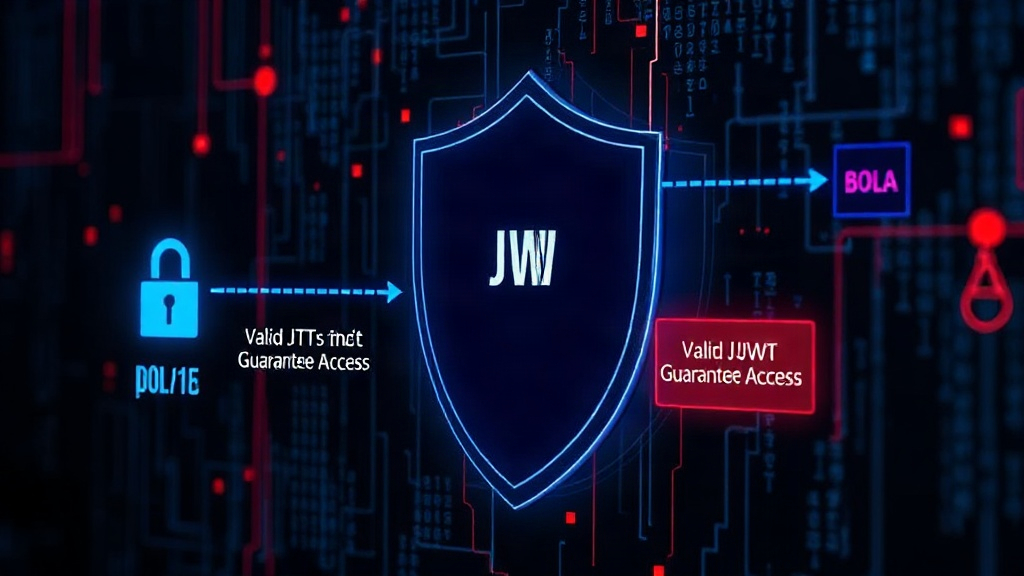
This distinction between authentication and authorization is paramount. A common pitfall, known as Broken Object Level Authorization (BOLA), arises when an application successfully verifies a JWT but fails to properly restrict access to the requested data based on the user's permissions. Imagine a scenario where User A creates a patient record (patient X). Later, User B logs in, receives a valid JWT, and attempts to access patient X by making a request like GET /patients/X. If the application's backend logic simply looks up the patient record using the provided patientId (X) without cross-referencing it with the authenticated user's identity (User B), User B might gain access to User A's sensitive patient data. User B is authenticated by their valid JWT, but they are certainly not authorized to view patient X.
Authorization Must Scope the Query
The fundamental principle being violated in BOLA is that authorization checks must be integrated into the data retrieval process, not just at the initial authentication stage. A valid JWT unequivocally establishes the identity of the requester. The application's access control layer must then leverage this identity to ensure that the requested resource is actually associated with or permissible by that specific user. This means that resource lookups should not rely solely on an identifier (like a patient ID or order ID) that could be guessed or manipulated. Instead, they must incorporate the authenticated user's context.
The correct approach involves combining the requested resource identifier with the authenticated user's identifier. For example, when retrieving patient X, the backend should perform a lookup that effectively translates to: 'Find patient record X for the currently logged-in user.' In code, this might look like:
// Simplified pseudo-code
function getPatient(patientId, currentUser) {
  // Instead of just: SELECT * FROM patients WHERE id = patientId
  // The query MUST be scoped:
  return db.patients.findUnique({
    where: {
      id: patientId,
      userId: currentUser.id // Crucial authorization check
    }
  });
}
This ensures that a user can only access resources they legitimately own or have been granted permission to view. The JWT provides the currentUser.id, but the application logic must be designed to use it effectively in every data access operation.
The Broader Landscape of Authorization Failures
BOLA is a subclass of broader authorization failures, which are consistently ranked among the top security risks for web applications. OWASP's Top 10 list frequently highlights broken access control as a critical vulnerability. These failures occur when restrictions on what authenticated users are allowed to do are not properly enforced. This can manifest in various ways:
- Function-level authorization failures: Users can perform actions they are not permitted to, such as an ordinary user accessing an administrator's panel.
- Role-based access control (RBAC) bypasses: Flaws in how roles are assigned or checked allow users to gain privileges beyond their assigned roles.
- Insecure direct object references (IDOR): Similar to BOLA, but often specifically refers to predictable identifiers being used in URLs or API parameters to access unauthorized objects.
The common thread is that the application trusts the client's input (including authenticated identity) too much and fails to perform sufficient server-side validation to ensure the user is *allowed* to perform the requested action on the specific object. The JWT's role is solely to confirm *who* the user is, not *what* they are allowed to do or see beyond their authenticated session.
Mitigation Strategies for Developers
Preventing BOLA requires a defense-in-depth approach to authorization, integrated deeply into the application's architecture. Developers must implement checks at multiple layers:
1. Scoped Resource Lookups
As previously detailed, every database query or data retrieval operation that accesses a specific object must include a condition that verifies ownership or explicit permission by the currently authenticated user. This is the most direct mitigation for BOLA.
2. Centralized Authorization Logic
Avoid scattering authorization checks throughout the codebase. Instead, implement a centralized authorization service or middleware that can be consistently applied to all API endpoints and sensitive operations. This makes it easier to manage, audit, and update access control policies.
3. Principle of Least Privilege
Grant users only the minimum permissions necessary to perform their intended tasks. This reduces the attack surface and limits the potential damage if an authorization bypass occurs.
4. Input Validation
While not a direct BOLA fix, robust input validation on all parameters, including resource identifiers, can help prevent malformed requests that might be used to probe for authorization weaknesses.
5. Regular Security Audits and Testing
Conduct thorough security reviews, including penetration testing specifically targeting access control vulnerabilities. Automated security scanning tools can also help identify potential issues.
The Unanswered Question: Legacy Systems and Migration
While implementing these measures for new development is crucial, what remains a significant challenge is the remediation of BOLA vulnerabilities in existing, large-scale legacy systems. Many older applications were not designed with granular, context-aware authorization from the outset. Retrofitting these checks without breaking existing functionality or introducing new vulnerabilities is a complex and resource-intensive undertaking. The cost of refactoring entire data access layers can be prohibitive, leading many organizations to accept a certain level of residual risk. What hasn't been adequately addressed is the development of practical, less disruptive strategies for auditing and migrating authorization logic in complex, mature codebases.
In conclusion, a valid JWT is a necessary but insufficient condition for granting access. Developers must remember that authentication confirms identity, but robust, context-aware authorization checks are what truly determine if a user is permitted to interact with a specific resource. Ignoring this fundamental principle leaves applications vulnerable to significant data breaches and unauthorized access.