
The V8 Engine's Secret Sauce: Dynamic Compilation
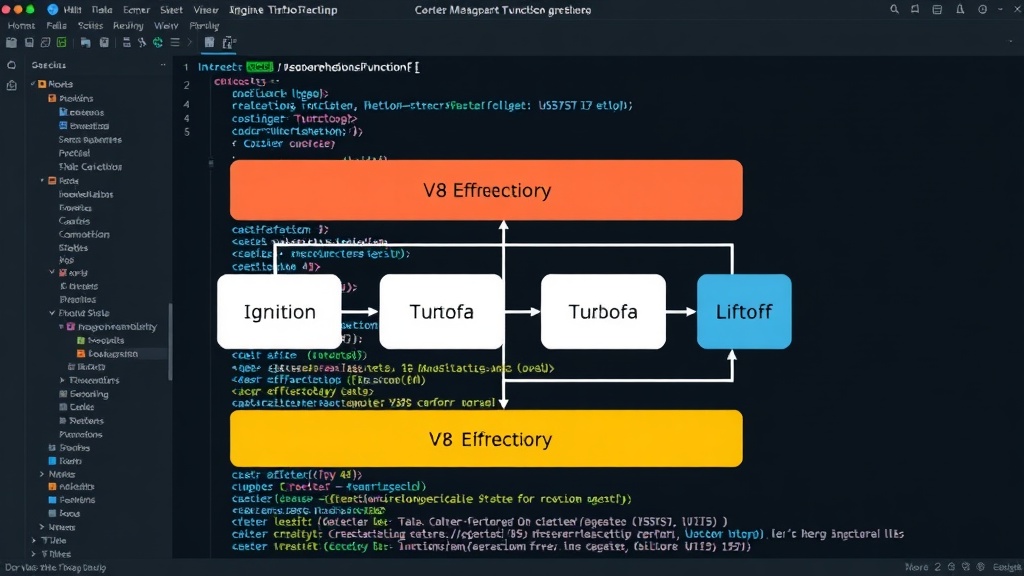
JavaScript, often perceived as a dynamically typed, flexible language, undergoes a radical transformation under the hood at runtime. The V8 engine, powering Chrome and Node.js, doesn't just interpret your code; it actively optimizes it. At its core, V8 employs a sophisticated multi-tiered compilation pipeline. This process begins with an interpreter that executes the code initially. As functions are called repeatedly, V8 identifies these 'hot' functions and compiles their corresponding bytecode into highly optimized native machine code. This is where the magic happens: turning flexible scripting into a performance powerhouse akin to statically typed languages.
Think of V8's optimization process like a seasoned chef preparing a complex dish. The initial cooking might be standard (interpretation). But for dishes ordered repeatedly, the chef develops a special, faster technique using precisely measured ingredients and specialized tools (optimized machine code). This specialized technique yields a much faster result. However, if a diner suddenly requests a variation with an unexpected ingredient (a different data type), the chef has to abandon the special technique and revert to the standard, slower method to accommodate the change. This disruption is analogous to V8's deoptimization.
The Peril of Type Instability: Deoptimization
The optimization V8 achieves is contingent on type stability. When a function consistently receives arguments of the same data types, V8 can generate machine code that makes specific assumptions about those types. This allows for aggressive optimizations, such as pre-allocating memory or using specialized processor instructions. However, JavaScript's dynamic nature means that a function optimized for numbers might suddenly receive strings, objects, or other types. When V8 encounters such a type mismatch within an optimized function, it cannot safely execute the specialized machine code. This triggers a process called deoptimization. V8 has to discard the optimized machine code and fall back to interpreting the bytecode. This switch-back is computationally expensive and significantly slows down execution. If a function is frequently deoptimized, it can enter a deoptimization loop, where it's repeatedly optimized and then deoptimized, leading to severe performance degradation. This is why maintaining type stability within your frequently called functions is paramount for achieving peak JavaScript performance.
Achieving Monomorphic Functions for Maximum Speed
The key to avoiding V8's deoptimization panic lies in ensuring your functions are 'monomorphic.' A monomorphic function is one that consistently operates on the same data types for its arguments and internal operations. For instance, a function that always adds two numbers is monomorphic. A function that sometimes adds numbers and sometimes concatenates strings (treating them as if they were numbers or strings based on input) is polymorphic or even megamorphic, and thus a prime candidate for deoptimization.
Developers can actively work towards creating monomorphic functions. This involves being mindful of how functions are called and what types of data they typically process. For example, if you have a function that handles user IDs, ensure you consistently pass numbers. If you later need to handle user IDs represented as strings, it might be more performant to create a separate function specifically for string IDs rather than trying to force the original numeric function to handle both. Similarly, when working with objects, ensure that objects passed to a function always have the same set of properties in the same order. This predictability allows V8 to perform its most aggressive optimizations, leading to faster execution speeds. The performance gains can be substantial, especially in performance-critical applications like game engines, real-time data processing, or complex UI frameworks.
Beyond Monomorphism: Other V8 Optimizations
While monomorphism is a critical concept for developers to grasp, V8 employs numerous other sophisticated techniques. Its pipeline includes the Ignition interpreter, which handles initial execution and generates bytecode, and the TurboFan optimizing compiler, which produces highly optimized machine code. Liftoff is another compiler that can quickly generate optimized code from bytecode, serving as an intermediate step before TurboFan takes over for more extensive optimization. V8 also employs techniques like inline caching, where it stores type information from previous calls to speed up property access. Garbage collection is another area of intense optimization, with V8 using generational garbage collection to efficiently manage memory. Understanding these underlying mechanisms, while complex, provides a deeper appreciation for how JavaScript can achieve remarkable performance levels.
The continuous evolution of the V8 engine means that best practices for optimization can shift. However, the fundamental principle remains: predictable code leads to predictable performance. By writing clear, type-stable JavaScript, developers can harness the full power of V8's optimization capabilities and deliver faster, more responsive applications.