Implementing Attack Montages in Unreal C++
This chapter of the Unreal C++ course focuses on the practical implementation of attack montages using both Blueprints and C++. Attack montages are a fundamental tool in game development for orchestrating complex character animations, particularly for combat sequences. They allow developers to synchronize animations, sound effects, and gameplay logic seamlessly.
The core of this implementation involves leveraging Unreal Engine's Animation Montage system. In C++, this translates to creating or referencing montage assets and triggering their playback through code. The process typically starts by defining a function within the character class, such as EchoAttack, which will be responsible for initiating the attack sequence.
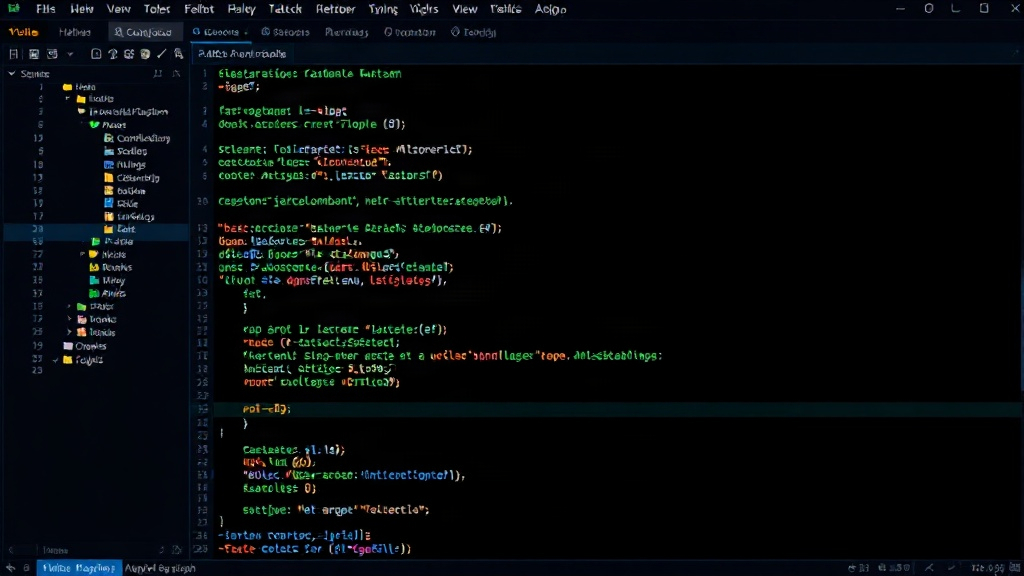
Within the EchoAttack function, developers can access the animation system to play a specific montage. This involves obtaining a pointer to the character's Skeletal Mesh Component, which manages the animation playback. From there, the PlayAnimMontage function is called, passing in the montage asset and any desired parameters like play rate or starting section.
The advantage of using montages over simple animation assets is their ability to embed specific events at different points in the animation timeline. These events, known as AnimNotifies, can trigger C++ functions or Blueprint events. For instance, a montage might have an AnimNotify at the point where a weapon strike should register damage, or another that plays a distinct sound effect. This event-driven approach provides fine-grained control over the timing of gameplay actions relative to the visual animation.
Character State Validation for Attacks
A critical aspect of implementing combat mechanics is ensuring that attacks are only performed under appropriate conditions. The source material highlights an important check: verifying if the character's state is "unequipped" before allowing an attack. This prevents players from attempting to attack when they have no weapon equipped, which would lead to nonsensical animations or gameplay errors.
This validation step is typically implemented as a conditional check at the beginning of the attack function. Before calling PlayAnimMontage, the code queries the character's current state. This state could be managed by an enum or a more complex state machine system. If the character is in a state where attacking is not permitted (e.g., unequipped, stunned, reloading), the function should simply return, preventing the montage from playing.
The implementation detail shown involves a check for an "unequipped" state. This suggests a robust system where different equipment slots or weapon types are tracked. When a character attempts an attack, the system first determines if they are currently holding a valid weapon. If not, the attack is aborted. This is a common pattern in action games to maintain logical consistency and prevent exploits.
This proactive validation is far more elegant than relying solely on AnimNotifies to handle invalid states. By checking the character's status upfront, the system avoids unnecessary animation playback and potential visual glitches. It’s a testament to the principle of failing fast and early in code execution.
Integrating Blueprints and C++
While the focus is on C++ implementation, the source mentions the straightforward use of Blueprints alongside C++. This reflects a common workflow in Unreal Engine development where C++ forms the backbone of core systems and logic, while Blueprints are used for rapid iteration, level design, and assembling gameplay elements. Attack montages are a prime example of this synergy.
A C++ function can be exposed to Blueprints, allowing designers to select and assign specific attack montages to characters or abilities. Conversely, Blueprint-driven events within a montage can call back into C++ functions to execute complex game logic that might be cumbersome to implement entirely in Blueprints. This hybrid approach offers the best of both worlds: the performance and power of C++ combined with the flexibility and accessibility of Blueprints.
The workflow likely involves creating a base C++ class for characters with the core attack logic and state management. Then, in the Unreal Editor, designers can create Blueprint classes that inherit from this C++ base. They can then assign different animation assets and montages to these Blueprint characters, customizing their combat behavior without touching C++ code. This modularity is key to managing large game projects efficiently.
Future Considerations: Advanced State Management
The author's note about getting ahead of themselves and anticipating the next lesson on character states hints at more advanced concepts. Beyond a simple "equipped" or "unequipped" status, real-world game characters often have intricate state machines governing their actions. These can include states like:
- Idle
- Walking/Running
- Jumping
- Attacking (with variations for light, heavy, special attacks)
- Blocking/Dodging
- Taking Damage
- Casting Spells
- Interacting with Objects
- Swimming
- Crouching
Each of these states may have its own set of rules regarding what actions are permissible. For instance, a character might only be able to initiate a block while in an Idle or Walking state, but not while already attacking or jumping. Implementing such a state machine, often using C++ enums, structs, or dedicated state pattern implementations, provides a robust foundation for complex character behavior.
The integration of attack montages with these advanced states becomes even more powerful. An attack montage might only be playable if the character is in an "Idle" or "Moving" state. Furthermore, the montage itself might transition the character into a new state, such as an "Attack Recovery" state, after the animation concludes. This interconnectedness is what brings game characters to life, allowing for believable and responsive interactions.
The approach detailed in chapters 114-115 provides a solid entry point into this complex domain. By mastering the fundamentals of attack montages and basic state validation, developers can build increasingly sophisticated character mechanics in Unreal Engine.