The Problem: Repeating Yourself to Your AI
Every regular Claude user eventually hits the same wall: a workflow they repeat every week — the way they want release notes written, code reviewed, or research briefs formatted — that they have to re-explain in every single session. You paste the checklist again. You correct the format again. You watch the agent improvise the steps you already decided. The knowledge exists, but it lives nowhere the agent can reliably find it. This inefficiency is a drag on productivity, turning powerful AI assistants into glorified note-takers who require constant hand-holding for even routine tasks.
This is not unique to Claude. As AI models become more capable, the desire to embed custom, repeatable logic into their interactions grows. Developers and power users alike want their AI agents to understand not just general knowledge, but *their* specific processes, preferences, and established best practices. Without a standardized way to convey this, each interaction becomes a fresh start, negating the potential for true automation and deep integration into daily work.
Anthropic's Solution: Agent Skills and SKILL.md
Agent Skills represent the industry's answer to this problem, and they are having a significant moment. Anthropic launched them as a Claude feature in October 2025. Crucially, they published the format as an open standard on December 18, 2025, at agentskills.io. This open standard is key: by mid-2026, it's projected that roughly forty products will be able to read the same files. This includes major players like Claude Code, OpenAI's Codex, Cursor, GitHub Copilot, and Google's Gemini CLI. This broad adoption signals a strong industry push towards interoperability in AI agent development.
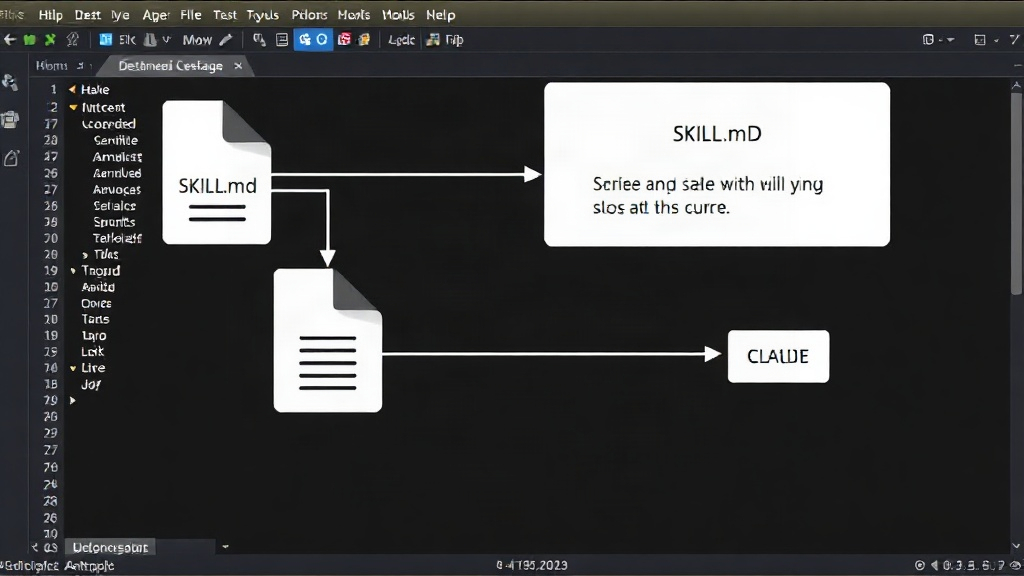
The core of this initiative is the SKILL.md file format. Think of it less like a traditional configuration file and more like a highly structured, AI-readable instruction manual for a specific task. It allows users to define a repeatable workflow that an AI agent, like Claude, can understand and execute reliably. Instead of re-typing instructions or pasting complex prompts each time, you provide a SKILL.md file. The AI then uses this file to guide its actions, ensuring consistency and accuracy according to your predefined rules and preferences.
What Goes into a SKILL.md File?
A SKILL.md file is essentially a Markdown document enhanced with specific YAML front matter and structured content. It's designed to be human-readable while also being machine-parseable by AI agents. The structure typically includes:
- Metadata: Information like the skill's name, version, description, author, and keywords. This helps in organizing and discovering skills.
- Inputs: Defines the parameters the skill expects. This could range from a simple text string to more complex data structures. For instance, a "Write Release Notes" skill might expect a list of features, bug fixes, and a version number as inputs.
- Outputs: Specifies the expected format and type of the output. This helps the AI understand what the final result should look like. For the release notes skill, the output might be defined as a Markdown document conforming to a specific template.
- Steps: This is the heart of the skill, detailing the sequential actions the AI should take. Each step can involve specific instructions, context, and even sub-prompts. This is where you embed your exact workflow logic. For example, a code review skill might have steps like: "1. Analyze code for style guide violations. 2. Check for common security vulnerabilities. 3. Verify adherence to API contracts."
- Tools: If the skill requires interaction with external tools or APIs (like a code interpreter, a search engine, or a database), these are declared here. This allows the AI to orchestrate calls to these tools as part of the workflow.
The beauty of this format lies in its explicit nature. By defining inputs, outputs, and discrete steps, users drastically reduce ambiguity. The AI isn't guessing your intent; it's following a blueprint you've meticulously crafted. This is particularly powerful for tasks that require strict adherence to format, style, or a multi-stage process.
Building Your First Agent Skill
Creating a SKILL.md file involves translating a manual workflow into this structured format. Let's consider the example of a "Code Review" skill for a Python project following a specific internal style guide.
First, you'd define the skill's metadata. Then, you'd specify inputs like the code snippet to review and potentially the project's style guide document itself. The output would be a structured review report, perhaps including sections for "Style Issues," "Potential Bugs," and "Suggestions." The critical part is the steps:
- Step 1: Load Style Guide. Instruction: "Load the provided internal Python style guide document."
- Step 2: Lint Code. Instruction: "Using the loaded style guide, lint the provided code snippet. Identify all deviations from the style guide and list them under 'Style Issues'. Focus on PEP 8 compliance and our project-specific rules."
- Step 3: Analyze for Bugs. Instruction: "Analyze the code for common Python pitfalls and potential runtime errors. List any findings under 'Potential Bugs'. Consider edge cases and resource management."
- Step 4: Suggest Improvements. Instruction: "Based on the code and the identified issues, suggest specific improvements or refactoring opportunities. List these under 'Suggestions'. Prioritize clarity and maintainability."
- Step 5: Format Report. Instruction: "Compile all findings into a final report matching the defined output schema."
This structured approach ensures that the code review process is consistent, regardless of who is performing it or when. It captures the implicit knowledge that a human reviewer would possess and makes it explicit for the AI.
The Broader Implications for AI Agents
The introduction of the SKILL.md standard by Anthropic, and its rapid adoption by other AI development platforms, is a significant step towards a more mature AI agent ecosystem. Before this, each platform or even each AI model had its own way of handling custom instructions or workflows, leading to fragmentation and vendor lock-in. This open standard changes that.
For developers, it means they can build reusable skills that work across different AI agents. This is analogous to how standardized file formats (like `.txt`, `.csv`, `.json`) or programming language libraries enable interoperability in traditional software development. You write a skill once, and it can potentially be used with Claude, Copilot, Gemini, and others that adopt the standard. This dramatically lowers the barrier to entry for creating sophisticated AI agents tailored to specific business needs.
For businesses, it translates to increased efficiency and reduced AI integration costs. Instead of maintaining custom integrations for each AI tool, they can develop a library of SKILL.md files that encapsulate their core processes. This allows them to leverage AI more deeply and consistently across their operations. It also means that as new AI models emerge, their existing investment in defining workflows isn't lost; they can migrate their skills more easily.
The surprising detail here is not just the existence of Agent Skills, but Anthropic's decision to publish the format as an open standard so quickly. This move signals a commitment to fostering an ecosystem rather than controlling it, a strategy that has historically led to widespread adoption and innovation in other technology sectors. It positions SKILL.md to become the de facto standard for defining AI agent workflows, much like Markdown became the de facto standard for simple text formatting on the web.
What's Next?
The success of SKILL.md will depend on continued adoption by AI platforms and the community's willingness to share and build upon existing skills. As more tools integrate support, the value proposition grows exponentially. We can expect to see marketplaces for skills, advanced tools for skill creation and debugging, and a proliferation of specialized agents powered by this standardized format. The ability to reliably teach AI agents your specific workflow is no longer a future dream; it's a developing reality.