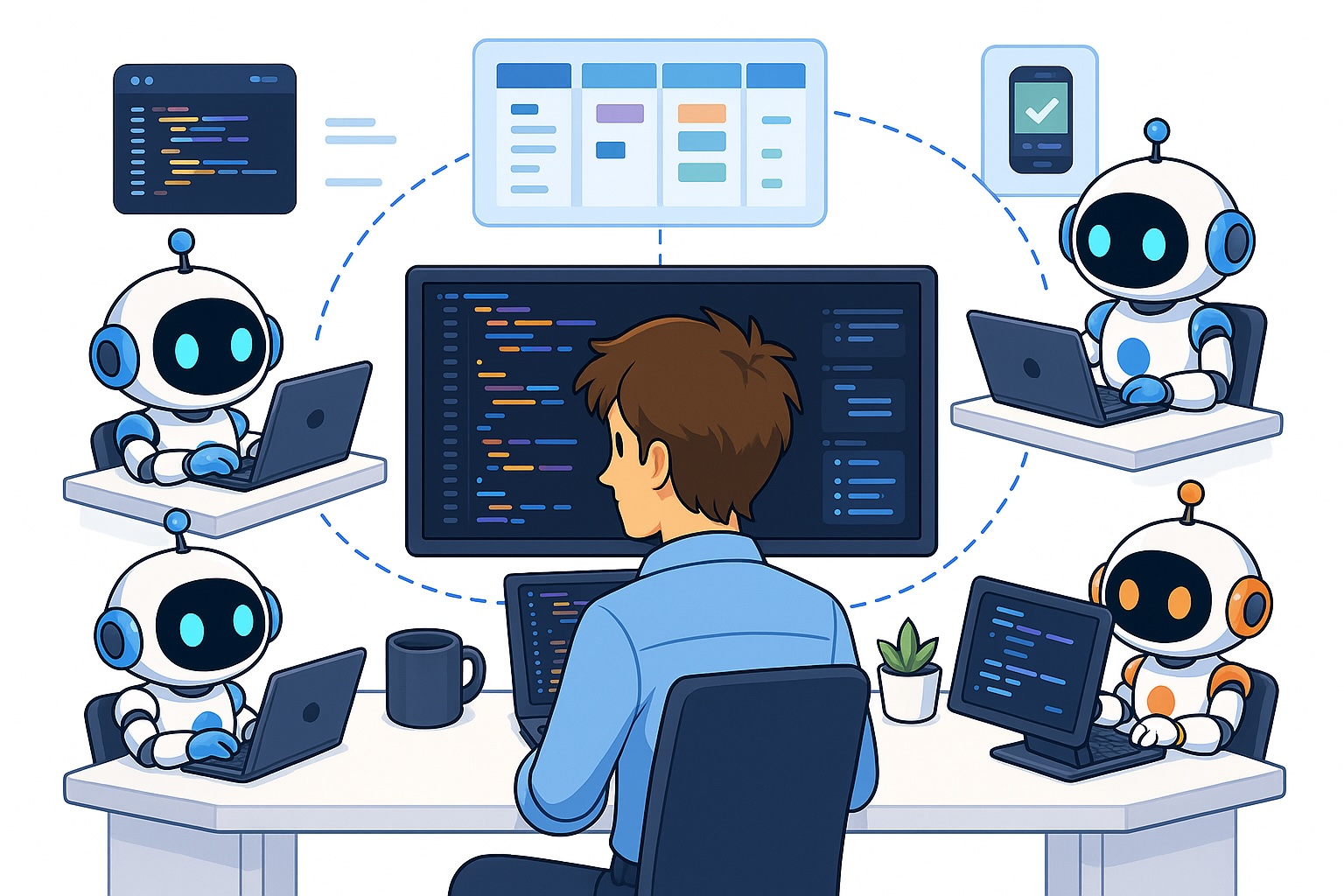
The Fragmented Landscape of AI Coding Agents
The proliferation of AI coding agents has created a significant cognitive burden for developers. Managing multiple tools like Claude Code, Codex, Hermes, opencode, and Mastra, each with its own command-line interface (CLI) flags, prompt syntaxes, and operational quirks, leads to confusion and inefficiency. Developers find themselves struggling to recall which flag spawns which agent, what prompts each agent expects, or how to manage their lifecycle – for instance, what happens if a laptop lid is closed mid-task. This fragmentation forces users to maintain numerous terminal tabs, each dedicated to a specific agent, leading to a "real jump in cognitive load" as noted by simonw and a common complaint on developer forums.
The core problem lies in the lack of a standardized interface across these powerful yet disparate tools. Each agent is developed with its own API, CLI arguments, and internal processes. This means a developer might use --prompt for one agent, --cwd for another, and need to manually navigate directories for a third. The risk of an agent hanging indefinitely or terminating unexpectedly due to environmental changes (like closing a laptop lid) adds another layer of stress, demanding constant babysitting and manual oversight.

Agentproto: A Unified Daemon for AI Coding Agents
To address this, developer agentiknet has created agentproto, a daemon designed to drive multiple AI coding agents from a single interface. The motivation behind agentproto is to eliminate the need for developers to constantly switch contexts and memorize unique commands for each AI assistant. Instead, it provides a unified lifecycle management system that can interact with various agents, abstracting away their individual complexities.
agentproto functions as a central hub. It allows developers to submit tasks and receive results through a single, consistent interface, regardless of which underlying AI model or agent is executing the work. This daemon aims to simplify the developer workflow significantly by providing a single point of control and supervision for all connected AI coding agents. The goal is to make the interaction with these tools as seamless as possible, reducing the cognitive overhead and allowing developers to focus on their code rather than managing the tools themselves.
The architecture of agentproto likely involves a core daemon that communicates with individual agent adapters. Each adapter translates the unified commands from the daemon into the specific syntax and protocols required by its corresponding AI coding agent. This modular design allows for the easy addition of support for new agents as they emerge, ensuring the system remains adaptable to the rapidly evolving AI landscape. The daemon also handles the lifecycle of these agents, including their initialization, execution, and termination, potentially mitigating issues like unexpected hangs or data loss.
The Promise of a Standardized Interface
The development of tools like agentproto signals a growing need for standardization in the AI development toolchain. As AI agents become more integrated into the software development process, their interfaces and operational paradigms must mature. A unified interface offers several key benefits:
- Reduced Cognitive Load: Developers can learn and use one set of commands and conventions instead of many.
- Increased Productivity: Less time spent managing tools means more time spent coding.
- Enhanced Supervision: A central daemon can implement more robust error handling, logging, and monitoring across all agents.
- Simplified Integration: A consistent interface makes it easier to integrate AI coding assistance into existing CI/CD pipelines or development environments.
The current state of AI coding agents is analogous to the early days of command-line utilities before standardized options like --help or common flags like -f became ubiquitous. Developers had to consult man pages for every single tool. The emergence of tools like agentproto represents a similar evolutionary step, aiming to bring order to a chaotic but powerful new category of developer tools. It’s less about the specific agents and more about the interface layer that allows them to coexist and be managed efficiently.
What remains to be seen is how widely such unified interfaces will be adopted and whether a de facto standard will emerge. The success of agentproto will depend not only on its technical robustness but also on its ability to support a broad range of popular and emerging AI coding agents. Furthermore, the underlying AI models themselves might eventually offer more standardized APIs, but until then, tools that abstract these differences will be invaluable.
Implications for the Future of Development
The trend towards unified interfaces for AI coding agents has profound implications. It suggests a future where AI assistants are not just standalone tools but integrated components of a cohesive development environment. This unification could accelerate the adoption of AI in mainstream development workflows, making powerful AI capabilities accessible to a wider range of developers, from individual contributors to large enterprise teams.
For founders, this means considering how their AI coding agent products fit into this emerging ecosystem. Will they offer their own unified interfaces, or will they rely on third-party solutions like agentproto to reach a broader audience? The ability to integrate smoothly with existing developer workflows will become a key differentiator. For security professionals, a unified interface could simplify auditing and policy enforcement across multiple AI tools, but it also presents a single point of potential compromise if not secured properly.
Ultimately, the quest for an optimal coding agent interface is a quest for efficiency and usability. As AI continues to augment human capabilities in software development, the tools that manage and orchestrate these AI partners will become as critical as the AI models themselves.