
The Growing Problem of Satellite Light Pollution
The proliferation of satellites in Earth's orbit, particularly large constellations like Starlink and OneWeb, has introduced a new and growing challenge for astronomers: light pollution. These satellites reflect sunlight, creating streaks and bright spots across the night sky that can interfere with ground-based astronomical observations. This artificial light can obscure faint celestial objects, disrupt long-exposure photography, and even impact our fundamental understanding of the universe by creating false positives in data. The issue is not merely aesthetic; it directly affects the scientific output of observatories worldwide.
The challenge lies in the reflective surfaces of these satellites. Even small amounts of reflected sunlight, when amplified by the vast number of satellites, can become a significant source of interference. Traditional solutions, such as altering satellite orbits or reducing their reflectivity through design changes, are complex and costly, often requiring significant redesigns of existing or planned satellite systems. Furthermore, the sheer scale of constellations means that even minor reflectivity from individual satellites aggregates into a substantial problem.
Introducing an Ultra-Black Solution
A recent study, published by astrophysicists from the University of Surrey, proposes a novel approach: the application of an ultra-black coating to satellite surfaces. This coating, similar to materials developed for terrestrial applications like stealth technology and thermal management, is designed to absorb nearly all incident light rather than reflect it. The research, led by Dr. John Davies, explores the potential of such coatings to drastically reduce the visual impact of satellites on the night sky.
The coating in question is a form of carbon-based nanomaterial that creates a surface with extremely low reflectivity across a wide spectrum of light. Unlike conventional black paints, which still scatter a significant amount of light, these ultra-black materials trap photons within their microscopic structure. This absorption capability is crucial for mitigating light pollution. If a satellite's surface absorbs light instead of reflecting it back towards Earth, its visibility from the ground is significantly diminished, effectively making it appear darker or even invisible to optical telescopes.
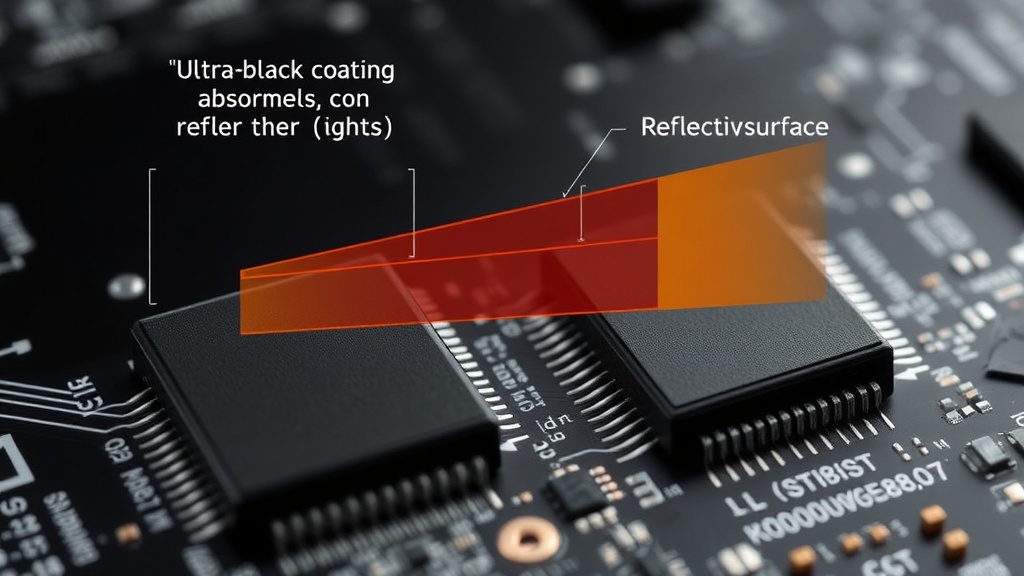
The researchers focused on quantifying the potential reduction in satellite brightness. Their models indicate that applying this ultra-black coating could reduce the apparent magnitude of satellites by several orders, making them far less intrusive. This is not a trivial improvement; it could mean the difference between a satellite being a bright, disruptive streak and a faint, ignorable glint, or even complete invisibility to sensitive instruments. The study highlights that the effectiveness of the coating depends on its uniformity and coverage across the satellite's exterior surfaces.
Technical Feasibility and Challenges
The primary technical hurdle is the application of such a coating in a space environment. Materials used in space must withstand extreme conditions, including vacuum, radiation, and wide temperature fluctuations. The ultra-black coating needs to maintain its absorptive properties and structural integrity over the lifespan of a satellite, which can range from a few years to over a decade. The development of space-grade versions of these coatings, which are robust and can be applied efficiently, is an ongoing area of research.
Another consideration is the potential impact on satellite thermal management. Highly absorptive surfaces can also absorb more heat from the sun. While this is beneficial for reducing reflections, it could lead to overheating of the satellite's internal components if not managed properly. Satellite designers would need to incorporate this into their thermal control systems, perhaps by strategically applying the coating only to surfaces that do not require active cooling or by using it in conjunction with radiative cooling techniques. The research paper acknowledges these complexities, suggesting that targeted application and further material science advancements are necessary.
Implications for Astronomy and Space Exploration
If successfully implemented, this ultra-black coating could represent a significant step forward in preserving the integrity of astronomical observations. It offers a potential mitigation strategy that can be retrofitted to existing satellites or integrated into the design of future ones without necessarily compromising their primary mission functions. This is a more scalable solution than demanding wholesale redesigns from every satellite operator.
The study raises an important question: Will satellite operators adopt this technology proactively, or will it require regulatory intervention? The cost and complexity of applying such coatings, even if reduced in future iterations, will be a factor. However, the long-term scientific value of clear night skies, and the economic implications for astronomical research and space-based observation industries, may eventually necessitate such measures. The researchers are optimistic that their findings will spur further investigation and collaboration between material scientists, satellite manufacturers, and the astronomical community.
A Path Forward
The University of Surrey's study provides a compelling proof-of-concept for using advanced materials to address the challenges posed by an increasingly crowded space environment. While significant engineering and logistical challenges remain, the prospect of an ultra-black coating offers a tangible and potentially effective solution to satellite light pollution. This research underscores the critical need for interdisciplinary approaches to managing the impacts of our expanding presence in space, ensuring that technological advancement does not come at the irreversible cost of our view of the cosmos.