
The Challenge of Real-Time Geospatial Matching
Tapping "Confirm Ride" on the Uber app feels instantaneous. Within seconds, a driver is assigned, and you’re on your way. This seamless experience, however, masks a colossal backend challenge: matching hundreds of thousands of riders with nearby drivers in real-time across a major city. A naive approach—iterating through every driver for every rider request—would instantly overwhelm any database under the load of thousands of requests per second. Uber’s dispatch engine, codenamed DISCO, tackles this massive geospatial matching problem with a sophisticated, multi-layered architecture.
The core difficulty lies in scale and latency. Every second, the system must process countless rider requests, constantly update driver locations, and perform complex proximity calculations. Traditional database queries are too slow. The system needs to efficiently query and filter millions of data points across a dynamic, ever-changing landscape. This requires an architecture that can shrink the search space, distribute the load, and prioritize the most relevant matches.
Shrinking the Search Space: Google S2 Geometry
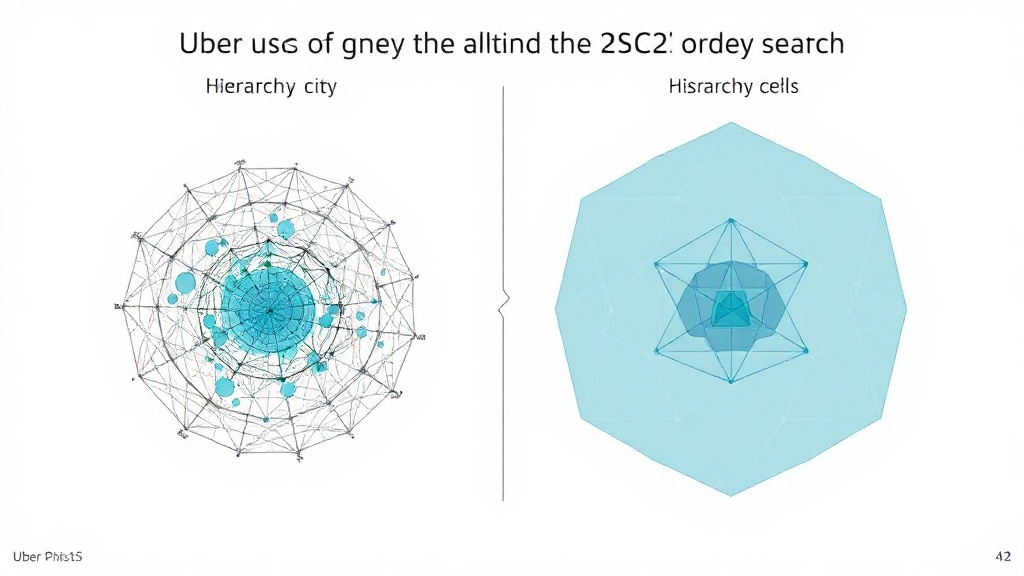
The first critical step in DISCO’s design is to drastically reduce the number of potential drivers a rider needs to consider. Searching the entire city for every request is computationally infeasible. Uber employs Google’s S2 Geometry Library to divide the world into a hierarchical grid of cells. These cells are indexed by unique IDs, and their size decreases as you go deeper into the hierarchy. This means that any two points on Earth can be represented by their S2 cell IDs. Crucially, nearby geographical locations are often mapped to adjacent or the same S2 cells, especially at a given level of detail. This cellular division allows Uber to efficiently group drivers and riders based on their proximity. Instead of querying a vast geographical area, the system can focus on drivers located within the same or immediately adjacent S2 cells as the rider.
The S2 library projects the spherical Earth onto a cube, and then subdivides the faces of the cube into cells. This method offers several advantages: it provides a consistent cell size across different latitudes, unlike traditional latitude-longitude grids, and it allows for efficient spatial indexing and querying. When a rider requests a ride, the system determines the S2 cells covering the rider’s location. It then queries for drivers within those specific cells and a predefined buffer of neighboring cells. This dramatically narrows down the potential matches, making the subsequent steps feasible.
Efficient Data Storage and Retrieval: Redis
Once the search space is narrowed by S2 cells, the system needs to quickly retrieve the locations and status of the drivers within those relevant cells. For this, Uber utilizes Redis, an in-memory data structure store. Redis is chosen for its speed and its ability to handle large volumes of real-time data with low latency. Driver locations, availability status, and other relevant metadata are stored in Redis, indexed by their corresponding S2 cell IDs.
When a rider requests a ride, the system queries Redis for all active drivers within the rider’s S2 cell and its immediate neighbors. Because Redis stores data in memory, these lookups are exceptionally fast, often measured in milliseconds. This allows for the rapid retrieval of a candidate pool of drivers. Furthermore, Redis supports various data structures and operations, such as sorted sets, which can be leveraged for basic sorting or filtering based on driver ratings or other criteria before more complex calculations are performed.
Real-Time Driver Matching and Dispatch
With a reduced set of candidate drivers from Redis, the system then performs more precise distance calculations. For each candidate driver, the precise distance to the rider is computed. This is where sophisticated algorithms come into play. The system needs to consider not just straight-line (as-the-crow-flies) distance but also estimated travel time, which accounts for real-time traffic conditions. Uber likely uses a combination of its own mapping data and external services to estimate these travel times.
The matching algorithm then ranks these drivers based on a combination of factors: proximity (shortest travel time), driver rating, vehicle type, and potentially rider preferences. The goal is to find the optimal driver who can reach the rider quickly and provide a good service experience. Once the best driver is identified, the system locks them in for the ride. This involves updating the driver’s status to "en route" and notifying both the rider and the driver through their respective apps.
The entire process must be robust and fault-tolerant. If a selected driver becomes unavailable or declines the ride, the system must be able to quickly select the next best alternative from the candidate pool without significant delay. This often involves maintaining a short queue of potential matches and having retry logic built into the dispatch process.
Scalability and Fault Tolerance
Handling millions of requests per day in numerous cities simultaneously requires a highly scalable and distributed architecture. DISCO is designed as a distributed system, meaning it comprises multiple independent services that work together. This allows Uber to scale different components of the system independently based on demand. For instance, if a particular city experiences a surge in ride requests, the services responsible for processing requests and matching drivers in that region can be scaled up without affecting other parts of the system.
Key to this scalability is the use of message queues, such as Kafka. Rider requests and driver location updates are published to message queues. These queues decouple the different services, allowing them to process events asynchronously. This prevents a bottleneck in one service from halting the entire system. For example, even if the matching service is temporarily overloaded, rider requests can still be queued up, ensuring no data is lost and they can be processed once capacity becomes available. The system also employs techniques like sharding and replication to distribute data and processing load across multiple servers, enhancing both performance and availability.
The surprising detail here is not the complexity of the matching algorithm itself, but the sheer engineering effort required to make it performant at Uber's global scale. The choice of technologies like S2 Geometry for spatial indexing and Redis for low-latency data retrieval are fundamental to achieving the sub-three-second dispatch time. It’s a testament to how abstract mathematical concepts and specialized data stores can solve very real-world, high-throughput problems.
The Unanswered Question: Dynamic Re-matching
While DISCO excels at the initial dispatch, what remains less clear is the system's ability to handle dynamic re-matching. If a driver encounters unexpected, prolonged traffic delays, or if a rider needs to change their destination mid-trip, how does the system efficiently re-evaluate and potentially re-assign the ride to a better-suited driver without causing significant disruption or user frustration? The current design focuses heavily on the initial match, but the intricacies of real-time, mid-journey optimization present a fascinating, and likely ongoing, engineering challenge.