The Need for Rigorous Interconnect Verification
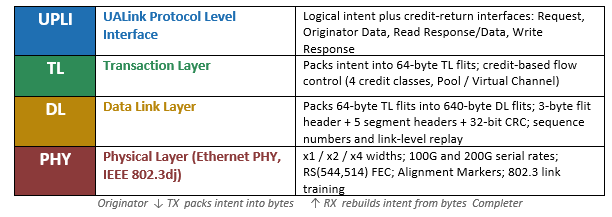
As chip designs become increasingly complex, integrating multiple processors, accelerators, and memory controllers, the interconnect fabric is no longer a passive plumbing system. It is an active participant in data movement, and its integrity is paramount. UALink, a new high-speed chip-to-chip interconnect standard, recognizes this by placing a strong emphasis on full-stack verification. This approach means verifying the entire path a transaction takes, from its initiation at a source to its completion at a destination, ensuring that both the meaning and the raw bytes of the data are preserved.
Traditional verification methods often focus on individual components or specific protocol layers. However, for a high-performance interconnect like UALink, this is insufficient. A transaction can be corrupted, delayed, or misinterpreted at any point in its journey. Full-stack verification aims to catch these issues by simulating and validating the entire transaction flow as it would occur in silicon. This involves not just checking protocol compliance but also ensuring that the data itself remains coherent and correct throughout its traversal of the interconnect.
The UALink standard is designed to support advanced computing workloads, including AI, HPC, and high-performance storage. These applications are characterized by massive data transfers and stringent latency requirements. Any error or performance degradation in the interconnect can have cascading negative effects on the overall system performance and reliability. Therefore, the verification strategy must be as sophisticated as the interconnect itself.
UALink's Verification Philosophy: Following the Transaction
UALink's verification methodology is built around the concept of 'following the transaction.' This means that verification engineers and tools must be able to trace a transaction step-by-step, mirroring the actual path it would take through the physical hardware. This granular tracking allows for the identification of subtle bugs that might be missed by more abstract verification techniques.
Consider a data read request from a CPU to a memory controller. This request initiates a series of events: the CPU issues a command, it travels across the UALink fabric, the memory controller receives it, processes it, fetches data from memory, and then sends the data back across the interconnect to the CPU. Full-stack verification ensures that each of these steps is correctly implemented and that the data returned is precisely what was requested, in the correct order, and without any corruption. This is akin to meticulously tracking a package from its sender, through every sorting facility and delivery truck, to its final recipient, ensuring no damage or loss occurs along the way.
This comprehensive approach requires a robust set of verification IP (VIP), advanced simulation environments, and sophisticated debug capabilities. UALink's specification and associated tools are being developed with this in mind, providing mechanisms for detailed transaction logging, error injection, and coverage analysis across the entire interconnect stack. The goal is to achieve a high degree of confidence in the interconnect's behavior under all expected operating conditions, and even under certain fault conditions.
Key Aspects of Full-Stack Verification in UALink
Several key aspects define UALink's full-stack verification strategy:
- Protocol Compliance: Ensuring that all aspects of the UALink protocol are adhered to, including packet formatting, flow control, error detection, and addressing. This is the foundational layer of verification.
- Data Integrity: Verifying that the data payload remains unchanged throughout its journey. This involves checking for bit flips, corruption, or incorrect reordering of data packets. Techniques like CRC checks and end-to-end data comparison are crucial here.
- Performance and Latency: UALink is a high-performance interconnect. Verification must confirm that the interconnect meets its specified latency and bandwidth targets under various traffic patterns and load conditions. This often involves directed testing and stress testing scenarios.
- Power Management: Modern chips require sophisticated power management. UALink's verification must include checks for correct entry and exit from low-power states, ensuring that transitions are seamless and do not compromise data or connectivity.
- Error Handling and Recovery: No system is perfect. Verification must include scenarios where errors occur, such as packet loss or link failures, and confirm that UALink's mechanisms for detecting, reporting, and recovering from these errors function as designed.
- Coherency: For multi-core systems and cache-coherent architectures, ensuring that data coherency is maintained across different agents connected by UALink is critical. Verification must address cache coherence protocols and their interaction with the interconnect.
Challenges and Benefits
Implementing full-stack verification for a complex interconnect like UALink presents significant challenges. It requires advanced verification methodologies, extensive testbench development, and considerable computational resources for simulation. The complexity of tracing transactions across multiple hops and different protocol layers can be daunting.
However, the benefits far outweigh the challenges. A thoroughly verified interconnect leads to more reliable and robust chip designs. It significantly reduces the risk of costly silicon re-spins due to interconnect-related bugs. For end-users, this translates to better performance, higher reliability, and more predictable behavior from their systems, especially critical for demanding applications like AI training and inference where sustained performance is key.
The UALink initiative, by championing this rigorous verification approach, is setting a high bar for future chip interconnect standards. It acknowledges that in the pursuit of ever-increasing performance and complexity, the underlying fabric must be as meticulously scrutinized as the processors and accelerators it connects. This focus on end-to-end transaction integrity is not just a technical detail; it's a strategic imperative for building the next generation of advanced computing hardware.
What remains to be seen is how widely this full-stack verification methodology will be adopted by tool vendors and IP providers developing for UALink, and whether it will become a de facto standard for other emerging interconnect technologies.