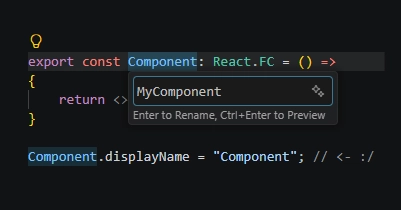
The Problem: Stale Display Names
In modern React development, maintaining accurate displayName properties for components is crucial for debugging and tooling. However, manually setting and updating these string-based names often leads to drift. When a component is refactored or renamed, its displayName can remain outdated, causing confusion in React DevTools and error reporting. This is a small but persistent annoyance that can compound in large component libraries.
The typical approach involves:
- Manually assigning a string literal:
Button.displayName = "Button"; - Forgetting to update it when the component name changes:
IconButton.displayName = "Button";
This disconnect is not just an aesthetic issue. Tools that rely on displayName for identification, like React DevTools, error boundaries, or server-side rendering (SSR) hydration, can misreport component hierarchies, making debugging significantly harder. Imagine tracing an error through a tree of components, only to find the names in the DevTools don't match your actual code. This is precisely the problem developers at Source 1 encountered.
The C# Inspiration: The `nameof` Operator
The inspiration for a robust solution came from C#'s nameof operator. This operator returns the name of a variable, method, or type as a string literal at compile time. For example, nameof(MyComponent) evaluates to the string "MyComponent". This eliminates the possibility of the string literal diverging from the actual identifier.
The challenge was to replicate this compile-time string capture in TypeScript, specifically for React component displayNames, without resorting to manual string management. The goal is to have the displayName automatically reflect the component's name, just like nameof does in C#.
The TypeScript Proxy Solution
TypeScript's advanced type system and JavaScript's runtime capabilities, particularly Proxies, offer a path to achieve this. A Proxy object allows you to intercept and redefine fundamental operations for an object, such as property lookups, assignments, and function invocations. This interception capability is key to automating the displayName assignment.
The proposed solution involves creating a higher-order component (HOC) or a utility function that wraps your actual React components. This wrapper uses a JavaScript Proxy to intercept the component definition. When the proxy is created, it captures the identifier of the component being wrapped. This captured identifier is then used to automatically set the displayName property.
How the Proxy Works
At its core, the technique leverages the fact that when you export a component, you are exporting a reference to that component function or class. A proxy can wrap this reference. When the proxy is instantiated, it can access the original component's name (which is available at runtime as Component.name for functions and classes) and assign it to displayName.
Consider a simplified conceptual example:
function withDisplayName(Component: React.ComponentType(any)) { // ... }The actual implementation would involve a proxy handler that intercepts property access. When displayName is accessed or set, the proxy can intervene. More precisely, the proxy can be set up such that when the component is *defined*, the proxy immediately sets the displayName based on the component's runtime name.
A more refined approach might look like this:
const displayNameProxy = (Component: React.ComponentType(any) => { const proxy = new Proxy(Component, { get(target, prop, receiver ) { if (prop === 'displayName') { return target.name || 'Component'; } return Reflect.get(target, prop, receiver); } }); return proxy; };This proxy intercepts the access to the displayName property. When it's requested, instead of returning a potentially stale string, it returns the component's actual runtime name (Component.name). This effectively links the displayName to the component's identifier at all times.
The Impact and Benefits
This technique offers several significant advantages:
- Automatic Synchronization:
displayNames are always consistent with the component's code name. Renaming a component in the IDE automatically updates itsdisplayNamewithout manual intervention. - Reduced Debugging Time: Accurate component names in React DevTools and error logs streamline the debugging process. Developers can more easily identify the source of UI issues or runtime errors.
- Improved Tooling Compatibility: Libraries and tools that rely on
displayNamewill function more reliably. - Developer Experience (DX) Boost: It removes a tedious manual task, allowing developers to focus on building features rather than managing boilerplate metadata.
The surprising detail here is not the complexity of Proxies themselves, but how a relatively straightforward JavaScript feature can solve a common, persistent problem that has plagued React developers for years, especially in large, evolving codebases. It’s a testament to leveraging runtime introspection for a compile-time-like benefit.
Implementation Considerations
While powerful, this approach requires careful integration. The proxy should wrap the component *before* it's exported or used in places where its displayName might be inspected. This could be achieved through:
- A Higher-Order Component (HOC): Wrap your components like
export default withDisplayName(MyComponent); - A Babel Plugin or TypeScript Transformer: Automate the wrapping process at build time, making the developer experience even smoother, similar to how
nameofworks. This would abstract the proxy logic entirely from the developer's direct view.
The choice between these methods depends on the project's build setup and desired level of abstraction. A Babel plugin or transformer would offer the most seamless integration, making the solution feel almost like a language feature.
The Unanswered Question: Performance Implications
What nobody has addressed yet is the potential performance overhead of using Proxies for every component. While JavaScript Proxies are generally performant for typical application logic, introducing them universally for displayName management in large applications could introduce a small, but measurable, impact on initial component rendering or hot module replacement (HMR) times. Benchmarking this effect in real-world scenarios would be valuable to ensure this elegant solution doesn't introduce its own set of subtle issues.