The Unstable API Causing the Breakage
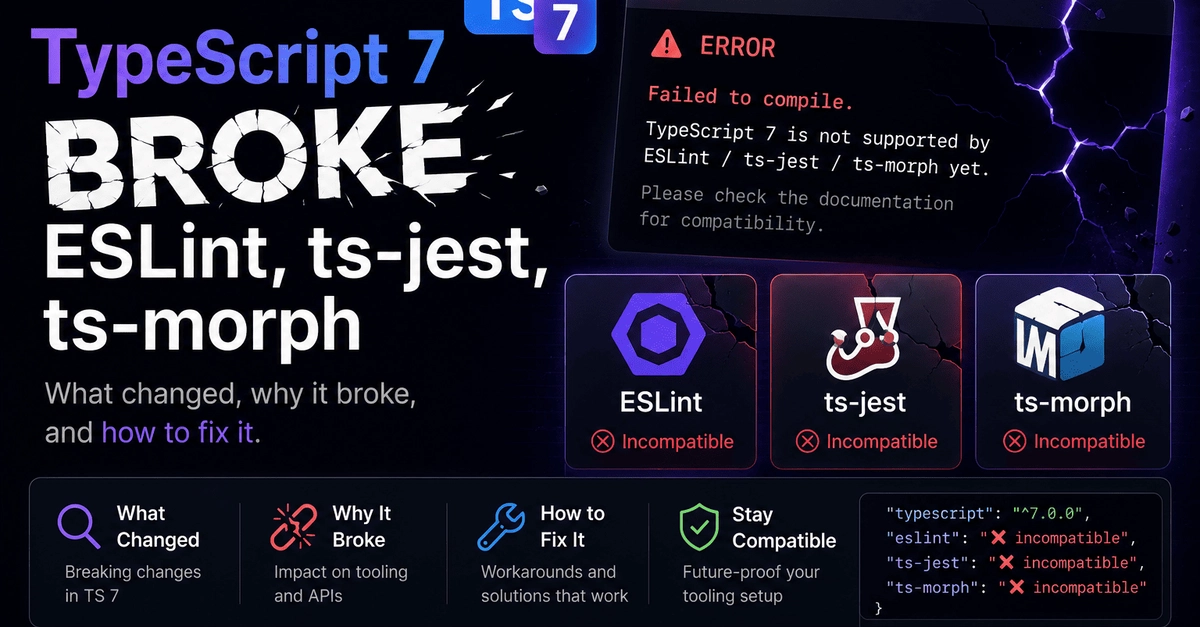
Developers upgrading to TypeScript 7 are encountering unexpected build failures and runtime errors, particularly with tools like ESLint, ts-jest, and ts-morph. The root cause lies in TypeScript 7’s introduction of tsgo, a port of the type-checker written in Go. While this offers performance benefits, it has led to instability in the programmatic API that development tools rely on to interact with TypeScript’s type-checking capabilities.
These tools do not directly use the Go binary. Instead, they interface with TypeScript through its programmatic API. This API, crucial for linters, test runners, and code transformation tools, has not yet reached stability in version 7. The stable version of this API is slated for release in TypeScript 7.1. Until then, any tool that programmatically interacts with the TypeScript compiler will likely encounter errors, manifesting as cryptic messages like TypeError: Cannot read properties of undefined (reading 'Cjs') or outright failures to process files.
The immediate consequence is that projects using these common development tools will break upon upgrading their TypeScript dependency to the 7.x release line. This affects the entire development workflow, from linting code during development to running automated tests in CI/CD pipelines.
The 10-Second Fix: Pin Your TypeScript Version
For developers currently relying on TypeScript-eslint, ts-jest, ts-morph, or any other tool that performs programmatic type-checking, the immediate solution is to explicitly pin your typescript dependency to a version within the 6.x range. This ensures that your existing development tools continue to function without interruption while the TypeScript ecosystem catches up.
This isn't a bug in your project configuration or a mistake in your upgrade process. The issue stems directly from the underlying TypeScript release and its interaction with the broader ecosystem. The TypeScript team is aware of this dependency on API stability and is working towards resolving it in future releases.
To implement this fix, you will need to modify your project’s dependency management file (e.g., package.json for npm/yarn, or pyproject.toml for Poetry if using Python with TypeScript tooling). Specifically, you’ll want to ensure that the typescript package is listed with a version constraint that excludes 7.x and includes the latest stable 6.x version.
For npm users, this might look like:
"dependencies": {
  "typescript": "^6.5.0", // Or the latest 6.x version
  // ... other dependencies
}
For yarn users, the approach is similar:
"dependencies": {
  "typescript": "^6.5.0", // Or the latest 6.x version
  // ... other dependencies
}
After modifying your package.json, run your package manager’s install command (e.g., npm install or yarn install) to downgrade or ensure the correct version is installed.
Ecosystem Impact and Future Outlook
The breakage highlights a critical dependency within the JavaScript and TypeScript development ecosystem. Tools that extend or integrate with TypeScript’s core functionality often rely on its internal APIs. When these APIs change without backward compatibility, it creates a ripple effect across numerous popular development tools.
This situation underscores the importance of API stability for foundational language tools. Developers building on top of TypeScript expect a reliable interface to leverage its powerful type-checking and code analysis capabilities. The introduction of tsgo, while a positive step for TypeScript’s performance, has temporarily disrupted this expectation.
The TypeScript team’s strategy for handling such transitions is key. By communicating the timeline for API stabilization (targeting version 7.1) and providing clear guidance to developers, they mitigate the immediate impact. However, the incident serves as a reminder that major version upgrades of core language tooling can have far-reaching consequences for project stability.
For maintainers of tools like ESLint (specifically the TypeScript parser), ts-jest, and ts-morph, the path forward involves updating their integrations once the TypeScript 7.1 API becomes available. This will likely involve code changes to adapt to any finalized API adjustments. Users of these tools will then need to update their tool dependencies in turn.
The broader implication for the ecosystem is a renewed focus on robust API contracts and potentially more rigorous testing of integrations against upcoming TypeScript releases. While the Go port offers significant performance advantages, the transition period requires careful management to avoid widespread disruption. Developers should exercise caution when upgrading TypeScript to major versions and always check compatibility notes for their critical development tools.
This issue is not unique to TypeScript; similar challenges arise when core language runtimes or compilers undergo significant internal overhauls. The tight coupling between language features and development tooling means that changes at the core can necessitate widespread updates across the toolchain.
Until TypeScript 7.1 is released and the relevant APIs are stabilized, developers must manage their TypeScript versions carefully. Keeping TypeScript pinned to 6.x remains the pragmatic approach for projects utilizing the affected tools, ensuring that development and testing workflows remain uninterrupted.