
The Core Innovation: Typesafe-computer-use
A novel framework, dubbed "typesafe-computer-use," is making waves for its ability to drive Mac automation with unprecedented efficiency. The project, originating from a Hacker News discussion, proposes a method for directing a Mac toward a specific goal for as little as 1/50th of a cent per step. This cost-effectiveness stems from a sophisticated approach to defining and executing computational tasks, leveraging type safety to minimize errors and redundant processing.
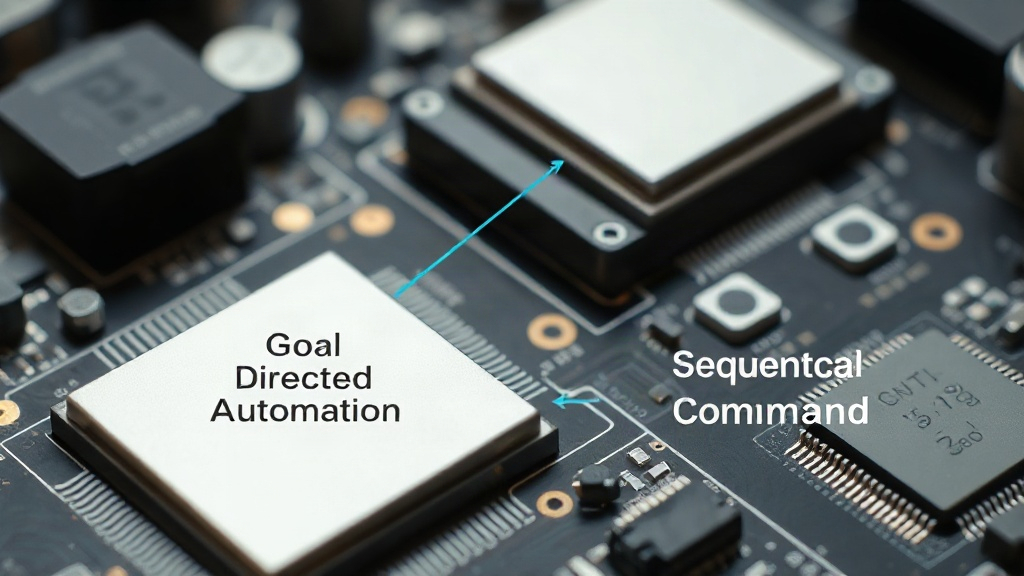
At its heart, typesafe-computer-use operates on the principle of explicit goal definition. Instead of issuing a series of discrete, potentially ambiguous commands, users define a desired end state. The framework then intelligently orchestrates the necessary steps to reach that state. This is analogous to telling a highly competent assistant, "Ensure this document is formatted correctly and sent to John," rather than listing out "Open document, select all, apply Arial 12pt, bold the title, attach to email, find John's address, send." The typesafe nature means that the framework understands the 'types' of operations and data involved, preventing misinterpretations that could lead to costly errors or wasted cycles.
The efficiency metric – 1/50th of a cent per step – is particularly striking. This suggests that the computational overhead of the framework itself is extremely low. It implies that the process of interpreting the goal, planning the execution path, and carrying out individual actions is optimized to consume minimal CPU, memory, and I/O resources. This is a significant departure from many existing automation tools that can be resource-intensive, often requiring dedicated virtual machines or cloud instances for complex workflows.
Consider the difference between a GPS navigation app and a traditional map. The GPS (typesafe-computer-use) understands your ultimate destination and calculates the best route, adapting dynamically to traffic. A traditional map (a series of manual commands) requires you to interpret roads, turns, and distances yourself, a much more error-prone and time-consuming process. The typesafe framework aims to provide that intelligent, goal-oriented navigation for computational tasks on a Mac.
Technical Underpinnings and Efficiency Gains
While the specific implementation details are still emerging from the Hacker News discussion, the concept hinges on a robust internal representation of tasks and states. By using strongly typed definitions, the framework can perform compile-time checks or sophisticated runtime validation, catching potential issues before they consume resources. This proactive error handling is a key contributor to the low per-step cost.
Traditional scripting, for example, often relies on string manipulation and dynamic typing. A typo in a filename, a missing argument, or an unexpected output format can cause a script to fail, requiring manual intervention and wasting processing time. Typesafe-computer-use likely employs a more structured approach, perhaps using a domain-specific language (DSL) or a carefully designed API that enforces correct usage. This reduces the likelihood of runtime errors that would otherwise necessitate retries or corrective actions, each of which consumes computational resources and thus, cost.
The low cost also implies that the framework is designed to be lightweight and integrate smoothly with macOS's native capabilities. It likely avoids heavy dependencies or external services that would incur significant overhead. This makes it suitable for running on personal Macs, even for very frequent or granular automation tasks, without a noticeable impact on system performance or incurring substantial cloud computing bills.
The potential applications are vast. Developers can use it to automate repetitive build, test, and deployment processes. Content creators could streamline video editing workflows, image processing, or social media posting. System administrators could automate system checks, software updates, or user management tasks. The key is that any goal that can be broken down into a sequence of discrete, definable computational steps is a candidate for this type of automation.
Implications for Developers and Users
The most immediate implication is for anyone who performs repetitive tasks on a Mac. The ability to automate these tasks for a fraction of a cent per step drastically lowers the barrier to entry for sophisticated automation. It democratizes powerful workflow optimization, making it accessible even for individuals or small teams without large budgets for specialized automation software or cloud infrastructure.
For developers, this could mean a significant shift in how they approach task automation. Instead of spending hours writing brittle shell scripts or complex Python programs, they can leverage a framework that guarantees a certain level of correctness from the outset. This allows them to focus on the higher-level goal rather than the minutiae of implementation, potentially accelerating development cycles and reducing bugs.
The surprising detail here is not the sheer efficiency, but the democratization of such efficiency. Tools that offer such granular control and cost-effectiveness have traditionally been either prohibitively expensive, complex to set up, or limited in scope. Typesafe-computer-use appears to be addressing all three by prioritizing type safety and goal-oriented design, making advanced automation accessible to a much wider audience.
What remains to be seen is the ecosystem that will grow around this framework. Will there be a marketplace for pre-defined goals or task modules? How will it integrate with existing CI/CD pipelines or other automation platforms? The potential for a standardized, highly efficient way to describe and execute computational tasks on macOS is significant, and its adoption could reshape how we think about personal computing automation.