The Problem with Traditional LLMs for Backend Systems
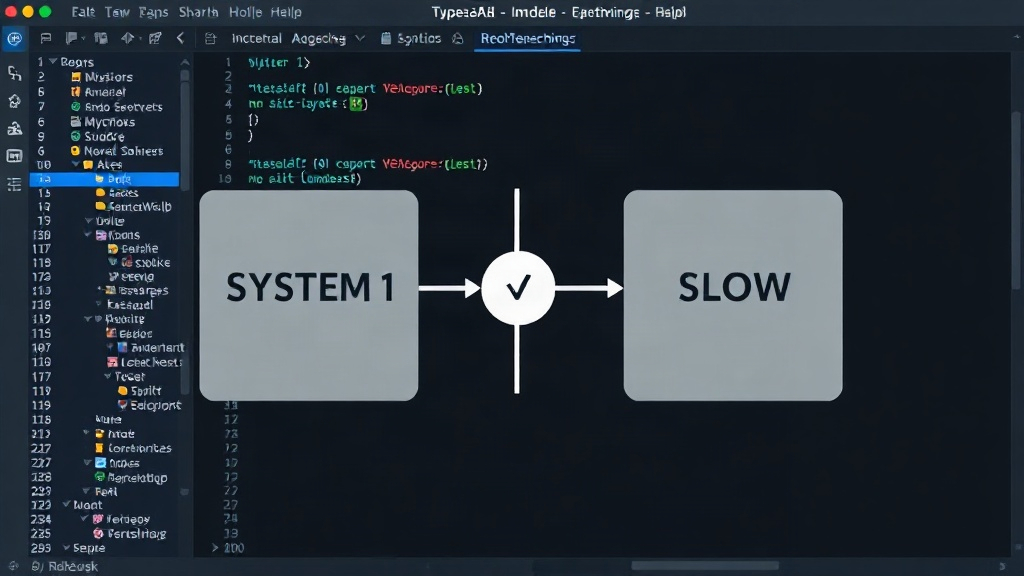
AI engineers often grapple with the limitations of traditional Large Language Models (LLMs) like GPT or Claude when applied to automation tasks. While powerful for generative text, their token-by-token, autoregressive output mechanism mirrors "System 2" thinking – deliberate, slow reasoning. This is fundamentally at odds with the requirements of most backend systems, which demand "System 1" decision-making: rapid, intuitive judgments and, crucially, strongly typed return values. Trying to force LLMs to perform tasks like precise data classification, accurate risk scoring, or deterministic data routing often results in slow, resource-intensive processes that are ill-suited for real-time operations.
This mismatch means developers frequently spend significant time parsing unstructured text outputs, validating data, and handling errors, adding complexity and latency. For applications that need to react instantly, like fraud detection, real-time analytics, or automated content moderation, this architectural bottleneck becomes a critical issue. The inherent nature of these models is designed for expansive text generation, not for the constrained, predictable outputs needed for programmatic decision-making.
TypeSafe AI's Jev Model: A System 1 Alternative
Recognizing this gap, TypeSafe AI, a company founded by former OpenAI engineers, has released Jev. This model is positioned as the first "System 1" model, designed specifically to address the shortcomings of traditional LLMs in backend automation. Instead of generating free-form text, Jev is engineered to deliver structured, strongly typed data outputs rapidly. This fundamental shift means developers can receive predictable results that integrate seamlessly into their existing Go applications without extensive post-processing or validation layers.
The core innovation lies in Jev's architecture, which prioritizes speed and data integrity. It bypasses the slow, token-by-token generation process, opting for a more direct approach to data extraction and classification. This allows it to function more like a highly efficient, specialized API endpoint than a general-purpose language model. For developers accustomed to dealing with the inherent ambiguity and latency of traditional LLMs, Jev represents a significant departure, offering a path to integrate AI-driven decision-making that aligns with the performance expectations of modern distributed systems.
Introducing the taurus-jev-sdk-go
While TypeSafe AI currently offers official SDKs primarily for Python and JavaScript, the demand for Jev's capabilities in other ecosystems is clear. To bridge this gap for the Go community, the team behind the dev.to article has developed and open-sourced the taurus-jev-sdk-go. This SDK provides a robust and idiomatic Go interface for interacting with the Jev model, abstracting away the complexities of network communication and data serialization.
Using the SDK involves a few key steps. First, developers need to obtain an API key from TypeSafe AI. Then, they instantiate the Jev client, providing their API key and the desired endpoint URL. The SDK handles the underlying HTTP requests, ensuring that data is sent to the Jev model in the correct format and that responses are deserialized into Go structs. This dramatically simplifies the integration process, allowing Go developers to leverage Jev's structured output capabilities with minimal boilerplate code.
For instance, a common use case would be to classify incoming user requests or extract specific entities from unstructured input. With taurus-jev-sdk-go, a developer can define a Go struct that mirrors the expected output structure from Jev. The SDK then takes the input text, sends it to the Jev API, and returns a populated Go struct. This is a stark contrast to traditional LLM approaches, where the output might be a JSON string that then needs to be parsed, validated against a schema, and potentially corrected for errors. The typed nature of Jev's output, facilitated by the Go SDK, significantly reduces the "parsing and validation" tax.
Example Usage in Go
To illustrate, consider a scenario where you need to classify customer support tickets into predefined categories like "Billing," "Technical Support," or "Feature Request." With taurus-jev-sdk-go, you could define an enum or a string type for these categories and a struct to hold the classification result:
type TicketCategory string

const (
    Billing TicketCategory = "Billing"
    TechnicalSupport TicketCategory = "Technical Support"
    FeatureRequest TicketCategory = "Feature Request"
)

type ClassificationResult struct {
    Category TicketCategory `json:"category"`
    Confidence float64 `json:"confidence"`
}
Then, you would initialize the client and make a prediction:
import (
    "github.com/taurus/jev-sdk-go/jev"
)

func main() {
    apiKey := "YOUR_TYPE_SAFE_API_KEY"
    client, err := jev.NewClient(apiKey)
    if err != nil {
        // Handle error
    }

    input := "I was charged twice for my subscription this month."
    var result ClassificationResult

    err = client.Predict(input, &result) // &result is a pointer to the struct to be populated
    if err != nil {
        // Handle error
    }

    fmt.Printf("Ticket classified as: %s with confidence %.2f\n", result.Category, result.Confidence)
}
This example demonstrates the direct mapping of Jev's structured output to Go's type system. The client.Predict function, provided by the SDK, handles the API call and deserializes the JSON response directly into the ClassificationResult struct. If Jev were to return an unexpected structure, the Go type system and the SDK's error handling would likely catch it at compile-time or runtime, providing a level of safety absent in text-parsing approaches.
Implications for Go Developers
The availability of taurus-jev-sdk-go is a significant boon for Go developers seeking to integrate AI capabilities into their applications without compromising on performance or type safety. It enables the use of TypeSafe AI's "System 1" model for a range of tasks, including data validation, routing, sentiment analysis with predefined labels, and more, all while adhering to Go's strong typing principles.
This SDK effectively lowers the barrier to entry for adopting Jev. Developers no longer need to write custom HTTP clients or JSON parsers for Jev. They can focus on the business logic that consumes the AI's output. The structured nature of Jev's responses, combined with the SDK's idiomatic Go implementation, leads to more maintainable, robust, and performant applications. This move democratizes access to advanced AI decision-making paradigms for the Go ecosystem, paving the way for more sophisticated and efficient backend services.