
Trump's AI Vision: "Super Americans" and National Dominance
Donald Trump's campaign is increasingly highlighting artificial intelligence as a cornerstone of his vision for America. This focus, however, is not centered on consumer applications or economic growth in the typical sense. Instead, Trump's rhetoric points towards AI as a tool for national power, military superiority, and potentially, social control. He has spoken of creating ".super Americans" through AI, a phrase that has sent shivers through technologists and civil liberties advocates alike, evoking images of enhanced soldiers or a populace managed by algorithms.
The former president’s emphasis on AI as a strategic asset, capable of outmaneuvering global rivals, echoes a broader trend in geopolitical strategy. However, the specific language used by Trump and his campaign suggests a more direct, and perhaps more concerning, application. The idea of ".super Americans" is particularly ambiguous and potentially alarming. It could refer to enhanced military capabilities, but the vagueness allows for interpretations that range from AI-assisted decision-making in governance to more invasive forms of societal management. This ambiguity is a significant source of anxiety, as it leaves open the possibility of AI being deployed in ways that erode individual freedoms or create new forms of inequality.
The campaign's embrace of AI appears to be a strategic play to position Trump as a forward-thinking leader, capable of harnessing cutting-edge technology for national benefit. Yet, the underlying message risks alienating a significant portion of the electorate that views AI with apprehension, particularly given its rapid advancements and the ethical dilemmas it presents. The discourse around AI often oscillates between utopian promises and dystopian warnings, and Trump’s framing leans heavily into the latter's aesthetic, even if not explicitly intended as such. The fear is that this technological frontier, when combined with a nationalist agenda, could lead to a future where AI serves to consolidate power rather than empower individuals.
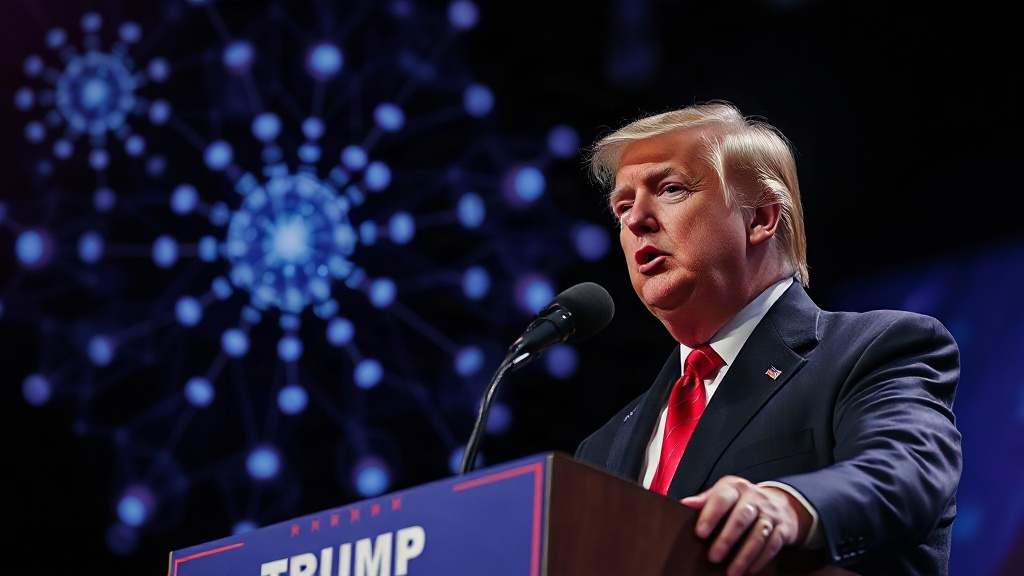
The "Terminator" Analogy and Public Anxiety
The immediate public reaction to Trump's AI pronouncements has been one of significant concern, with many drawing parallels to dystopian science fiction narratives, most notably the "Terminator" franchise. This comparison, while perhaps hyperbolic, captures a prevalent fear: that advanced AI, especially when wielded by an authoritarian-leaning power, could lead to a loss of human control and a future dictated by machines or those who command them. The fear is not just about autonomous weapons, but about the broader societal implications of AI being integrated into governance, surveillance, and even the definition of citizenship.
This anxiety is not unfounded. The rapid development of AI technologies, from sophisticated surveillance systems to AI-generated disinformation, has already raised profound ethical questions. When these tools are considered within the context of a political agenda that prioritizes national strength and potentially individual subservience to the state, the risks amplify. The "Terminator" analogy, in this light, serves as a shorthand for a future where AI systems, designed for efficiency and control, could inadvertently or intentionally suppress dissent, erode privacy, and create a society where human agency is diminished. The public's apprehension reflects a deep-seated unease about the potential for technology to be used as an instrument of oppression.
What remains unaddressed in this discourse is the specific technological roadmap Trump’s campaign envisions for achieving these ".super American" goals. Without concrete details on how AI will be developed, regulated, and deployed, the public is left to grapple with the most extreme interpretations of these ambitions. This lack of transparency fuels speculation and anxiety, transforming abstract technological potential into concrete fears of a future where human values are secondary to algorithmic efficiency and state power. The campaign's messaging, while aiming to project strength and innovation, inadvertently taps into widespread anxieties about the uncontrolled proliferation of powerful AI systems.
AI's Dual Nature: A Tool for Progress or Control?
Artificial intelligence is inherently a dual-use technology. It holds the promise of solving some of humanity's most pressing problems, from disease to climate change, by accelerating scientific discovery and optimizing complex systems. However, it also presents significant risks, including job displacement, the amplification of biases, and the potential for autonomous systems to operate beyond human oversight. The critical factor determining whether AI leads to progress or dystopia lies in its governance and application.
Trump's campaign rhetoric suggests a predisposition towards leveraging AI for control and dominance, rather than for broad societal benefit. The concept of ".super Americans" implies an enhancement or selection process, potentially creating divisions within society or a militarized elite. This approach contrasts sharply with a vision of AI that empowers all citizens, democratizes access to information and opportunity, and enhances human capabilities without compromising autonomy. The fear is that by prioritizing nationalistic applications and potentially authoritarian control, the campaign risks overlooking the ethical considerations and potential harms associated with advanced AI.
The rapid pace of AI development means that ethical frameworks and regulatory bodies are struggling to keep up. This gap creates fertile ground for the misuse of powerful AI tools. If political leaders, particularly those with a demonstrated inclination towards centralized power, begin to heavily invest in and deploy AI without robust ethical guardrails, the consequences could be severe. The public's fear of a ".Terminator-like dystopia" is, therefore, a reflection of a genuine concern that the transformative power of AI could be harnessed for purposes that undermine democratic values and human rights, rather than for the betterment of society as a whole. The challenge for policymakers and the public is to ensure that AI development aligns with humanistic goals, promoting progress and empowerment, not control and subjugation.