From Functional Prototype to Production-Ready
The transition from a functional prototype to a production-ready, scalable system is a journey fraught with hidden complexities. Trelix, an ambitious project, embarked on this path, evolving from its initial v1.0 release to v2.7. This evolution was not a linear progression but a series of critical engineering challenges, bug fixes, and architectural overhauls, all driven by the fundamental need to move from a state of 'it works' to 'it scales'.
The early days of Trelix, embodied by v1.0.0, were marked by the classic issues of a project still finding its feet. A particularly illustrative bug involved the RetrievalConfig object. Shortly after the v1.0.0 release, developers discovered a critical flaw: a RetrievalConfig object, intended to be overridden programmatically via a parameter in AdaptiveRouter, was being silently ignored. The constructor accepted the parameter, but the internal logic, driven by environment variables, would always re-initialize its own instance. This meant that carefully configured settings were effectively decoys, leading to unpredictable behavior and a lack of control over the system's retrieval mechanisms. The plumbing connecting Retriever, QueryPlanner, and AdaptiveRouter.__init__ was incomplete, a common oversight in rapid development where immediate functionality often trumps robust integration.

Architectural Shifts for Scalability
As Trelix progressed through its versions, the focus shifted dramatically towards addressing the scalability limitations inherent in its initial design. The issues encountered in v1.0 were not isolated incidents but symptoms of a broader need for architectural refinement. The system's core components, designed for simplicity and immediate usability, began to buckle under increasing load and complexity. This necessitated a re-evaluation of how data was processed, how configurations were managed, and how different modules interacted.
One significant area of improvement involved the internal configuration management. Moving beyond the environment-variable-driven defaults and programmatic overrides, Trelix began implementing more sophisticated mechanisms for dynamic configuration updates. This involved not just fixing bugs like the RetrievalConfig issue but architecting systems that could gracefully handle hot-swappable configurations without requiring restarts. This meant developing robust internal communication channels and state management systems that ensured consistency across all relevant components, regardless of how the configuration was applied.
The evolution from v1.0 to v2.7 also saw a substantial effort in disentangling dependencies and promoting modularity. Early versions often suffered from tight coupling, where changes in one module had cascading effects on others. This made debugging and feature development a slow and error-prone process. By v2.7, the architecture had matured to favor a more microservices-like approach, or at least a highly modular monolith, where components could be developed, tested, and deployed more independently. This modularity was crucial for scaling, as it allowed specific parts of the system to be optimized or scaled out without impacting the entire application.
The Data Flow Challenge
A core challenge in scaling any data-intensive application lies in managing the flow of information. Trelix, dealing with retrieval and planning, was no exception. The journey from v1.0 to v2.7 involved significant refactoring of how data traversed the system. The initial implementation likely relied on simpler, perhaps synchronous, data pipelines. As user load and data volumes increased, these pipelines became bottlenecks.
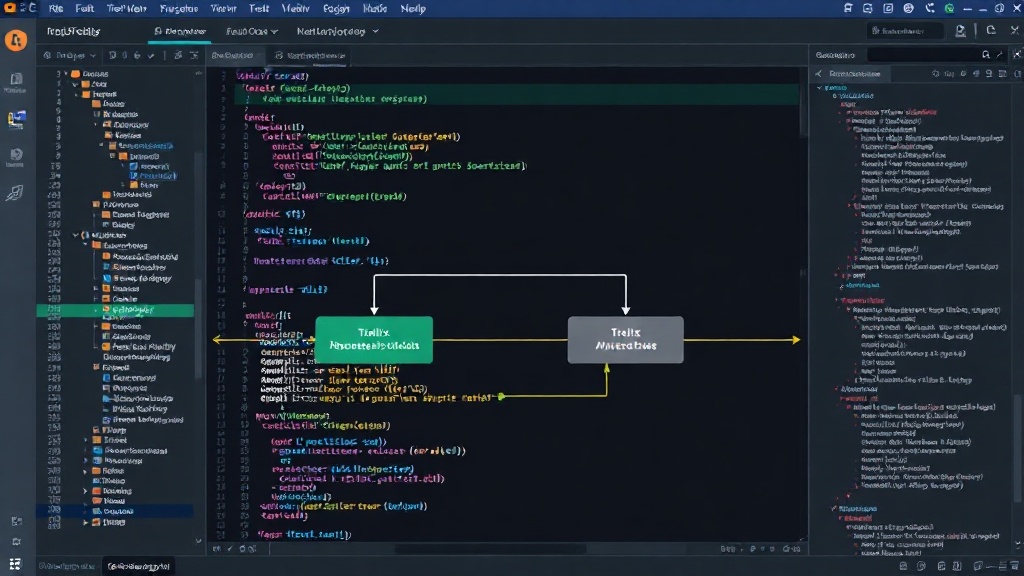
By v2.7, Trelix had likely adopted more asynchronous patterns, employing message queues or event-driven architectures to decouple data producers from consumers. This would allow components like the Retriever and QueryPlanner to operate more independently, processing data at their own optimal rates. The AdaptiveRouter, for instance, would no longer be blocked waiting for a slow configuration update or data retrieval; instead, it could react to events or messages, ensuring a more fluid and responsive system. This shift is akin to moving from a single-lane road where every car must wait for the one in front, to a multi-lane highway with on-ramps and off-ramps allowing for much greater throughput and flexibility.
Performance Benchmarking and Optimization
The ultimate test of scalability is performance under load. The progression from Trelix v1.0 to v2.7 was undoubtedly punctuated by rigorous performance benchmarking and targeted optimization efforts. What might have worked adequately for a handful of users in v1.0 would likely degrade significantly with hundreds or thousands. Identifying these performance cliffs was a critical step.
Optimization efforts would have focused on several key areas: reducing computational complexity in critical algorithms, optimizing database queries or data access patterns, minimizing network latency between components, and efficient memory management. The QueryPlanner, for example, might have seen the introduction of caching mechanisms or more advanced indexing strategies to speed up query generation. The Retriever could have been optimized to fetch data more efficiently, perhaps through batching requests or employing predictive fetching.
The difference between v1.0 and v2.7 represents more than just a version number increase; it signifies a maturation of the engineering process. It's the difference between building something that demonstrates a concept and building something that can reliably serve a large, demanding user base. The journey from 'it works' to 'it scales' is rarely straightforward, and Trelix's path, as evidenced by its evolution, highlights the continuous effort required to achieve robust, scalable software.