Understanding Topologic Contours
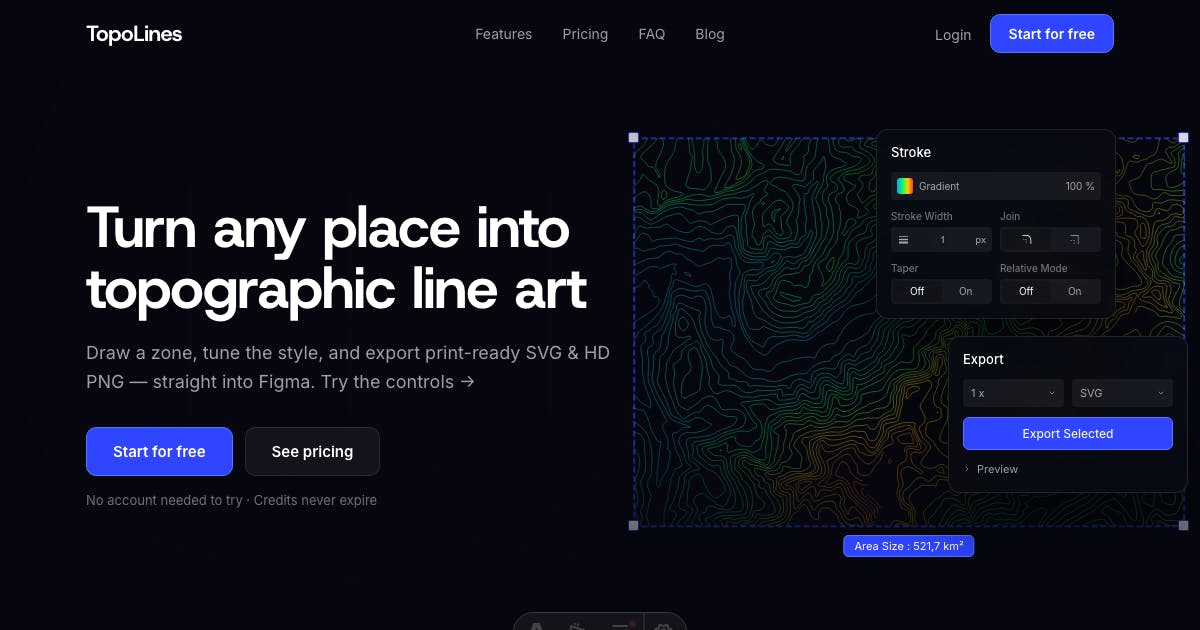
Topolines emerges as a new tool designed to simplify the generation of Topologic contours. For professionals in the Architecture, Engineering, and Construction (AEC) industry, creating accurate and efficient topological contours is a critical step in design and planning. These contours define the shape and elevation of terrain, influencing everything from building placement to drainage systems. Traditionally, this process can be complex, requiring specialized software and a deep understanding of geospatial data. Topolines aims to abstract much of this complexity, making the process more accessible and efficient.
The core functionality of Topolines revolves around generating these contours. While the provided source is brief, it indicates a focus on the output of 'Topologic contours.' This suggests the tool is likely geared towards parametric design workflows, where geometric forms are defined by relationships and algorithms rather than direct manipulation. In AEC, this approach is increasingly adopted for its flexibility and ability to manage complex design variations. Topolines appears to fit into this paradigm by providing a dedicated solution for a specific, yet crucial, geometric output.
Workflow Integration and Potential Applications
The primary value proposition of Topolines likely lies in its potential to integrate seamlessly into existing AEC software ecosystems. Tools like Rhino/Grasshopper, Revit, or even game engines used for visualization, often rely on well-defined geometric data. By generating Topologic contours, Topolines can potentially feed directly into these platforms, reducing manual data entry or conversion steps. This could significantly speed up the design iteration process, allowing architects and engineers to explore more options and refine their designs faster.
Consider the process of designing a building on a sloped site. Engineers need precise contour data to understand earthwork volumes, drainage patterns, and foundation requirements. Architects use this data to inform massing, access points, and landscape integration. If Topolines can quickly generate accurate contour sets from basic site data, it frees up valuable design time. Instead of spending hours on manual drafting or wrestling with complex GIS software, teams can focus on the creative and problem-solving aspects of their projects. This is akin to having a highly specialized assistant who can instantly produce detailed site maps based on a few key parameters.
The term 'Topologic' itself hints at a focus on the underlying structure and connectivity of the geometric data. This is crucial for computational design, where the relationships between geometric elements are as important as their spatial positions. For instance, ensuring that contours are continuous, correctly ordered, and free from self-intersections is vital for subsequent analysis or fabrication processes. Topolines's emphasis on 'Topologic contours' suggests it's built with these robust data requirements in mind.
The Competitive Landscape and Market Need
The AEC software market is crowded, with established players offering broad suites of tools. However, there's a constant demand for specialized plugins and standalone applications that excel at specific tasks. Topolines appears to be targeting such a niche. While general-purpose CAD and BIM software can generate contours, dedicated tools often offer greater precision, speed, or ease of use for particular workflows. The success of Topolines will depend on how effectively it addresses pain points that current solutions do not fully resolve.
The fact that the tool is being discussed on platforms like Product Hunt indicates it's targeting an audience that actively seeks out new solutions and workflows. This community often includes early adopters and innovators who are willing to experiment with new tools to gain a competitive edge. The demand for streamlined digital workflows in AEC has never been higher, driven by pressures to reduce costs, improve sustainability, and accelerate project delivery. Tools that can demonstrably save time and reduce errors in critical processes like site analysis are likely to find a receptive market.
Future Development and User Feedback
As with any new tool, particularly one targeting a technical audience, user feedback will be paramount. The initial discussion on Product Hunt will likely provide early insights into what users like, what they find challenging, and what features they wish to see added. For Topolines, key areas for development might include expanding the range of input data formats it supports, offering more customization options for contour generation (e.g., interval control, smoothing algorithms), and enhancing its interoperability with other AEC software. The community's reaction will shape the future trajectory of the product, guiding developers toward the most impactful improvements.
What remains to be seen is how Topolines handles the nuances of real-world terrain data, which is often noisy and incomplete. The ability to robustly process imperfect input and still generate usable, topologically sound contours will be a significant differentiator. Furthermore, understanding the underlying algorithms and the robustness of its 'Topologic' engine will be crucial for adoption by seasoned professionals who rely on predictable and accurate geometric outputs.