
Rust's New Frontier in Server Applications
Rust, long lauded for its memory safety and performance, is stepping into more demanding server application roles. The new Topcoat framework, developed by the Tokio team, aims to push Rust's capabilities beyond what was previously considered feasible for high-concurrency, low-latency backend services. Historically, these domains have been the stronghold of languages like Go and C++ due to their mature ecosystems and established patterns for handling massive numbers of simultaneous connections and minimal response times. Topcoat seeks to bridge this gap, offering a robust and efficient path for developers to build sophisticated server applications in Rust.
The core challenge Topcoat addresses is the intricate management of asynchronous operations, I/O, and state across a vast number of concurrent client connections. While Rust's async/await syntax provides a powerful foundation, building a complete, production-ready server framework requires significant boilerplate and careful orchestration. Topcoat abstracts away much of this complexity, providing a higher-level API that allows developers to focus on application logic rather than the underlying concurrency primitives. This is achieved through a meticulously designed architecture that leverages Tokio, Rust's premier asynchronous runtime, and extends its capabilities with specialized components for server workloads.
One of the key innovations in Topcoat is its approach to resource management and state sharing in a concurrent environment. Unlike traditional frameworks that might rely on global mutable state or complex locking mechanisms, Topcoat emphasizes a more idiomatic Rust approach, favoring explicit ownership, borrowing, and message passing. This not only enhances safety but also provides clearer performance characteristics. The framework is designed to minimize overhead, ensuring that the performance gains promised by Rust are not eroded by framework-level abstractions.
Architectural Innovations for Performance
Topcoat introduces several architectural patterns that differentiate it from existing Rust web frameworks. It adopts a work-stealing scheduler, a common pattern in high-performance concurrency, to ensure efficient utilization of CPU cores. This scheduler distributes tasks dynamically among worker threads, preventing bottlenecks and maximizing throughput. The framework's I/O handling is also highly optimized, utilizing epoll (on Linux) and kqueue (on BSD-based systems) for efficient event notification, allowing a small number of threads to manage thousands of active connections.
The framework's design prioritizes composability. Developers can select and integrate specific components of Topcoat as needed, rather than being forced into a monolithic architecture. This modularity is crucial for building tailored server applications, from small microservices to large, complex distributed systems. For instance, a developer might only need Topcoat's connection management and request routing capabilities, while opting for a different library for serialization or database access. This flexibility is a significant advantage for teams with specific performance or feature requirements.
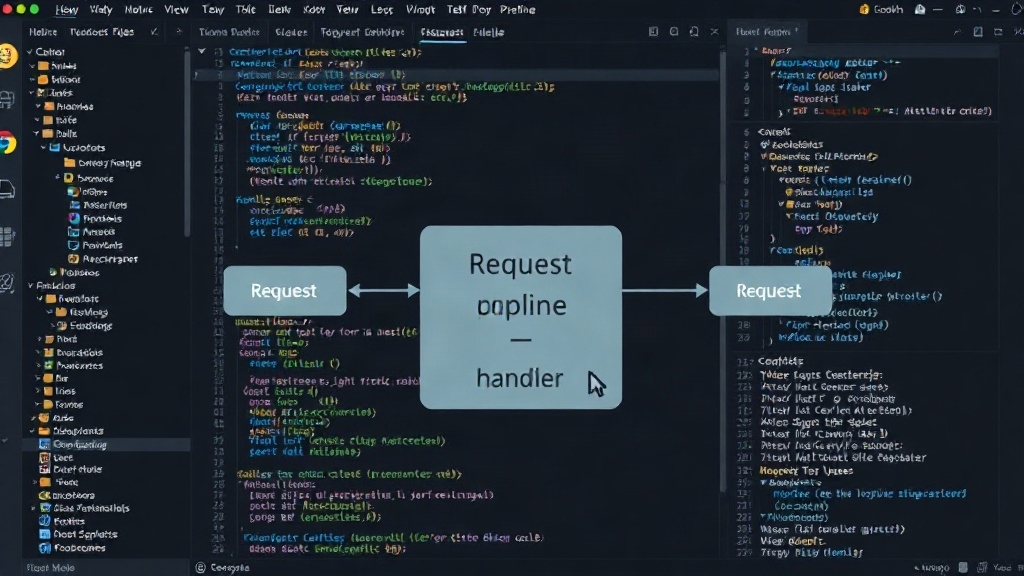
Topcoat's approach to request processing is also noteworthy. It employs a pipeline model where requests can pass through a series of handlers, each performing a specific task such as authentication, logging, or data transformation. This pattern is familiar to developers from other ecosystems but is implemented here with Rust's strict type system and zero-cost abstractions in mind. The goal is to provide a clear, traceable flow for requests while ensuring that each step incurs minimal performance penalty. This is akin to an assembly line in a highly efficient factory, where each station performs its task flawlessly before passing the product to the next, with no wasted movement or material.
Addressing the Ecosystem Gap
While Rust's core language features are compelling, the maturity of its server application ecosystem has been a point of discussion. Topcoat aims to bolster this ecosystem by providing not just a framework, but also by fostering best practices and encouraging the development of complementary libraries. The Tokio team's involvement suggests a strong commitment to long-term support and community engagement. This includes providing comprehensive documentation, examples, and guidance on how to effectively leverage Rust for demanding server workloads.
The framework is designed with future-proofing in mind. As Rust continues to evolve, Topcoat is expected to adapt, incorporating new language features and runtime improvements. This forward-looking approach is critical for an ecosystem that is still relatively young compared to established languages like Java or Python. By building on Tokio, Topcoat inherits a stable and performant foundation that is actively maintained and widely adopted within the Rust community.
The implications for developers are significant. For those already invested in Rust, Topcoat offers a path to build more complex and performance-critical server applications. For teams considering Rust for new projects, it lowers the barrier to entry for building robust backends. It positions Rust as a viable, and in many cases superior, alternative for scenarios that previously required the careful manual memory management of C++ or the garbage collection overhead of Go. The ability to achieve both high performance and strong safety guarantees in a single language is a powerful proposition for modern application development.
The Unanswered Question of Adoption
While the technical merits of Topcoat are evident, the ultimate success of the framework will hinge on its adoption by the developer community. The server application landscape is crowded, with established players and a wealth of existing codebases. Will Topcoat's promise of Rust's performance and safety be enough to entice developers away from familiar tools and ecosystems? What challenges will arise as developers begin to integrate Topcoat into large-scale production systems, and how will the community address them? These are questions that only time and widespread usage will answer.
Topcoat represents a significant step forward for Rust in the realm of server applications. By providing a high-level, performant, and safe framework, it lowers the barrier to entry for complex backend development. It challenges the status quo, positioning Rust as a serious contender for high-concurrency, low-latency services. As the framework matures and gains traction, it could redefine the landscape of modern server application development, making Rust a go-to choice for a broader range of critical infrastructure.