
The Tokio/Rayon Concurrency Conundrum
Rust developers often reach for Tokio for asynchronous I/O and Rayon for CPU-bound parallelism. On the surface, these libraries are designed to coexist, enabling efficient handling of both network requests and heavy computation. However, a subtle but significant trap exists when these two powerful tools are combined, particularly concerning how they manage threads and tasks. This isn't a bug in either library; rather, it's a consequence of their fundamental design philosophies clashing in certain common usage patterns.
The core of the issue lies in how Tokio's async runtime operates. Tokio uses a small pool of worker threads to poll asynchronous tasks. When an async function yields control (e.g., waiting for network data), Tokio can schedule another task onto that same worker thread. This is highly efficient for I/O-bound workloads, as it maximizes thread utilization without the overhead of traditional OS threads for each concurrent operation. Rayon, conversely, is designed for CPU-bound tasks and typically uses a larger thread pool, often sized to the number of CPU cores, to execute computations in parallel across multiple cores.
The Trap: Blocking the Async Runtime
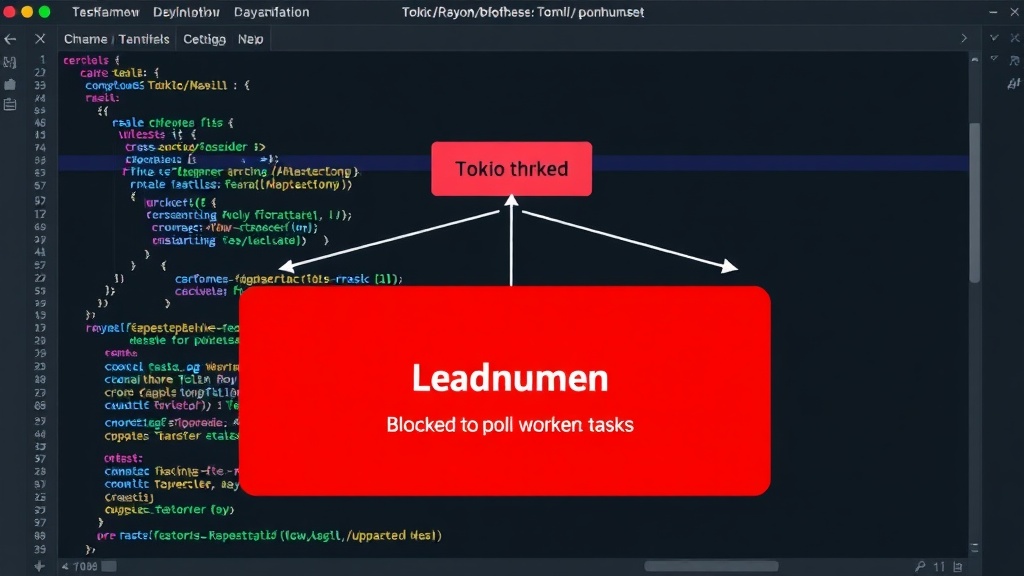
The problem emerges when a long-running, CPU-intensive operation, intended to be parallelized by Rayon, is executed within an asynchronous task managed by Tokio. If this Rayon-executed code blocks the Tokio worker thread, it prevents that thread from polling other asynchronous tasks. This effectively stalls the async runtime for any tasks scheduled on that particular worker thread.
Imagine an async function that needs to perform a complex data processing task. A naive approach might be to simply call a Rayon-powered parallel iterator directly within the async function. For example:
async fn process_data_async(data: Vec<u8>) -> Vec<u8> {
    let processed = data.into_par_iter().map(|byte| byte.wrapping_add(1)).collect::<Vec<u8>>();
    // ... other async operations ...
    processed
}
In this scenario, the .into_par_iter().map().collect() call, even though it leverages Rayon for parallelism *within* the computation, will block the Tokio worker thread until the entire parallel computation completes. If this computation takes a significant amount of CPU time, the Tokio worker thread cannot service other incoming network requests or wake up other pending async tasks. The entire async runtime's responsiveness degrades because one CPU-bound task, intended to be parallel, is hogging a critical asynchronous resource: the worker thread.
The Solution: Offloading CPU-Bound Work
The correct pattern is to explicitly offload CPU-bound work from the Tokio runtime's worker threads. This ensures that the async runtime remains responsive. Rust's standard library, and libraries like Tokio itself, provide mechanisms for this.
The most straightforward method is to use Tokio's spawn_blocking function. This function takes a closure that performs blocking I/O or CPU-bound work and executes it on a dedicated thread pool managed by Tokio specifically for blocking operations. This thread pool is separate from the async worker threads. When the blocking operation completes, it returns its result, and the original async task can resume.
Here's how the previous example would be rewritten using spawn_blocking:
use tokio::task;

async fn process_data_async_safely(data: Vec<u8>) -> Vec<u8> {
    let processed = task::spawn_blocking(move || {
        data.into_par_iter().map(|byte| byte.wrapping_add(1)).collect::<Vec<u8>>()
    }).await.expect("Blocking task failed");
    // ... other async operations ...
    processed
}
By wrapping the Rayon computation in task::spawn_blocking, the heavy lifting is moved to a dedicated thread pool. The original Tokio worker thread is freed up immediately after spawning the blocking task, allowing it to continue polling other async tasks. The .await on the spawned blocking task simply waits for the result to become available without blocking the executor's core loop.
Rayon's `join` and `scope` for Fine-Grained Control
While spawn_blocking is a robust solution, for more complex scenarios or when fine-grained control over parallelism is needed within an async context, Rayon's own primitives can be adapted. Rayon's join and scope functions allow for structured concurrency within a single thread or a specific set of threads. However, using these directly within an async task without careful consideration can still lead to blocking.
The key takeaway is that any operation that is inherently blocking or CPU-intensive, and could potentially take a non-trivial amount of time, should not be run directly on a Tokio async worker thread. This applies not only to Rayon computations but also to synchronous I/O operations, file system access, or any other long-running synchronous function call.
Beyond Tokio/Rayon: The General Async Principle
This Tokio/Rayon trap is a specific instance of a more general principle in asynchronous programming: never block the executor thread. Whether you're using Tokio, async-std, or another runtime, the threads responsible for polling and scheduling your asynchronous tasks must remain free to do so. Long-running computations or blocking I/O operations are the primary culprits that can bring an async application to a grinding halt.
Developers must consciously identify and offload these blocking operations. This often means using runtime-provided mechanisms like spawn_blocking or dedicated thread pools. For libraries that perform CPU-bound work, it's crucial to offer async-friendly APIs that either use offloading internally or clearly document how users should integrate them into an async environment.
The surprising detail here is not that these libraries can cause issues, but how subtly and easily this performance pitfall can be introduced by developers who are otherwise experienced with both async programming and parallel computation. It requires a specific understanding of how async runtimes manage threads to avoid the trap.
What This Means for Users
For users of applications built with Tokio and Rayon, this translates directly to responsiveness. An application that falls into the Tokio/Rayon trap might appear sluggish or unresponsive under heavy load, with requests taking an unpredictably long time to complete, or the entire application freezing. Debugging such issues can be challenging because the symptoms might not immediately point to a specific line of code but rather to a systemic interaction between the async runtime and parallel execution.
The solution, as demonstrated, requires developers to be mindful of their execution contexts. It’s about architecting asynchronous systems that keep the event loop clean and dedicated to its primary job: managing I/O and scheduling tasks efficiently. CPU-bound work, while essential, must be segmented and run in its appropriate environment.