
Understanding Token Limits and Costs
Large Language Models (LLMs) process text by breaking it down into tokens. These tokens are the fundamental units of text that an LLM understands. Depending on the model, a token can be a word, a part of a word, or even a punctuation mark. The length of an LLM's response, and therefore its cost and processing time, is directly tied to the number of tokens it generates.
Developers and users often face challenges when trying to predict how long an LLM's response will be. An unexpectedly long reply can lead to higher API costs, exceed character limits for certain applications, or simply take too long to process, negatively impacting user experience. This is particularly true for generative tasks where the output length can vary significantly.
The problem is that most LLM interfaces provide little to no immediate feedback on the potential length of a generated response before it's fully produced. Users submit a prompt and wait, only to discover later if the output was too long, too short, or too expensive. This trial-and-error approach is inefficient and can be costly, especially for high-volume applications or when experimenting with complex prompts.
Imagine writing an email and only finding out the word count after you've already finished typing it, and then being told it's too long for the recipient's inbox. That's the equivalent problem LLM users face when response length is unpredictable. It forces a reactive rather than proactive approach to managing LLM interactions.
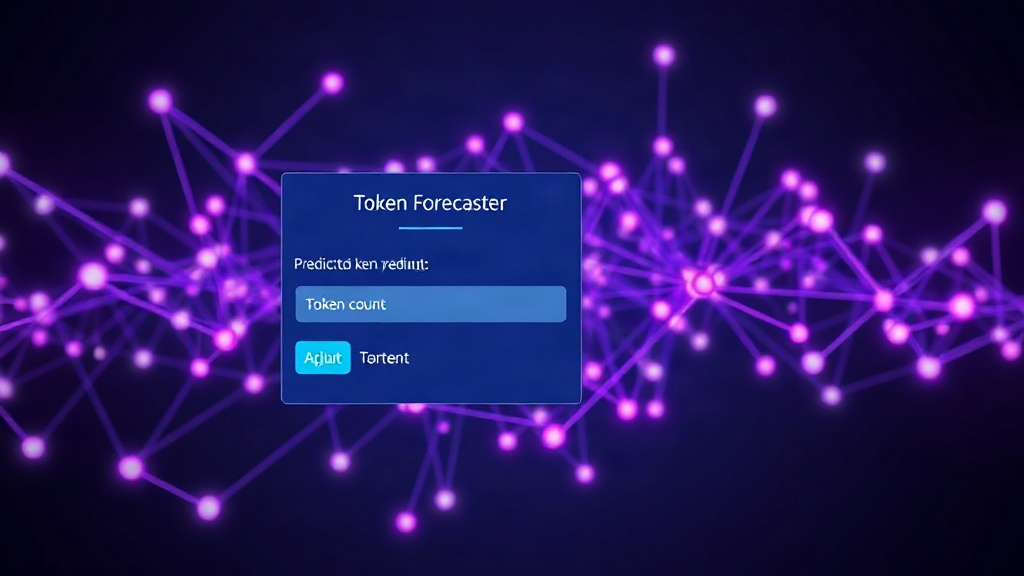
Introducing Token Forecaster
Token Forecaster emerges as a solution to this common pain point. Developed with the goal of providing foresight into LLM response lengths, the tool aims to allow users to estimate the number of tokens a model will generate before they hit the submit button. This predictive capability is crucial for anyone managing LLM usage, from individual developers prototyping applications to businesses integrating LLMs into production workflows.
The core functionality of Token Forecaster is to analyze a given prompt and, based on the LLM's known behavior or statistical models, predict the approximate token count of the ensuing reply. This prediction can then inform the user's decision-making process. If the forecast indicates a potentially lengthy or costly response, the user can refine their prompt, adjust parameters, or choose a different model altogether.
This proactive approach has several immediate benefits. Firstly, it enables better cost management. By forecasting token usage, users can avoid incurring unexpected high bills from LLM API providers. Secondly, it improves efficiency. Developers can iterate on prompts more quickly, knowing whether a particular line of inquiry is likely to yield an excessively long output that might require further processing or truncation.
Furthermore, for applications where response time is critical, such as real-time chatbots or interactive assistants, predicting response length can help manage user expectations and system load. A user can be informed that a complex query might take longer to process, or the system can preemptively manage resources based on estimated output size.
How Token Forecaster Works (Conceptual)
While the exact technical implementation details are not fully elaborated by the product's initial announcement, the concept likely involves one or a combination of several approaches. One possibility is that Token Forecaster leverages historical data from a specific LLM. By analyzing a vast dataset of prompts and their corresponding generated replies, it can build statistical models that correlate prompt characteristics (length, keywords, complexity) with reply token counts.
Another approach might involve a lighter-weight, internal model that simulates or approximates the LLM's generation process. This wouldn't require running the full LLM but would offer a reasonable estimate of its output. This is akin to a chef tasting a small sample of a dish to predict the final flavor profile, rather than cooking the entire meal just to find out.
The tool's interface, as suggested by its Product Hunt debut, is likely designed for simplicity. Users would input their prompt, and the tool would output a predicted token count. Advanced versions might allow users to select the target LLM (e.g., GPT-3.5, GPT-4, Claude, Llama) as different models have varying tokenization schemes and generation patterns. This would enhance the accuracy of the predictions.
The