
The AI Divide: Generation vs. Decision-Making
The current wave of AI innovation is largely defined by generative models – systems that can create text, images, and code. Large Language Models (LLMs) like GPT-4 and Claude have captured the public imagination with their ability to produce human-like content. However, a critical gap exists between generating content and making reliable, verifiable decisions. This is where specialized AI systems, distinct from general-purpose LLMs, are poised to make a significant impact. TypeSafe AI's Jev platform represents a new frontier, aiming to bridge this gap by focusing on accuracy, latency, calibration, and confidence in classification tasks, moving AI from creative generation to critical decision-making.
The distinction between generation and decision-making is crucial for enterprise AI adoption. While LLMs excel at tasks requiring creativity and broad knowledge synthesis, they often struggle with the precision, explainability, and deterministic outputs required for operational systems. Imagine a customer service chatbot: an LLM can draft a helpful response, but a specialized system is needed to accurately classify the customer's intent (e.g., 'billing inquiry,' 'technical support,' 'cancellation') and route it to the correct department or trigger an automated action. This is the domain where Jev operates.
Testing Jev's Decision Capabilities
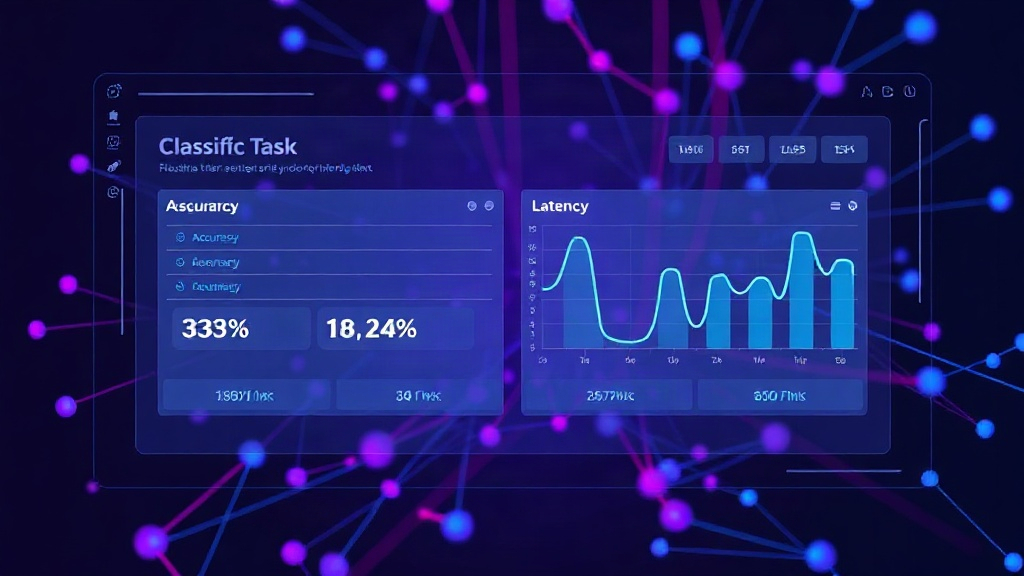
To assess Jev's viability as a decision layer, a comprehensive benchmark was conducted. The platform was tested across 3,080 distinct classification tasks. These tasks represent a broad spectrum of real-world use cases, requiring the AI to categorize inputs into predefined classes. The evaluation focused on four key metrics: accuracy, latency, calibration, and confidence. These metrics are paramount for any system intended to make decisions that impact business operations or user experience.
Accuracy measures how often Jev correctly classifies an input. Latency is critical for real-time applications, indicating how quickly a decision can be made. Calibration refers to how well the model's predicted probabilities align with the actual likelihood of correctness – a well-calibrated model means a 90% confidence score truly reflects a 90% chance of being right. Confidence, often intertwined with calibration, reflects the model's certainty in its predictions.
Performance Benchmarks: Jev vs. LLMs
The results from the 3,080 classification tasks reveal a significant divergence in performance between Jev and traditional LLMs when applied to decision-making scenarios. Jev consistently outperformed LLMs across the board, particularly in accuracy and latency. For tasks demanding high precision, such as fraud detection, medical diagnosis support, or financial transaction categorization, Jev’s specialized architecture proved more reliable. LLMs, while capable of performing classification, often required extensive prompt engineering and fine-tuning, and even then, their performance could be variable and less predictable.
Latency is another area where Jev shines. In scenarios where immediate action is necessary – for example, approving or denying a credit card transaction in real-time – the sub-millisecond response times of Jev are a stark contrast to the seconds often required by larger LLMs to process a request. This speed advantage makes Jev suitable for applications where milliseconds count, a requirement that general-purpose LLMs typically cannot meet without significant trade-offs in model size or infrastructure complexity.
Calibration and confidence are equally important. Decision-making AI must not only be accurate but also provide reliable confidence scores. If a system assigns a 99% confidence to a prediction that is actually wrong 10% of the time, it can lead to disastrous outcomes. Jev’s design emphasizes robust probability estimation, ensuring that its confidence scores are trustworthy indicators of its accuracy. This is a hallmark of systems built for decision-making, where understanding the certainty of a prediction is as vital as the prediction itself.
The Practicality of a Decision Layer
The implications of Jev’s performance extend beyond benchmarks. It suggests that a practical, dedicated 'decision layer' for AI systems is not only possible but increasingly necessary. As AI applications mature and move from experimental phases to critical production environments, the need for specialized tools that guarantee performance, reliability, and explainability becomes paramount. LLMs will continue to play a vital role in content generation, summarization, and complex reasoning, but for discrete, high-stakes classification and decision tasks, specialized models like Jev offer a more robust and efficient solution.
Consider the architecture of an advanced AI system. Instead of relying on a monolithic LLM to handle every aspect, a hybrid approach becomes more effective. An LLM might be used for initial data interpretation or user interaction, but critical decisions – such as whether to approve a loan, flag a security threat, or route a support ticket – would be delegated to a specialized, high-performance system like Jev. This modularity allows for optimization: using the right tool for the right job. It also enhances security and compliance, as specialized systems can be designed with stricter controls and audit trails.
The Future of AI: Specialization and Trust
The rapid evolution of AI presents a dichotomy: the broad, creative power of LLMs and the precise, reliable decision-making capabilities of specialized systems. The success of Jev in classification tasks points towards a future where AI systems are built with modularity and specialization in mind. Developers and businesses can leverage LLMs for their generative strengths while integrating dedicated decision engines for critical operational functions.
This shift is not about LLMs being obsolete, but rather about recognizing their limitations and understanding where specialized AI excels. The AI landscape is expanding, and the demand for trustworthy, high-performance decision-making tools will only grow. Jev's performance in this benchmark suggests it is well-positioned to meet that demand, enabling AI to move beyond generating possibilities to making concrete, reliable decisions.
What remains to be seen is how quickly other specialized decision-making AI platforms will emerge and how they will integrate with the ubiquitous LLM ecosystem. The ability to seamlessly orchestrate between generative and decision-making AI will be key to unlocking the next generation of intelligent applications.