The Inference Pipeline Tycoon Challenge
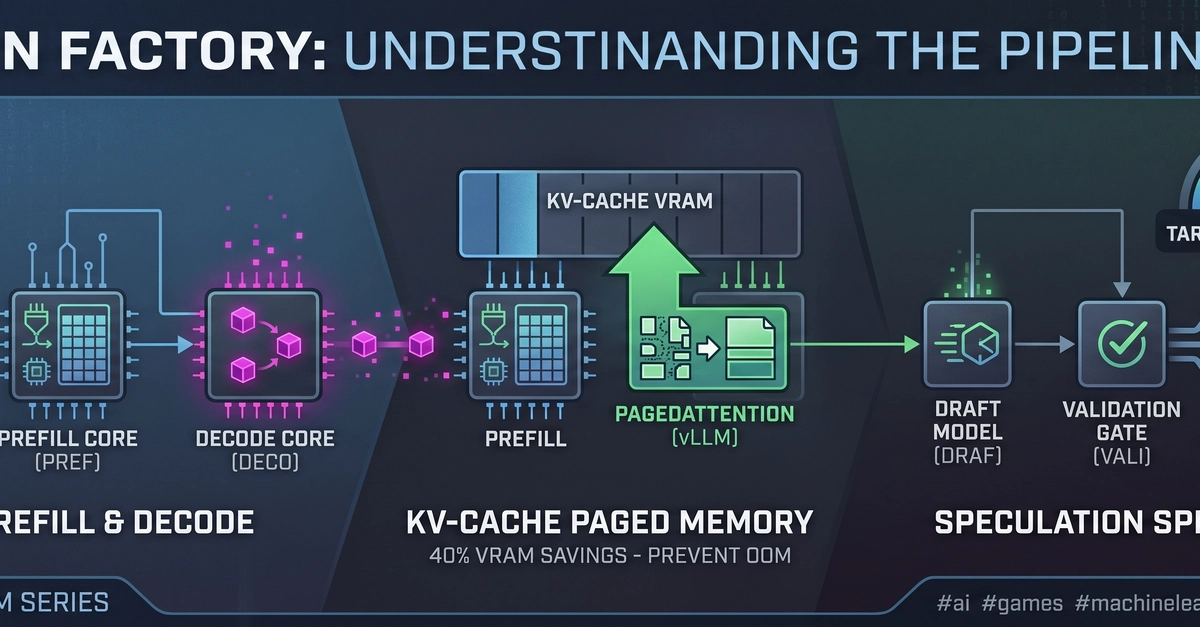
Deploying large language models (LLMs) at scale is a high-stakes balancing act. Frameworks like vLLM, TensorRT-LLM, and Hugging Face TGI face the constant challenge of delivering tokens to users efficiently while managing complex internal processes. These include scheduling prompt pre-computation, efficiently paging memory segments, verifying speculative token chains, and avoiding system-crippling bottlenecks. To demystify this intricate process, an interactive simulation game, aptly named "Inference Pipeline Tycoon," has been developed. It offers a hands-on approach to understanding how LLMs are deployed, optimized, and served under demanding concurrent loads.
The game invites players to step into the role of an infrastructure architect, tasked with managing the flow of tokens through a simulated LLM deployment pipeline. The core objective is to maintain high throughput and low latency, even as user demand fluctuates and internal system pressures mount. Players must make critical decisions about resource allocation, scheduling strategies, and memory management to keep the pipeline healthy and responsive.
Navigating Terminal Levels
The player's journey through the complexities of LLM infrastructure is structured into distinct "terminal levels." Each level introduces new challenges and escalates the demands on the simulated pipeline. These levels are designed to progressively teach the fundamental concepts and trade-offs involved in optimizing LLM serving. Players begin with simpler scenarios, gradually encountering more sophisticated problems that require a deeper understanding of the underlying mechanics.
For instance, an early level might focus on basic prompt pre-computation and token generation. As players advance, they will face challenges related to memory management, such as efficiently paging segments of the LLM's weights to and from GPU memory. This is crucial because LLMs often exceed the capacity of a single GPU, necessitating sophisticated memory management techniques to swap in and out the required model parameters dynamically. The game simulates the latency introduced by these operations, forcing players to find the optimal balance between memory usage and inference speed.
Further levels introduce speculative decoding, a technique where the model predicts multiple potential next tokens simultaneously. This can significantly speed up inference, but it requires careful verification of the predicted token chains. The simulation models the computational overhead and potential for wasted computation if speculative branches are incorrect. Players must learn to tune the parameters of speculative decoding to maximize its benefits without introducing excessive complexity or resource contention.
The Bottleneck Battle
A central theme throughout the simulation is the constant battle against system bottlenecks. These can arise from various sources: insufficient GPU compute, slow memory bandwidth, network latency, or inefficient scheduling. The game visualizes these bottlenecks, showing players where their pipeline is struggling. For example, a CPU bottleneck might occur if prompt processing is too slow, leading to idle GPUs. Conversely, a GPU bottleneck could happen if the model is too large or complex for the available compute power, causing tokens to back up.
Players are presented with a dashboard of key performance indicators (KPIs) such as tokens per second, latency, GPU utilization, and memory usage. By monitoring these metrics, they can diagnose issues and implement solutions. Solutions might involve adjusting batch sizes, optimizing prompt processing logic, reconfiguring speculative decoding parameters, or even upgrading the simulated hardware. The game emphasizes that there is no single perfect configuration; the optimal setup depends heavily on the specific LLM, the hardware, and the workload characteristics.
One of the surprising details is how quickly a seemingly minor inefficiency can cascade into a major performance degradation. A slight delay in memory paging, for instance, can cause GPUs to starve for data, leading to a significant drop in throughput. This highlights the interconnectedness of the various components in an LLM inference pipeline. It's less like a linear assembly line and more like a complex, interconnected circulatory system where a blockage in one artery affects the entire body.
Beyond the Game: Real-World Implications
While presented as a game, "Inference Pipeline Tycoon" serves as a powerful educational tool. It translates abstract concepts of distributed systems, memory management, and parallel processing into an engaging and interactive experience. Developers and operations teams who manage LLM deployments can use this simulation to gain intuition about the trade-offs involved in optimizing inference performance.
The lessons learned in the game directly apply to real-world LLM serving frameworks. Understanding how to manage memory efficiently, how to tune speculative decoding, and how to identify and mitigate bottlenecks are critical skills for anyone working with LLMs in production. The game provides a safe environment to experiment with different strategies and observe their impact without the risk of disrupting live services.
The ultimate goal of these optimizations is to reduce the cost of serving LLMs and to improve the user experience by providing faster and more responsive AI applications. As LLM adoption continues to grow, the demand for efficient and scalable deployment solutions will only increase. Tools and simulations like "Inference Pipeline Tycoon" are essential for building the expertise needed to meet this demand.
What remains to be seen is how such simulation tools will evolve to incorporate the latest research in LLM optimization, such as advanced quantization techniques or novel attention mechanisms. As the field progresses, these educational simulations will need to adapt to reflect the ever-changing landscape of LLM deployment.