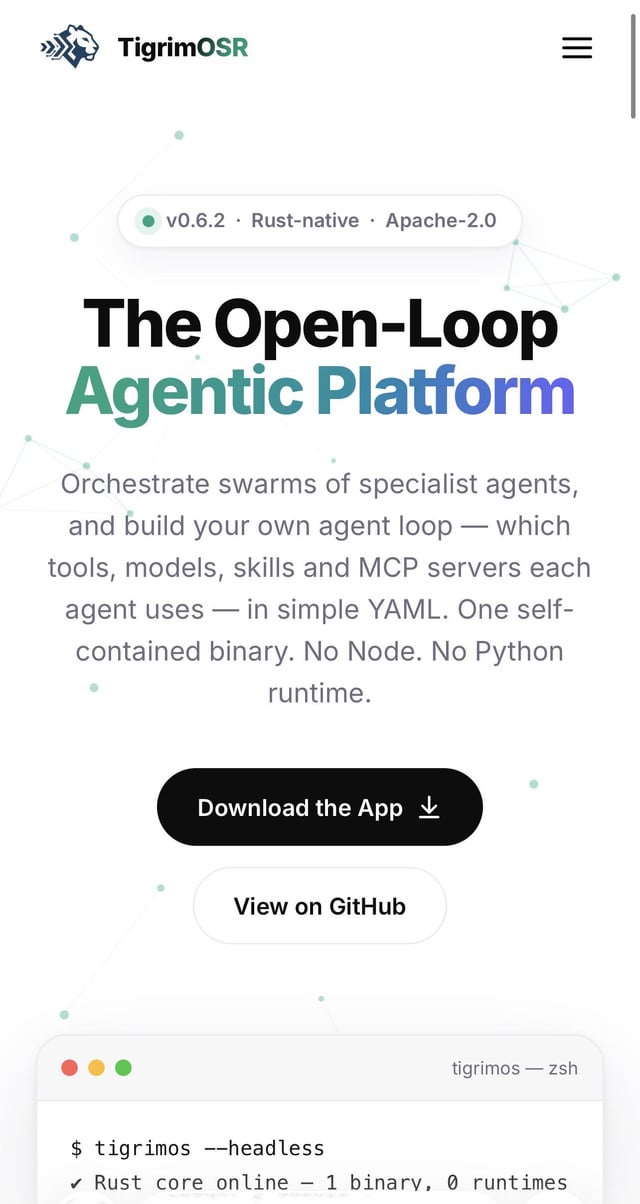
TigrimOSR: Customizable Agentic AI in Native Rust
A new open-source project, TigrimOSR, emerges as a native Rust desktop application designed to streamline the creation and execution of multi-agent AI workflows. Developed by an individual engineer, the system prioritizes flexibility by allowing the entire agentic loop to be configured via YAML files, rather than being hardcoded. This approach empowers developers to experiment extensively with different AI agent behaviors and configurations without deep-diving into core code.
TigrimOSR's core innovation lies in its highly configurable agent loop. Developers can define and modify key aspects of the AI's decision-making and operational process. This includes specifying the exact behavior of the agent loop itself, which dictates how agents interact, process information, and execute tasks. The system also allows for granular control over the tools available to each agent. This means developers can curate a specific set of functions or external services that agents can call upon, tailoring their capabilities to the task at hand.
Further customization options extend to the selection of Large Language Models (LLMs). TigrimOSR supports flexible model selection, enabling users to choose specific models for different agents or tasks, potentially optimizing for performance, cost, or specific capabilities. System prompts, which guide the AI's persona and objective, are also fully customizable. This is crucial for ensuring agents operate within defined parameters and maintain desired behaviors. The inclusion of self-verification rules adds a layer of robustness, allowing agents to check their own outputs or reasoning processes for errors or inconsistencies before proceeding.
The system also features configurable loop limits, preventing infinite loops and managing resource consumption. MCP (Multi-agent Communication Protocol) servers and agent 'skills' can also be defined and managed through the YAML configuration. This comprehensive configurability aims to abstract away much of the boilerplate code typically associated with building agentic systems, allowing developers to focus on the AI's logic and emergent behaviors.
Developer Experience and Customization
The primary goal of TigrimOSR is to facilitate rapid experimentation. By moving orchestration logic into declarative YAML files, the barrier to entry for exploring complex multi-agent interactions is significantly lowered. Developers can iterate on agent strategies, tool usage, and model interactions quickly. This is particularly valuable in the rapidly evolving field of AI agents, where new techniques and architectures are constantly emerging.
The choice of Rust as the development language is significant. Rust offers strong performance, memory safety guarantees, and concurrency primitives, which are essential for building robust and efficient AI systems, especially those that might involve parallel agent processing or high-throughput operations. This native approach contrasts with many existing agent frameworks that are often built on higher-level scripting languages, potentially incurring performance overhead.
TigrimOSR's architecture supports custom tools and skills. This means developers are not limited to a predefined set of functionalities. They can integrate their own custom code or external services as tools that agents can leverage. This extensibility is vital for building specialized AI agents capable of performing a wide range of tasks, from data analysis and code generation to complex simulation or automation.
The Agentic Loop: A Core Concept
At its heart, TigrimOSR is about providing a flexible framework for agentic loops. An agentic loop is the fundamental cycle through which an AI agent perceives its environment, makes decisions, and acts. In TigrimOSR, this loop is not a fixed piece of code but a configurable sequence of operations. Developers can define:
- Perception: How the agent gathers information from its environment or inputs.
- Reasoning: The process by which the agent analyzes information and decides on a course of action, potentially using LLMs or other logic.
- Action: The execution of the decided-upon action, which might involve using a tool, communicating with another agent, or generating an output.
- Self-Correction/Verification: The agent's internal checks to ensure the validity and effectiveness of its reasoning and actions.
By making each stage of this loop and the transitions between them configurable, TigrimOSR allows for the creation of diverse agent architectures. For instance, one agent might have a simple observe-act loop, while another might incorporate a complex planning, reflection, and verification stage. The system's ability to manage multiple such agents and their interactions is key to its utility.
Potential Applications and Future Development
The flexibility of TigrimOSR suggests a wide range of potential applications. Developers could use it to build sophisticated chatbots with custom personalities and tool access, create automated research assistants that can synthesize information from various sources, or develop complex simulation environments where multiple AI agents interact. The native Rust implementation also positions it as a strong candidate for performance-critical applications where latency and resource efficiency are paramount.
The project is currently open-source, inviting community contributions and further development. As the field of agentic AI continues to expand, tools like TigrimOSR that offer deep customizability and performance advantages are likely to gain traction. The focus on a declarative configuration approach, coupled with the power of Rust, positions TigrimOSR as an interesting development for anyone building advanced AI systems.