The Phantom Performance Degradation
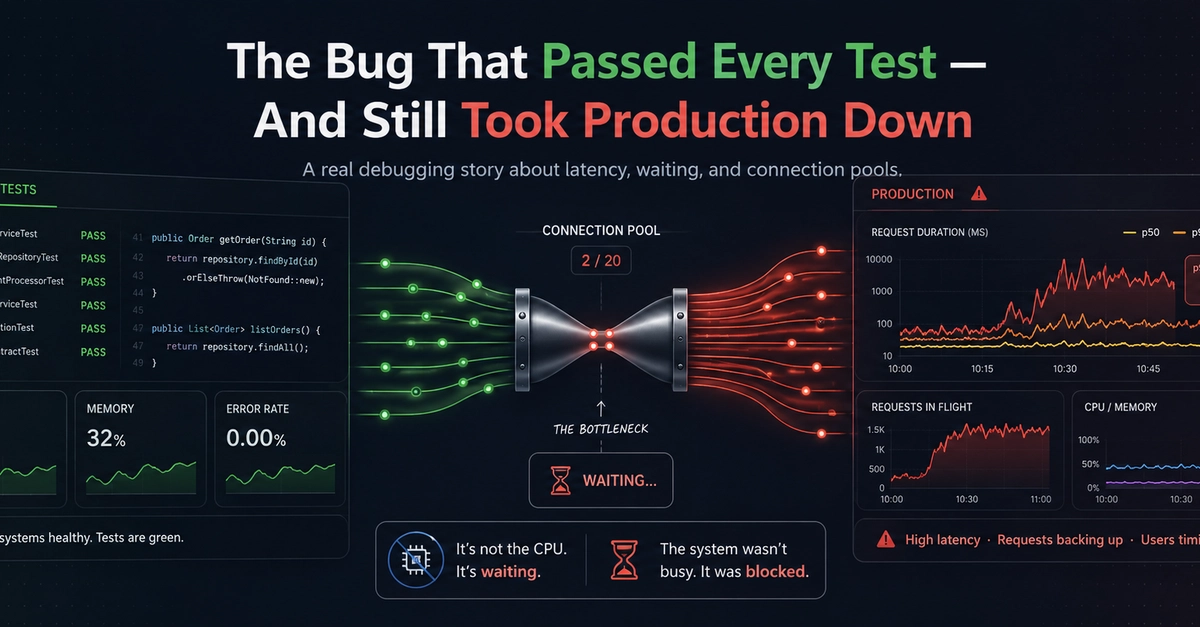
Imagine a backend service that looks perfect on paper. Tests are green. CPU and memory metrics are nominal. No obvious exceptions litter the logs. Yet, periodically, requests transform from snappy responses of 80-120ms into agonizing 8-12 second waits. Then, just as mysteriously, everything returns to normal. These are the most insidious bugs, the ones that don’t crash systems but instead erode user trust and productivity through intermittent, severe slowdowns.
This was the reality for a team battling a production issue that defied conventional debugging. The initial instinct was to scrutinize recent code changes – a reasonable starting point for any performance degradation. The team meticulously reviewed database queries, serialization logic, background job queues, caching strategies, and newly introduced endpoints. Each area checked out. No single commit or configuration change explained the sporadic, crippling latency.

The First Mistake: Focusing Solely on Application Code
The team’s initial approach, while logical, proved to be a dead end. By focusing on application-level code, they overlooked a critical dependency. The problem wasn't necessarily in what the service was doing, but how it was interacting with its environment, specifically its underlying infrastructure and external services. The symptoms – slow requests that eventually recovered – suggested a resource contention or a subtle deadlock scenario that wasn't manifesting as a hard failure but as a resource starvation event.
When a system becomes sporadically slow, the first hurdle is proving that a problem even exists and then identifying its location. Unlike a crash, which provides an immediate stack trace or error message, a slowdown requires careful observation and correlation of metrics across multiple layers of the system. The team was essentially hunting a ghost. They could see its effects – the sluggish response times – but couldn't pinpoint its source through traditional code inspection.
Unraveling the Intermittent Bottleneck
The breakthrough came when the team shifted their focus from *what* the application code was doing to *how* the application was behaving under load, and critically, *what it was waiting on*. They began instrumenting the application more deeply, not just for exceptions, but for resource acquisition and release events, and for the duration of calls to external dependencies.
This deeper dive revealed a pattern. During periods of high load, the service was making a specific type of external API call. This call, under normal circumstances, was fast. However, when the external service experienced its own intermittent performance issues or resource constraints, it would start responding much slower. The backend service, however, was configured with relatively short timeouts for this particular call, but critically, it wasn't implementing proper backpressure or circuit-breaking mechanisms. Instead of failing fast or retrying intelligently, it would simply wait for the slow response, holding onto its own resources (threads, connections) in the process.
This had a cascading effect. As more requests timed out or waited for these slow external responses, the backend service’s thread pool began to fill up. Threads that should have been available to process new, legitimate requests were now blocked, waiting for an external operation that was taking an order of magnitude longer than expected. This created a self-inflicted denial-of-service, where the system appeared healthy because no code errors were occurring, but it was effectively starving itself of resources due to a slow dependency.
The Root Cause: A Subtle Resource Exhaustion
The actual bug wasn't in the team's code logic itself, but in its handling of an unreliable dependency. The external API call was essential, but its intermittent slowness, combined with the backend service’s naive waiting strategy, led to resource exhaustion. The system wasn't crashing; it was choking. Threads were tied up, connection pools were depleted, and new requests would either queue up indefinitely or experience the severe latency as they waited for a freed resource.
The recovery was also self-inflicted. Eventually, the load on the external service would subside, its responses would speed up, and the backend service’s blocked threads would complete their operations. As threads became available, the backlog of requests would be processed, and normal performance would resume. This cycle explained the intermittent nature of the problem. The tests, running in a controlled, low-load environment, never triggered this specific failure mode. They couldn’t replicate the complex interplay of high application load, external service latency, and resource contention.
Lessons Learned and Mitigation Strategies
This incident underscores several critical lessons for building resilient systems:
- Dependency Resilience: Never assume external services are always fast and available. Implement robust strategies like timeouts, retries with exponential backoff, circuit breakers, and bulkheads to isolate failures and prevent cascading issues.
- Deep Observability: Beyond basic metrics and logs, instrument your applications to understand resource utilization (thread pools, connection counts) and the performance of critical external calls. Distributed tracing is invaluable here.
- Load Testing Realities: Standard unit and integration tests are insufficient for catching these types of bugs. Performance and soak testing under realistic, high-load conditions are essential.
- Systemic Thinking: Bugs are often not isolated to a single piece of code but emerge from the interaction between components. Consider the entire system, including infrastructure and external dependencies, when debugging.
The team eventually implemented stricter timeouts on the problematic external calls, coupled with a circuit breaker pattern. When the external API exceeded a certain latency threshold for a sustained period, the circuit breaker would trip, causing subsequent calls to fail immediately rather than waiting. This prevented the thread pool from being exhausted. They also added more sophisticated load testing that simulated slow external dependencies, ensuring that future commits wouldn't reintroduce similar vulnerabilities.
This bug served as a stark reminder that passing all tests is a necessary but not sufficient condition for production readiness. True resilience comes from anticipating and gracefully handling the inevitable imperfections of distributed systems and their dependencies.