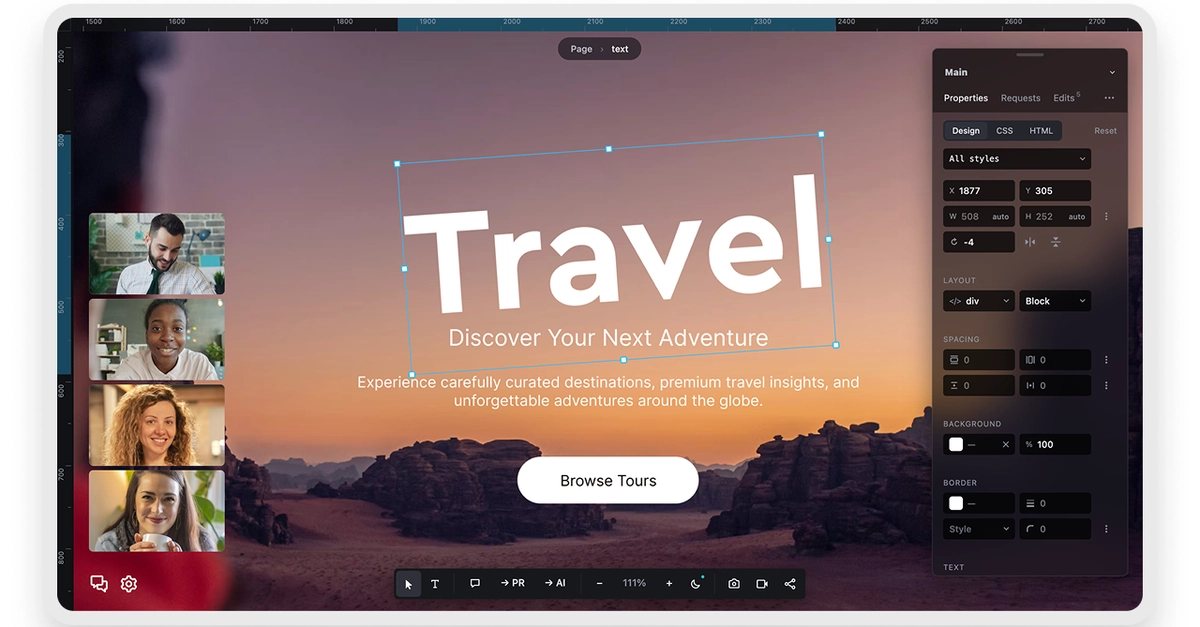
Visual Editing for AI Code Generation
Coding agents are rapidly advancing, capable of generating significant amounts of code. However, communicating complex or nuanced changes, especially visual ones, to these agents remains a bottleneck. Traditional methods involve detailed text prompts, screenshots with annotations, or extensive descriptions, all of which can be time-consuming and prone to misinterpretation. Pixy, a new project, addresses this challenge by introducing a visual interface that allows users to directly manipulate website elements, translating these visual edits into instructions for AI coding agents.
The core idea behind Pixy is to transform a live website into a direct canvas for editing. By adding a single script tag to an existing website, Pixy overlays a visual editing layer. This layer enables users to select elements on the page—such as sections, headings, or specific layout components—and modify properties like spacing, size, position, typography, and overall layout. The experience aims to feel intuitive, akin to using a standard website builder, but with the critical difference that the changes are then interpreted and actioned by an AI agent.

Bridging the Gap Between Design and AI
For developers and designers who rely on AI agents for website development, the friction point has often been the disconnect between visual intent and the agent's understanding. Describing precise pixel adjustments, responsive behavior across different breakpoints, or subtle aesthetic tweaks through text alone is inefficient. Pixy's approach bypasses this by enabling direct visual interaction. A user can simply drag a section to make it narrower, move a heading, or adjust spacing at a particular breakpoint. Pixy captures these direct manipulations and converts them into actionable commands for the AI.
This visual-to-prompt translation is a significant step towards a more natural human-AI collaboration in web development. Instead of painstakingly crafting prompts that describe what a change should look like, users can simply make it look that way. This not only speeds up the iteration process but also reduces the cognitive load on the user and minimizes the chances of the AI misunderstanding the desired outcome. The system effectively turns the live website into the definitive source of truth for the desired state, with Pixy acting as the interpreter.
Harnessing AI Agents with Control and Oversight
While Pixy focuses on the user interface for directing AI agents, the broader ecosystem for AI-powered development is also evolving. Harness, for instance, has launched initiatives like the Agent-Ready Harness Code Repository and AI Code Review. These tools are designed for teams that are increasingly using AI agents to produce code. They introduce a control layer around the code generated by AI, rather than simply being another code generator.
Harness’s approach emphasizes scoped permissions for AI agents, allowing them access only to specific repositories, branches, or environments. This is crucial for maintaining security and preventing unintended consequences. Furthermore, their system groups code differences (diffs) by risk and can enforce AI checks that must pass before a merge is allowed. This means that permissions and review policies are integrated directly into the agent workflow, transforming them from a post-merge cleanup task into an essential part of the development pipeline. The repository is offered with a free tier, starting with 50 GB of storage, making it accessible for teams to begin integrating AI code review into their processes.
The Future of Human-AI Collaboration in Development
The convergence of visual interfaces like Pixy and robust control layers like Harness’s offerings points to a future where AI agents are not just tools but integrated team members. Pixy empowers the human user to provide precise, intuitive feedback on visual aspects, while systems like Harness ensure that the AI’s output is secure, compliant, and aligned with team standards. This dual approach addresses both the usability and the governance challenges of AI-driven development.
For developers, this means a shift from writing verbose instructions to visually guiding AI. For product managers and designers, it offers a more direct way to iterate on visual designs without needing to be proficient coders or overly reliant on developer interpretation. The ability to directly modify elements on a live page and have an AI agent implement those changes promises to accelerate design-to-deployment cycles significantly. The key benefit is the reduction of ambiguity; what you see is what you get, and what the AI implements.
The underlying technology likely involves advanced DOM inspection, style parsing, and the ability to translate abstract visual changes into concrete CSS, HTML, and potentially JavaScript modifications. The challenge lies in accurately capturing user intent from visual interactions, especially for complex layouts and dynamic behaviors. Pixy’s success will hinge on its ability to interpret a wide range of visual edits reliably and translate them into clean, efficient code that AI agents can then seamlessly integrate.
As AI agents become more sophisticated, the interfaces we use to interact with them must evolve. Visual tools like Pixy are a natural progression, making AI development more accessible and efficient. Coupled with the necessary control and review mechanisms, the integration of AI into the coding workflow is set to become more seamless and secure, allowing human creativity to focus on higher-level problem-solving rather than the minutiae of instruction-giving.