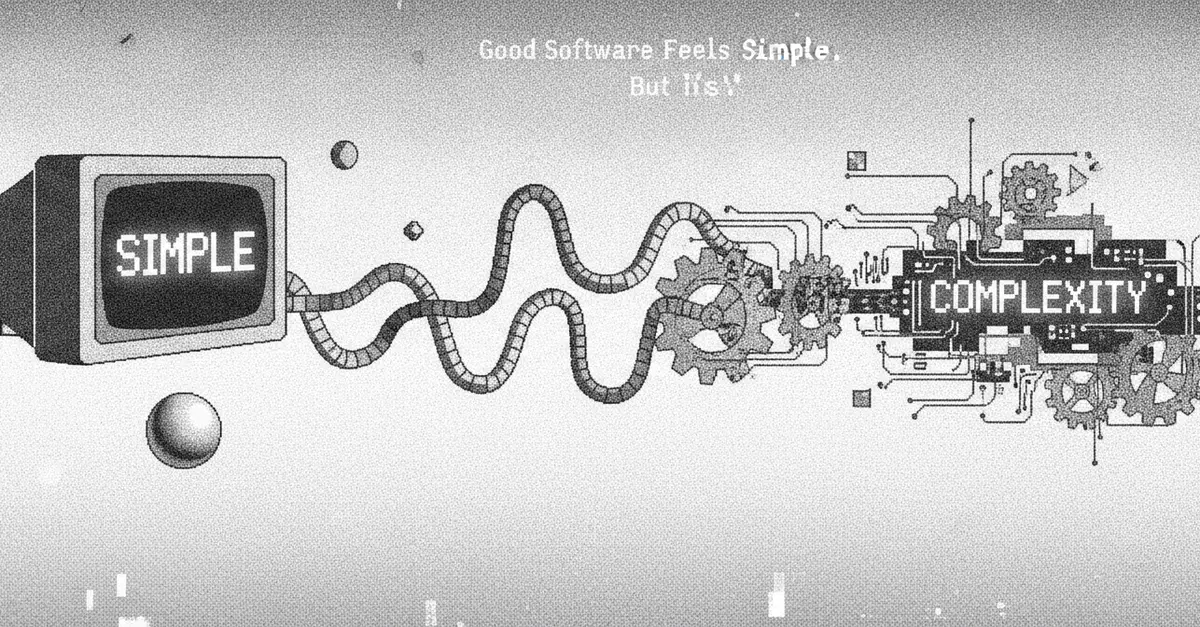
The common wisdom for software development, especially for new founders, often leads down a path of relentless feature addition. We add one more button, one more screen, one more setting, one more animation, believing that ‘more equals better.’ This approach feels productive, a tangible sign of progress. However, in most cases, it results in software that is more complicated, not more valuable.
The Deceptive Nature of Simplicity
When we describe software as simple, we are not referring to the ease of its construction. Instead, simplicity in software means it feels natural to the user, creating an experience where the product seems to understand their intent. This understanding allows users to accomplish their goals with minimal friction. This effortless feel is the hallmark of exceptional software, yet it is ironically the most challenging to engineer.
The best software rarely impresses users with its sheer volume of capabilities. Instead, its impact comes from how deeply it grasps user needs and facilitates their objectives with the least possible effort. Think of it less like a Swiss Army knife with a thousand tools, and more like a perfectly tuned instrument that plays exactly the right note at the right time, every time. The engineering behind that single, perfect note is often vastly more complex than creating a dozen mediocre ones.
The Engineering Behind Effortless Experiences
Creating a user experience that feels simple requires significant engineering effort. It involves understanding the core problems users are trying to solve and then designing systems that abstract away the underlying complexity. This means not just building features, but meticulously designing the interactions, the data flows, and the underlying architecture to support an intuitive user journey. It’s about making the difficult appear easy.
Consider the difference between a command-line interface (CLI) and a graphical user interface (GUI). A CLI can offer immense power and flexibility, allowing expert users to perform complex operations with precise commands. However, for the average user, it presents a steep learning curve and significant cognitive load. A well-designed GUI, on the other hand, can expose that same power through intuitive visual elements, making it accessible to a much broader audience. The GUI might look simple on the surface, but the engineering required to map complex operations to intuitive interactions, manage state, and provide immediate feedback is substantial. It’s a sophisticated form of misdirection, where the user sees only the elegant solution, not the intricate problem-solving that made it possible.
The Pitfalls of Feature Creep
The drive to add more features, often fueled by a desire to appear competitive or to cater to every conceivable edge case, leads to feature creep. This is the process by which a product becomes bloated with functionalities that, while perhaps useful to a select few, detract from the core experience for the majority. Each new feature adds to the cognitive load, increases the potential for bugs, complicates maintenance, and dilutes the product’s core value proposition. What starts as a focused solution morphs into a complex, unwieldy application that tries to be everything to everyone, and ends up being a master of nothing.
Founders and developers must resist the temptation to equate feature count with product quality. The true measure of good software lies in its ability to solve user problems effectively and efficiently. This requires a disciplined approach to product development, focusing on core user needs and ruthlessly pruning features that do not contribute to that central goal. It means making hard decisions about what not to build, and investing the saved engineering effort into refining the essential functionalities.
The Unseen Complexity of a Single Button
What does it take to build a truly simple interface, like a single button that performs a complex, multi-step operation flawlessly? It requires understanding the user's context, anticipating potential errors, and designing a robust backend to handle the operation. This might involve complex state management, sophisticated error handling, background processing, and clear feedback mechanisms to the user. The button itself is just the visible tip of a massive iceberg of engineering. The real work happens beneath the surface, orchestrating a symphony of processes to deliver a seamless outcome. This hidden complexity is the secret sauce that makes sophisticated software feel effortlessly simple.
The challenge, then, for any software team, is to invest in the engineering that masks complexity, rather than adding to it. This means prioritizing user research, focusing on core workflows, and dedicating resources to building robust, scalable, and maintainable systems. It requires a shift in mindset from quantity of features to quality of experience. The goal is not to build software that is easy to build, but software that is easy and delightful to use. This pursuit of perceived simplicity is the ultimate test of engineering skill and product vision.
Ultimately, the software that feels simple is the software that has had its complexity most effectively managed and hidden. It's a testament to the engineering team's ability to understand user needs so deeply that they can construct an experience that feels intuitive, natural, and, above all, simple.