Understanding the .NET System Namespace
If you write C# daily, you interact with the System namespace constantly, often without explicit thought. This foundational namespace is the bedrock of .NET development, housing fundamental types and services that underpin virtually every application. It’s crucial to understand its scope, its contents, and its significance beyond just being a collection of classes.
A common point of confusion is the designation of System itself. It is not a class, but rather a namespace. Namespaces serve as logical containers, organizing a vast array of classes, structs, interfaces, and delegates. Prominent examples of types residing within System include System.String for text manipulation, System.Console for input/output operations, and System.DateTime for handling dates and times. The architecture behind System is complex, involving multiple assemblies and a deep integration with the .NET runtime.
Historical Roots and Evolution
The System namespace has been a cornerstone of the .NET Framework since its inception. Introduced in 2002 with the initial release of .NET, it has evolved significantly across .NET Framework, .NET Core, and the current unified .NET platform. Its longevity speaks to its fundamental importance and the careful management of its evolution. While the core types remain, new additions and refinements have kept pace with the language and platform advancements.
Core Components and Sub-Namespaces
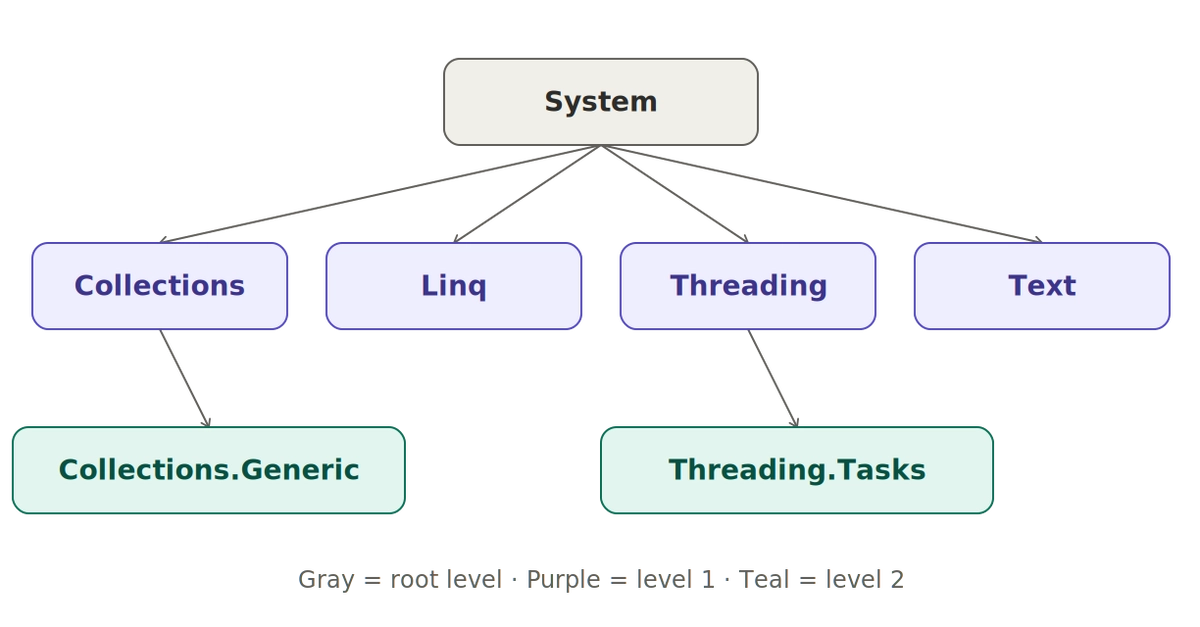
The System namespace is not monolithic; it’s a vast ecosystem containing numerous sub-namespaces, each dedicated to specific functionalities. Understanding these can significantly improve how developers leverage .NET's capabilities.
System.Collections: This sub-namespace provides fundamental collection types such asArrayList,Hashtable, and interfaces likeICollectionandIEnumerable. While generic collections (System.Collections.Generic) are often preferred for type safety, these non-generic collections still exist and are used in some legacy or specific scenarios.System.IO: Essential for file and stream operations, this namespace contains classes likeFile,Directory,Stream, andTextReader/Writer. It enables applications to interact with the file system and manage data input and output.System.Text: This namespace deals with character encodings and string manipulation. Classes likeStringBuilder(for efficient string construction) and encoding classes (e.g.,UTF8Encoding) are critical for handling text data reliably.System.Threading: For managing concurrency and asynchronous operations, this namespace provides types likeThread,Mutex, and the foundational elements that evolved into the more modern Task Parallel Library (TPL) and async/await patterns.System.Net: This namespace handles network communications, including classes for HTTP requests, sockets, and IP addresses. It’s the gateway for applications to communicate over networks.System.Reflection: Crucial for metadata inspection and dynamic type loading,System.Reflectionallows applications to examine types, methods, and properties at runtime. This is the engine behind many framework features and third-party tools.System.Runtime.InteropServices: Facilitates interoperability between .NET code and unmanaged code (like COM or native libraries). This is vital for extending .NET applications with platform-specific functionality or integrating with existing C/C++ codebases.System.Globalization: This namespace manages culture-specific information, such as date, time, number, and currency formatting. It ensures applications can adapt to different regional conventions.
Fundamental Types within System
Beyond its sub-namespaces, System itself defines some of the most frequently used types in C#:
System.Object: The ultimate base class for all types in .NET. Every class implicitly or explicitly inherits fromObject, providing fundamental methods likeToString(),Equals(), andGetHashCode().System.String: Represents a sequence of Unicode characters. Despite being a reference type, strings in .NET exhibit value-like behavior due to their immutability and efficient management by the runtime.System.ValueType: The base class for all value types, including primitive types (likeint,float,bool) and user-defined structs. Value types are stored directly where they are declared, offering performance benefits for small data structures.System.Exception: The base class for all exceptions thrown by the .NET runtime and applications. Proper exception handling viatry-catch-finallyblocks relies on this hierarchy.System.Int32,System.Double,System.Boolean, etc.: These are the .NET type representations of primitive C# types (int,double,bool). They are value types inheriting fromSystem.ValueType.
The Role of System in Application Architecture
The System namespace is not merely a library; it's an integral part of the Common Language Runtime (CLR). Many types within System, particularly those related to fundamental operations like memory management, type information, and basic data structures, are deeply intertwined with the CLR’s internal workings. For instance, the CLR manages the lifecycle of objects, including garbage collection, which is heavily influenced by how types derived from System.Object are used.
Consider System.String. Its immutability means that any operation that appears to modify a string actually creates a new string instance. This design choice, while sometimes leading to performance considerations, simplifies reasoning about code and prevents unintended side effects. The runtime optimizes string handling, including interning common string literals, to mitigate performance impacts.
Similarly, the exception handling mechanism, rooted in System.Exception, is a critical aspect of building robust applications. The CLR catches and propagates exceptions, allowing developers to gracefully handle runtime errors. The structure of the exception hierarchy, from general exceptions to specific ones like NullReferenceException or ArgumentException, provides developers with fine-grained control over error management.
Where System Stops and Other Namespaces Begin
While System is vast, it doesn't encompass everything. As .NET evolved, specialized functionalities were moved to other top-level namespaces to improve organization and reduce the monolithic nature of the core. For example:
System.Collections.Generic: Introduced with generics in C# 2.0, this namespace provides type-safe generic collections likeList<T>andDictionary<TKey, TValue>.System.Linq: Provides Language Integrated Query capabilities, allowing for declarative data querying across various data sources.System.XmlandSystem.Text.Json: Dedicated namespaces for XML processing and modern JSON handling, respectively.System.Web,System.Net.Http,Microsoft.AspNetCore: Namespaces related to web development, networking, and the ASP.NET Core framework.System.Windows.Forms,System.Windows.Presentation(WPF),Xamarin.Forms: UI frameworks for desktop and mobile development.
Developers often import these specialized namespaces explicitly using using directives to access their rich functionalities. The distinction is vital: while System provides the absolute fundamentals, modern .NET development relies heavily on these more focused namespaces for specific tasks.
The Future of System
The System namespace is unlikely to be replaced, given its fundamental role. However, its contents will continue to be refined. As .NET iterates, new types might be added, and existing ones optimized. The trend is towards greater specialization in dedicated namespaces, keeping System focused on the most universal and core functionalities. For developers, staying abreast of these evolutions, particularly the interplay between System and newer specialized namespaces, is key to writing efficient, modern, and maintainable .NET applications.