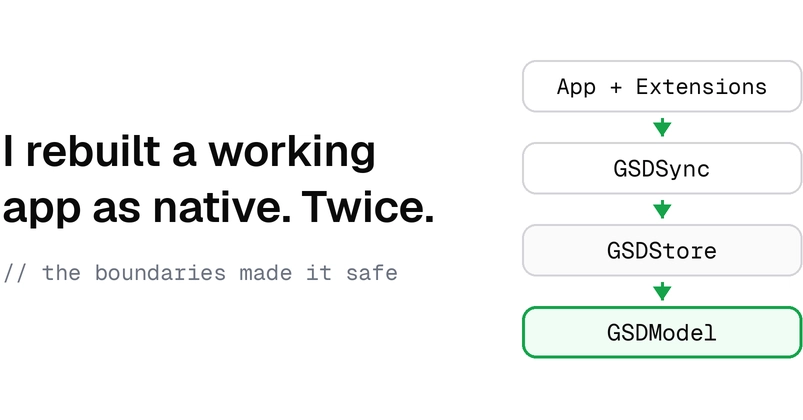
The Genesis: From PWA to Native Ambition
The journey began with GSD, a web app designed for a singular purpose. It ran effectively for years before evolving into a Progressive Web App (PWA). While functional, the PWA experience lacked the polish and reliability the developer desired. This led to a complete architectural overhaul, aiming for native iOS and Mac applications. The driving force wasn't vanity, but a pragmatic need for a more robust and integrated user experience. The decision to rebuild, not once but twice, underscores the complexity of transitioning from a flexible web environment to the stringent requirements of native platforms.
PWAs offer a compelling middle ground, blending web accessibility with installable, app-like features. Tools like Angular and Ionic, coupled with service workers and web manifests, allow developers to create applications that can be added to home screens, function offline, and offer native gestures. These frameworks bring native touch gestures, such as swipe-to-go-back and pull-to-refresh, directly into the browser, alongside hardware-accelerated animations for smoother transitions. This approach can bypass app store gatekeepers and enable instant, free deployment. However, the GSD project highlights that even with these advancements, achieving a truly native feel and robust performance can necessitate a deeper dive into native development.

Architectural Hurdles: Layer Boundaries and Sync Bugs
The core of the rebuild effort centered on architectural decisions. A significant challenge involved enforcing strict layer boundaries within the package manifest. The goal was to prevent an AI agent, used in the development process, from breaching these boundaries and introducing unintended side effects or architectural drift. This requires careful structuring of modules and dependencies, ensuring that higher-level layers cannot directly access or manipulate lower-level implementations. Such discipline is crucial for maintainability and for enabling AI agents to contribute safely without compromising the application's integrity.
Another critical issue encountered was a synchronization bug. This bug manifested when a device’s clock was inaccurate, leading to silent data loss. In a system where data consistency and reliability are paramount, especially for a task management application, such a flaw is unacceptable. Resolving this involved implementing robust data validation and synchronization mechanisms that are resilient to clock discrepancies. This might include using server-side timestamps as the source of truth, employing conflict resolution strategies, and implementing checksums or other integrity checks on data transfers. The subtle nature of this bug—silent data loss—underscores the need for comprehensive testing that goes beyond standard functional checks to include edge cases related to system clock accuracy and network instability.
The Role of the AI Agent
An AI agent played a pivotal role in this architectural migration. While the source doesn't detail the specific AI used, its involvement suggests an experimental or advanced approach to development. The challenge was not just in the AI's capability but in how it interacted with the application's architecture. Enforcing layer boundaries was partly about guiding the AI's actions and partly about structuring the codebase so that even an AI, if it were to err, would be constrained. This implies a sophisticated understanding of modular design principles and potentially the use of AI-assisted code generation or refactoring tools that are aware of architectural constraints.
The success of such an agent hinges on its ability to understand and adhere to predefined architectural patterns. For developers, this means clearly defining these patterns and potentially using tools that can verify adherence. The agent could be instrumental in accelerating the migration by automating repetitive tasks, refactoring code to meet new native APIs, or even suggesting architectural improvements. However, the inherent complexity of native development means that human oversight and architectural expertise remain indispensable. The AI acts as a powerful assistant, but the architect's vision guides the process.
Why Native? The Limitations of PWAs
The decision to move away from a PWA, despite its advantages, points to the inherent limitations of the web platform for certain application types. While PWAs have advanced significantly, they still operate within the browser sandbox. This can restrict access to deep system-level features, background processing capabilities, and the full spectrum of hardware integrations that native applications enjoy. For an app like GSD, where reliability, seamless background synchronization, and a deeply integrated user experience across devices are critical, the compromises made by a PWA might become too significant.
Native applications, on the other hand, offer direct access to the operating system’s APIs. This allows for more sophisticated background tasks, richer notifications, tighter integration with system services like calendars and contacts, and potentially better performance for computationally intensive operations. The user experience can also be more tailored to platform-specific conventions, leading to a more intuitive and fluid interaction. The rebuild suggests that for applications demanding peak performance and deep system integration, the native route, despite its higher development cost and complexity, remains the superior choice. This trade-off between web accessibility and native power is a constant consideration for developers building sophisticated applications.
Broader Implications for Cross-Platform Development
This project raises important questions about the future of cross-platform development. While frameworks like React Native, Flutter, and even advanced PWAs aim to provide a single codebase for multiple platforms, the GSD story suggests that for certain high-demand applications, a native-first or hybrid-native approach might still be necessary. The architectural challenges encountered are not unique to PWA-to-native migrations; they are fundamental to building complex, scalable applications regardless of the initial platform.
The use of an AI agent in this context is particularly forward-looking. It hints at a future where AI plays a more significant role in application architecture and development, potentially automating aspects of platform migration and ensuring adherence to complex design patterns. However, the need to explicitly manage layer boundaries and address subtle bugs like data loss during synchronization indicates that AI is not yet a silver bullet. Developers must still possess a deep understanding of software architecture, data integrity, and platform specifics. The architectural decisions made during the GSD rebuild—enforcing layer boundaries and ensuring robust synchronization—are critical lessons for any developer undertaking complex application development, whether with or without AI assistance.