
The Log as the Agent: A Paradigm Shift in AI Control
The traditional approach to building AI agents often involves complex state machines, intricate planning modules, and elaborate reward functions. These systems, while powerful, can become brittle, difficult to debug, and challenging to extend. A new concept, dubbed "The Log Is the Agent," proposes a fundamental shift: leverage a structured, append-only log as the central nervous system and reasoning engine for an AI agent. This paradigm, detailed in emerging research, suggests that a well-defined log can encapsulate an agent's actions, observations, and internal state, thereby simplifying control and unlocking new avenues for introspection and reasoning.
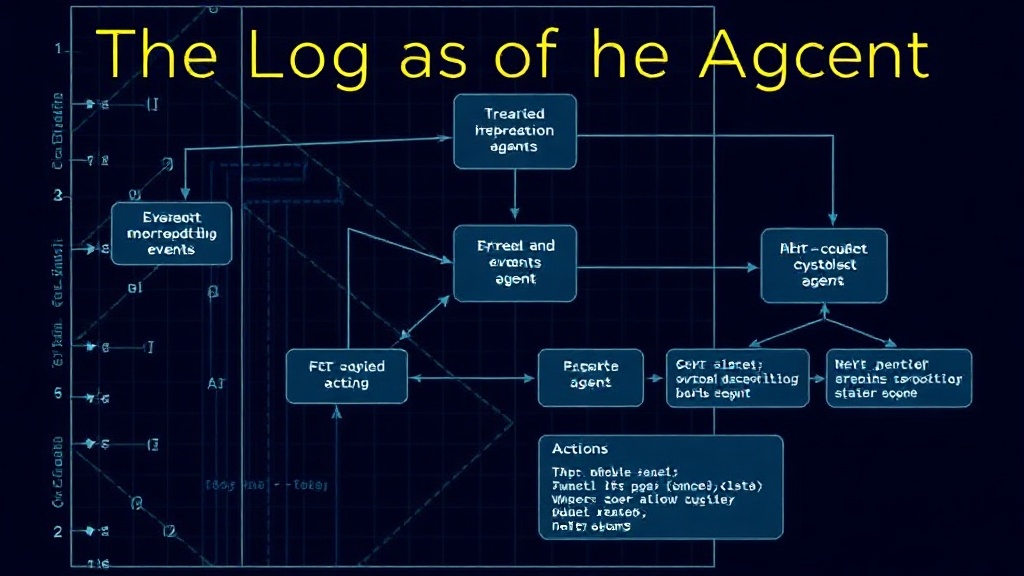
At its core, the idea is elegantly simple. Instead of a myriad of interconnected components managing an agent's behavior, the agent's entire history and current understanding are represented as a sequence of entries in a log. Each entry could represent an action taken, an observation received from the environment, a thought process, or a decision made. This log isn't just a passive record; it actively informs the agent's future actions. The agent's 'state' is effectively the current state of the log, and its 'reasoning' is the process of interpreting and extending this log.
How It Works: From Events to Actions
Imagine an AI agent tasked with managing a smart home. In a conventional system, this might involve separate modules for sensor input processing, rule engines, actuator control, and perhaps a learning component. With the "Log Is the Agent" approach, the process would look different. When a sensor detects a change – say, a door opening – this observation would be appended to the log as an event entry. The agent's reasoning process would then analyze this new log entry, potentially in conjunction with previous entries (e.g., "time of day is evening," "occupancy sensor shows no one home"). Based on this analysis, the agent might decide to trigger an action, such as turning on a porch light. This decision, in turn, would be appended to the log as an action entry, and the corresponding command would be sent to the smart home system.
This continuous cycle of observation, reasoning, and action, all mediated through the log, forms the agent's operational loop. The key innovation lies in how reasoning is performed. Instead of complex, pre-programmed logic, the agent could employ more flexible methods. For instance, it could use a large language model (LLM) to interpret the log's context and predict the most appropriate next action, or it could use more traditional symbolic reasoning techniques applied to the structured log data. The log itself acts as a form of working memory and a knowledge base, accessible and interpretable by the chosen reasoning mechanism.
Advantages: Simplicity, Transparency, and Debugging
The benefits of this architectural shift are substantial. Firstly, it offers a profound simplification of agent design. By centralizing state and history in a single, structured entity, the need for complex inter-component communication and synchronization is drastically reduced. This leads to more modular and potentially more robust systems.
Secondly, transparency and debuggability are significantly enhanced. When an agent behaves unexpectedly, the entire history of its operation is laid bare in the log. Developers can trace the sequence of observations, thoughts, and actions that led to a particular outcome. This is akin to having a perfect, step-by-step audit trail, which is invaluable for diagnosing errors, understanding emergent behaviors, and verifying the agent's decision-making process. It moves away from the 'black box' problem often associated with deep learning models, offering a more interpretable view of the agent's internal "thought" process as captured by the log.
Thirdly, the structured nature of the log opens up new possibilities for meta-reasoning. An agent could, for example, analyze its own log to identify patterns in its decision-making, detect inefficiencies, or even learn to improve its own reasoning strategies over time. It could also be used for more sophisticated planning, by allowing the agent to simulate future log states based on potential action sequences.
Challenges and Future Directions
Despite its promise, the "Log Is the Agent" paradigm is not without its challenges. The primary concern is scalability. As an agent operates over extended periods or in complex environments, the log can grow immensely. Efficiently querying and processing this vast amount of data becomes critical. Techniques for log compression, summarization, and efficient indexing will be paramount. Furthermore, ensuring the integrity and immutability of the log, especially in distributed or multi-agent systems, requires robust mechanisms.
Another challenge lies in the design of the reasoning mechanism itself. While LLMs offer a powerful way to interpret natural language-like log entries, they can be computationally expensive and prone to hallucination. Integrating these with more deterministic or symbolic reasoning methods will be key to building reliable agents. The definition of what constitutes a 'log entry' also needs careful consideration; it must be expressive enough to capture the nuances of an agent's experience while remaining structured enough for programmatic analysis.
What nobody has addressed yet is what happens when multiple agents need to coordinate, with each agent's primary interface being its own log. How do these logs synchronize? Can one agent directly 'read' another's log, or is communication strictly mediated through actions and observations? This raises fundamental questions about distributed AI control and emergent collective intelligence.
Implications for AI Development
The "Log Is the Agent" concept represents a compelling alternative to current AI agent architectures. It offers a path towards more transparent, debuggable, and potentially more capable AI systems. For developers, it suggests a shift in focus from building complex control flows to designing effective log structures and powerful reasoning modules that can operate on these logs. This could lead to a new generation of AI tools and frameworks that prioritize introspection and interpretability.
For researchers, it opens up fertile ground for exploring novel reasoning algorithms, efficient data management techniques for temporal data, and new methods for inter-agent communication and coordination. As AI systems become more integrated into our lives, the ability to understand, debug, and trust their decision-making processes will be paramount. The log, as the agent, might just be the key to unlocking that trust.