Understand Load Balancer Capacity Units (LCUs)
Many engineers operate under the assumption that their cloud load balancer costs directly correlate with the amount of data they transfer. The intuition is simple: more traffic, more bandwidth, higher bill. This intuition, however, is fundamentally flawed when it comes to AWS Application Load Balancers (ALB) and Network Load Balancers (NLB). AWS does not bill these services based on raw throughput or bandwidth in gigabits per second. Instead, the billing is driven by Load Balancer Capacity Units (LCUs).
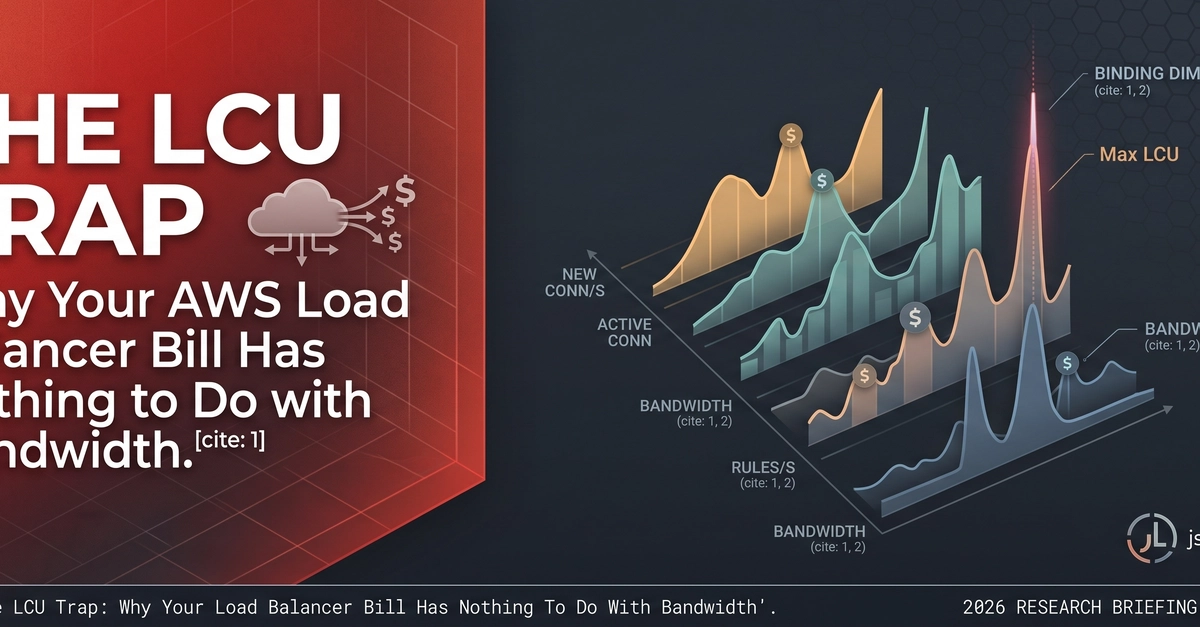
The critical misunderstanding lies in how LCUs are calculated and applied. AWS evaluates four key dimensions every hour to determine your LCU usage: new connections per second, active connections, bandwidth in Gbps, and for ALBs, rule evaluations per second (beyond the first 10 free rules). The pricing model is not additive; you pay for the single largest dimension, not the sum of all dimensions. This means optimizing three of the four dimensions will result in zero cost savings if the fourth dimension remains the dominant factor.
The formula for LCU calculation is:
LCU = ⌈ max(dim_1, dim_2, dim_3, dim_4) ⌉
Where:
dim_1= New connections/flows per seconddim_2= Active connections/flowsdim_3= Bandwidth (Gbps)dim_4= Rule evaluations per second (ALB only, for rules beyond the free tier)
This structure means that if your bandwidth usage is consistently high but your new connection rate is even higher, you will be billed for the connection rate, and any effort to reduce bandwidth alone will not impact your bill. This is the core of the LCU trap.
When Load Balancer Economics Break Down
The economic model of LCUs can lead to significant cost overruns when workloads exhibit specific characteristics that push one dimension far beyond the others. Understanding these scenarios is key to avoiding unexpected expenses.
The High-Connection Workload
One of the most common and costly scenarios involves workloads that generate a very high rate of new connections per second, or maintain a very large number of active connections. Consider a distributed system, an IoT platform, or a microservices architecture where each request might establish a new, short-lived connection. In such cases, the dim_1 (new connections) or dim_2 (active connections) can become astronomically high, dwarfing bandwidth consumption.
For example, an application that processes 100,000 new connections per second, even if each connection transfers only a few kilobytes and consumes minimal bandwidth, will be billed based on those 100,000 connections. If the bandwidth usage is only 0.5 Gbps, the LCU cost will be dictated by the connection rate. This can lead to a price gap that is orders of magnitude higher than what one might expect if they were only considering bandwidth. The source material highlights a potential 38x price gap in such scenarios, illustrating the dramatic impact of connection-heavy workloads on LCU billing.
This situation is particularly problematic because optimizing for bandwidth, which is the intuitive metric, offers no relief. The only way to reduce costs in this scenario is to reduce the number of new or active connections, which often requires architectural changes rather than simple configuration tweaks.
The Rule Evaluation Overhead (ALB Specific)
For Application Load Balancers (ALBs), a fourth dimension, rule evaluations per second, can also become a significant cost driver. ALBs use rules to route traffic based on request attributes like hostnames, paths, HTTP headers, and source IP addresses. While the first 10 rules are free, each additional rule evaluation consumes LCUs. Applications with complex routing logic, numerous microservices, or those that dynamically route based on a wide array of request parameters can incur substantial costs from rule evaluations alone.
Imagine an API gateway that uses an ALB to route requests to hundreds of different backend services, each with unique path or header-based routing rules. As the number of rules grows, and the rate of requests hitting these rules increases, the dim_4 can exceed bandwidth or connection metrics. This is especially true for scenarios where many rules are evaluated for each request, or where rules are highly specific and numerous.
The surprise here is that even if your bandwidth and connection counts are modest, a large number of complex, evaluated rules can drive up your LCU usage and, consequently, your bill. This necessitates careful management and optimization of ALB listener rules, potentially consolidating rules or re-architecting routing logic to stay within the free tier or minimize evaluations.
Strategies to Mitigate LCU Costs
Understanding the LCU model is the first step. The next is to implement strategies to manage costs effectively. Given that you pay for the maximum dimension, a multi-pronged approach targeting the most expensive dimension is crucial.
Optimize for Connections
If new or active connections are driving your costs, consider the following:
- Connection Pooling: Implement connection pooling on your client-side applications to reuse existing connections rather than establishing new ones for every request. This directly reduces
dim_1. - Keep-Alive Settings: Ensure your applications and load balancer are configured to utilize HTTP keep-alive effectively. This maintains active connections for longer periods, potentially improving efficiency if the
dim_2is less thandim_1, but be mindful of not letting idle connections inflatedim_2unnecessarily. - WebSockets and HTTP/2: For high-frequency, low-bandwidth communication, consider using protocols like WebSockets or HTTP/2. These protocols can multiplex multiple requests over a single, long-lived connection, significantly reducing the number of new connections required.
- Backend Architecture: Review your backend architecture. If microservices are each opening their own connections to the load balancer, explore ways to consolidate or use gateway patterns to manage connection counts more efficiently.
Optimize for Bandwidth
While bandwidth might not be the primary cost driver, it's still a factor. If it does become the dominant dimension:
- Data Compression: Enable compression (e.g., Gzip) for responses where applicable. This reduces the amount of data transferred, lowering
dim_3. - Content Delivery Networks (CDNs): Offload static asset delivery to a CDN. This significantly reduces the amount of bandwidth processed by your load balancer.
- Efficient Data Formats: Use efficient data formats like Protocol Buffers or Avro for inter-service communication if bandwidth is a critical constraint.
Optimize ALB Rule Evaluations
For ALBs, managing rule evaluations is key:
- Rule Consolidation: Review your listener rules. Can multiple specific rules be combined into a single, more general rule? For example, instead of rules for `/api/v1/users`, `/api/v1/posts`, and `/api/v1/comments`, a single rule matching `/api/v1/*` might suffice if the backend can handle the routing logic.
- Prioritize Rules: Ensure your rules are ordered efficiently. Place the most frequently hit or most specific rules at the top to ensure they are evaluated first and potentially exit the evaluation chain early.
- Simplify Logic: Avoid overly complex conditions within rules. If a rule requires evaluating multiple headers or query parameters in intricate ways, consider if this logic can be handled within the application itself after a simpler routing decision.
- Consider NLB: If your application does not require Layer 7 features like host-based routing or path-based routing and is primarily focused on high throughput and performance with minimal connection overhead, switching to a Network Load Balancer (NLB) might be more cost-effective, as NLBs do not incur costs for rule evaluations.
The Unanswered Question: Long-Term Cost Impact
While these strategies offer immediate relief, a lingering question remains: what is the long-term impact of these LCU-driven costs on architectural decisions? As cloud providers increasingly abstract away infrastructure and bill based on abstract capacity units, developers and architects must constantly re-evaluate their designs not just for performance and scalability, but also for cost predictability. The LCU model forces a deeper dive into connection management and routing logic than many originally anticipated, potentially shifting the focus from raw throughput optimization to a more nuanced understanding of application behavior and its impact on these unique billing metrics.
Understanding the LCU trap is not just about avoiding surprise bills; it's about making informed architectural decisions that align performance goals with financial realities in the cloud.