The Shifting Landscape of Software Development
The year is 2026. Generative AI models can now write functional code snippets, automate routine tasks, and even suggest architectural patterns. This has led some to question the fundamental need for human software engineers. Are we approaching a future where coding is entirely automated? The answer, surprisingly, is a resounding no. While AI tools are undeniably powerful assistants, they are not, and likely will not be for the foreseeable future, replacements for human creativity, critical thinking, and the nuanced understanding required to build complex, impactful software.
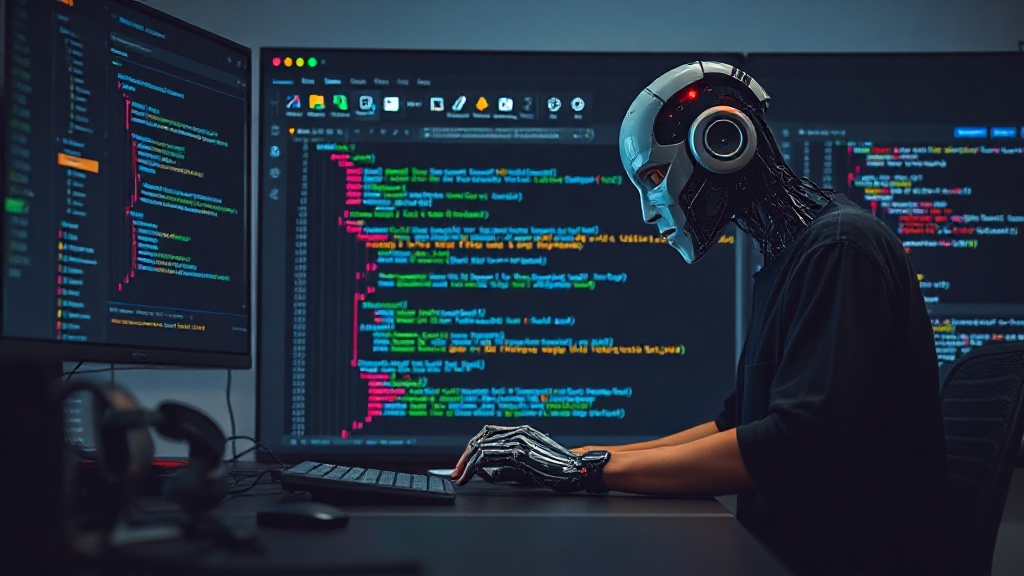
The core of software development is not just about syntax and logic; it's about understanding problems, designing elegant solutions, and iterating based on human needs and feedback. AI excels at pattern recognition and generation within established parameters. It can write a boilerplate function or translate a request into code, but it struggles with ambiguity, novel problem-solving, and the deep contextual understanding that seasoned developers bring to the table. Think of AI as an incredibly skilled apprentice who can execute precise instructions but lacks the vision and foresight of a master craftsman.
The skills that will be most valuable in 2026 are those that complement AI, not compete with it. This includes advanced problem decomposition, system design, architectural foresight, and the ability to critically evaluate and steer AI-generated output. Developers will transition from being pure coders to becoming orchestrators, architects, and quality assurance specialists for AI-assisted development.
Beyond Automation: The Human Element in Innovation
Innovation is rarely a linear process driven by logical steps alone. It often involves intuition, serendipity, and the ability to connect disparate ideas. Human developers bring these qualities to the table. They can identify edge cases that AI might miss, conceptualize entirely new product categories, and understand the subtle user experience nuances that make a product truly succeed or fail. The ability to empathize with users, anticipate future needs, and make trade-offs based on incomplete information are inherently human traits that AI cannot replicate.
Consider the development of a new AI model itself. While AI can assist in training and fine-tuning, the initial conceptualization, the ethical considerations, the definition of success metrics, and the interpretation of results all require human intellect and judgment. The very tools that some believe will replace developers are themselves products of human ingenuity and require human oversight for their continued evolution and responsible deployment.
Furthermore, the landscape of software is constantly evolving. New programming paradigms emerge, security threats adapt, and user expectations shift. Human developers are adaptable. They learn, they reason, and they can pivot their skill sets in ways that pre-programmed AI systems cannot. The ability to understand the 'why' behind a piece of code, not just the 'how,' is crucial for navigating this dynamic environment. This understanding allows developers to debug complex issues, optimize performance beyond generic suggestions, and integrate new technologies seamlessly.
The Rise of the AI-Augmented Developer
The most significant trend in 2026 is not the replacement of developers, but their augmentation. AI tools are becoming integrated into every stage of the software development lifecycle. Code completion, automated testing, bug detection, and even documentation generation are now powered by AI. This allows developers to focus on higher-level tasks, such as complex problem-solving, strategic planning, and creative design.
This shift means that the definition of a 'productive' developer will change. Instead of lines of code written, productivity will be measured by the complexity of problems solved, the elegance of solutions designed, and the impact of the software produced. Developers who can effectively leverage AI tools will be exponentially more productive than those who try to work in isolation. They will be able to prototype faster, iterate more quickly, and deliver more robust and feature-rich applications.
The skills in demand will include prompt engineering for code generation, understanding the limitations and biases of AI models, and integrating AI-generated code into larger, human-authored systems. Developers will need to be adept at verifying the correctness, security, and efficiency of AI-produced code, essentially acting as sophisticated editors and architects for AI-generated content. This requires a deeper understanding of programming principles, not less.
Unanswered Questions and the Future Outlook
What nobody has fully addressed yet is the long-term impact on developer education and career paths. If AI can handle much of the foundational coding, what should computer science curricula prioritize? Will we see a bifurcation where some focus on AI model development and others on high-level system architecture and human-centric design? The transition will require significant adaptation from educational institutions and continuous learning from developers themselves.
The demand for software will continue to grow, driven by digital transformation across all industries, the expansion of AI itself, and the creation of entirely new technological frontiers. While AI can automate many coding tasks, the fundamental need to design, build, and maintain the complex systems that power our world will persist. The role of the developer will evolve, becoming more strategic, more creative, and more indispensable than ever.
In 2026, writing code is not obsolete. It is transforming. The developers who thrive will be those who embrace AI as a powerful collaborator, focusing their human intellect on the aspects of software creation that AI cannot touch: innovation, critical problem-solving, and the art of building for humanity.