
The Ubiquitous 555 Timer: An Enduring Electronic Icon
In the vast landscape of integrated circuits, where towering microprocessors and complex memory chips often steal the spotlight, lies an unassuming hero: the 555 timer. Designed in 1971 by Swiss-born engineer Hans Camenzind while working for Signetics, this eight-pin marvel has defied obsolescence. More than five decades after its market debut in 1972, the 555 timer is still manufactured in the billions annually. Its enduring legacy is not built on raw speed or intricate architecture, but on a remarkable degree of flexibility that makes it a staple for both neophyte hobbyists and seasoned professionals.
The genius of the 555 lies in its elegant simplicity. At its core, the chip contains a mere two dozen transistors, a small collection of resistors, and two voltage comparators. These components are arranged around a basic voltage divider. When supplied with a voltage, and connected with a few external components like capacitors and resistors, the 555 can perform a surprising array of timing functions. This inherent adaptability has cemented its status as one of the most popular and widely used integrated circuits in history.
Unpacking the 555's Core Functionality
The 555 timer's versatility stems from its ability to operate in several distinct modes, primarily as an astable multivibrator or a monostable multivibrator. These modes allow it to function as a precise oscillator or a pulse generator, respectively. The external components dictate the timing parameters. For instance, in astable mode, the 555 can generate a continuous stream of pulses, creating a clock signal or a simple tone generator. The frequency and duty cycle of these pulses are determined by the values of two resistors and a capacitor connected to specific pins on the chip. This makes it incredibly easy to tune the output without altering the chip itself.
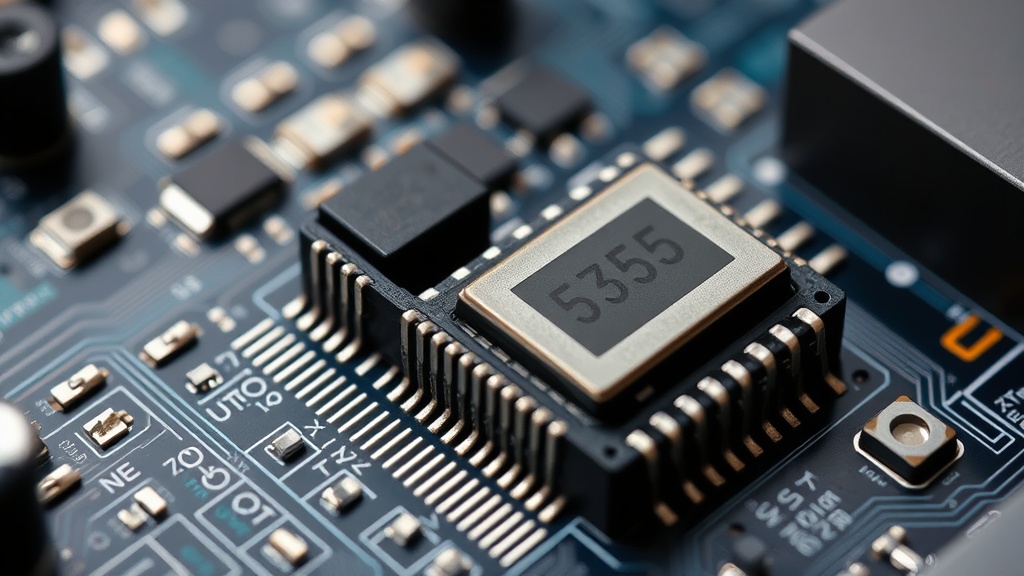
In monostable mode, the 555 acts as a one-shot pulse generator. When triggered by an external signal, it outputs a single pulse of a predetermined duration. This duration is solely dependent on the value of a single external resistor and capacitor. This mode is perfect for creating delays, debouncing mechanical switches, or generating single events in a sequence. The ease with which these timing intervals can be calculated and set using basic Ohm's Law and the capacitor's charge time makes the 555 an invaluable tool for rapid prototyping and educational purposes.
Why the 555 Endures: Simplicity, Cost, and Reliability
Several factors contribute to the 555 timer's half-century reign. Firstly, its low cost is a significant advantage. Manufactured in astronomical quantities, the 555 is exceptionally inexpensive, often costing mere cents per unit. This makes it an ideal choice for cost-sensitive applications, from simple toys to complex industrial control systems. Developers don't need to justify an expensive component when a cheap, reliable alternative exists.
Secondly, the simplicity of its operation and integration cannot be overstated. Unlike modern microcontrollers that require complex programming environments and extensive knowledge of software development, the 555 can be wired into a circuit with just a few external components. Its behavior is predictable and governed by straightforward analog principles. This low barrier to entry makes it the perfect first chip for students learning about electronics. It provides a tangible and immediate result, fostering a deeper understanding of fundamental concepts like capacitance, resistance, and voltage thresholds. Think of it less like a complex computer and more like a highly reliable, single-purpose mechanical switch that can be precisely timed.
Thirdly, the robustness and reliability of the 555 timer are legendary. Designed to operate over a wide range of supply voltages and temperatures, it can withstand significant abuse without failing. This makes it suitable for harsh industrial environments, automotive applications, and even some military uses. Its predictable behavior means engineers can trust it to perform its function consistently over long periods, minimizing the need for frequent maintenance or troubleshooting.
Applications Across the Spectrum
The 555 timer's applications are remarkably diverse, spanning nearly every facet of electronics. It's found in simple LED blinkers and alarm circuits, serving as the heart of hobbyist projects worldwide. Beyond the enthusiast realm, it plays critical roles in more complex systems. In audio equipment, it can generate tones for beepers and alarms, or create simple waveforms for electronic music synthesizers. In industrial automation, it's used for timing control sequences, generating delays for machinery operation, and as part of watchdog timers to monitor system health.
Consider its role in automotive systems: from interval wipers and turn signal flashers to dashboard warning lights, the 555 provides reliable timing functions. Even in scientific instruments, it can be employed for precise interval measurements or triggering specific events. The sheer breadth of its deployment underscores its status as a foundational component in the electronics engineer's toolkit. It’s the unsung hero that keeps many systems ticking, often hidden within larger, more sophisticated designs.
The Future of the 555 Timer
Despite the advent of highly integrated microcontrollers and specialized timing ICs, the 555 timer shows no signs of fading away. Its low cost, ease of use, and proven reliability ensure its continued relevance. For many applications, particularly those requiring simple, discrete timing functions, the 555 remains the most practical and economical choice. Furthermore, its continued production by numerous manufacturers worldwide guarantees its availability for the foreseeable future. While more complex tasks are undoubtedly better suited to modern digital solutions, the 555 timer has carved out an unassailable niche. It serves as a testament to elegant design, proving that sometimes, the simplest solutions are indeed the most enduring.